


Food safety · Practical guide · Updated August 8, 2026
There is no single safe number for every automatic feeder. Once canned or pouched food is opened and loaded, the answer depends on the food label, starting temperature, room heat, portion size, lid, ice pack, cooling system, and the temperature the food actually reaches.
The safest useful rule is temperature-based: FDA pet-food guidance says to promptly refrigerate or discard unused wet food and keep the refrigerator at 40°F / 4.4°C or below. If a feeder does not maintain the food at its required temperature, do not describe the setup as refrigerated.
A conservative answer
For an uncooled bowl at ordinary room temperature, use the shortest practical delay and follow the food label. Separate FDA guidance for perishable human food uses two hours at room temperature—or one hour above 90°F / 32°C—as a discard rule. That is a conservative reference point, not a pet-food guarantee.
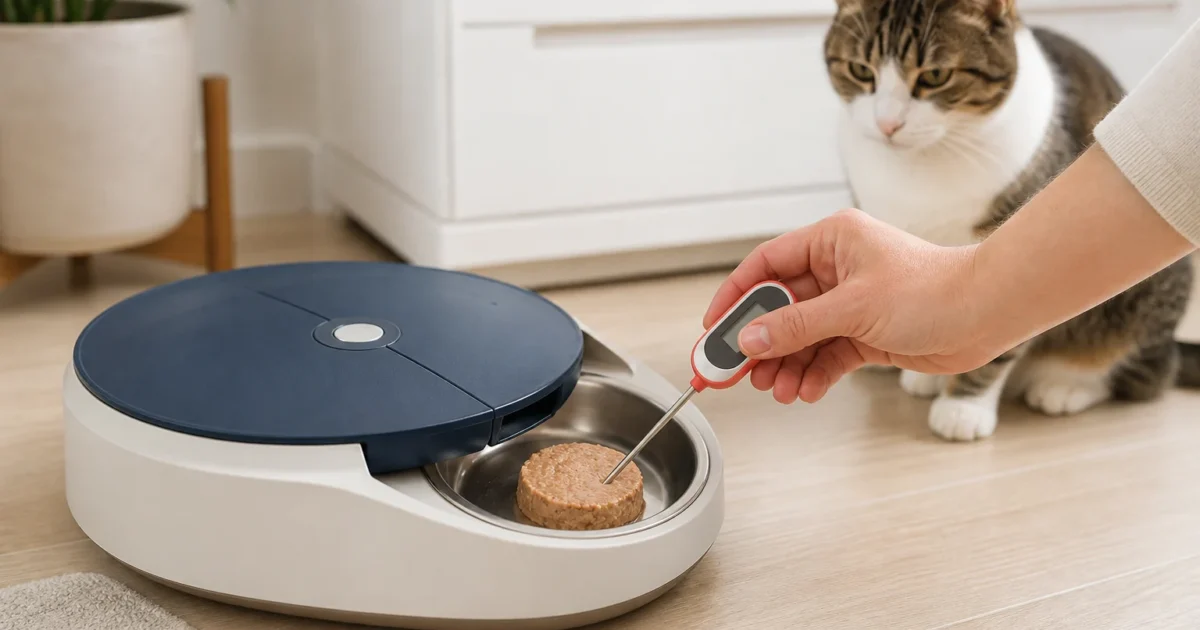
An ice pack can extend cool conditions, but only a food thermometer tells you whether it did so in your room. Even active-cooling feeders should be judged by the temperature of the food, not the marketing term used for the technology.
What each feeder design actually changes
| Design | What it does | What it does not prove | Best next check |
|---|---|---|---|
| Covered timer, no cooling | Limits exposure until the lid opens | Safe holding temperature | Use a short interval and follow the food label |
| Covered tray + ice pack | Slows warming | Refrigerator-equivalent cooling for the full timer | Measure the center of the food at serving time |
| Thermoelectric cooling | Actively moves heat away from the tray | That the food stayed at 40°F / 4.4°C or below | Compare published and real temperatures with guidance |
| Microchip lid | Blocks unauthorized pets | Timed dispensing or refrigeration | Use it for access control, not long holding |
Why Polar’s current numbers need context
PETLIBRO’s current US FAQ says Polar cooled food to around 54°F / 12°C in a 77°F / 25°C lab room and says the feeder preserves wet food for up to 72 hours. The FDA’s pet-food storage page says refrigerators should be 40°F / 4.4°C or below. Those are different thresholds, so the manufacturer claim should not be translated into “the same as a refrigerator.”
PETLIBRO also advises against raw food. Owners should use the exact current model documentation, the wet-food label, a thermometer, and veterinary advice where health risk is higher.
Think about two separate periods
Before serving: Food may be inside a cooled compartment, above an ice pack, or simply under a lid. These are not equivalent storage conditions.
After serving: The food is available to the cat. The compartment may have opened or moved away from cooling, and saliva or other contamination may now be involved. The storage claim may no longer describe its condition.
Record both periods when comparing a feeder. A three-day storage advertisement, for example, does not mean an opened serving can sit out for three days. Nor does an app allowing a long feeding window establish that the food remains suitable throughout that window.
Ask these questions about the exact feeder
| Feature or claim | What you need to clarify |
|---|---|
| Refrigerated storage | What temperature and ambient conditions are specified? |
| Ice-pack cooling | What preparation and replacement schedule is required? |
| Serving window | Does cooling continue while the portion is accessible? |
| Power interruption | What happens to stored meals if cooling stops? |
| Leftover handling | Can yesterday’s exposed portion remain in the rotation? |
If the instructions do not answer a safety-critical question, contact the manufacturer and the food maker. Do not fill the gap with a confident hour count from a general buying guide.
A practical timing framework
A short delayed meal in a cool room
Load a cold portion shortly before leaving, keep the feeder away from sunlight, radiators, ovens, and warm appliances, and choose the shortest delay that solves the routine. A covered compartment can keep insects and paws out, but it does not stop warming.
A meal later in the day
Use a fully frozen, correctly fitted ice pack or a purpose-built active-cooling design. Test the longest planned interval with the actual portion. Deep portions can have temperature differences between the surface, edge, and center.
Overnight or multi-day use
Do not infer safety from the maximum timer range. A 48-hour dial means the lid can wait 48 hours to open; it does not mean wet food is safe for 48 hours. Multi-day manufacturer claims still need to be reconciled with the food label, measured temperature, power reliability, and daily human check-ins.
Raw, homemade, or prescription food
Use the instructions for that exact diet and ask a veterinarian. Raw and homemade foods can have different contamination and nutrient-stability risks. A feeder that accepts the texture mechanically is not automatically approved for its storage.
Six steps for safer wet-food scheduling
- Read the food label first. Follow its opened-food storage directions and keep the lot information.
- Start cold. Load chilled commercial food and a fully frozen ice pack when the feeder uses one.
- Test with a food thermometer. Measure the food’s center at the latest planned opening during warm conditions.
- Shorten the interval when uncertain. Room temperature, sun, portion depth, and repeated lid openings change performance.
- Discard leftovers promptly. Do not keep cycling exposed leftovers into a future compartment.
- Wash and dry after every cycle. The FDA advises cleaning bowls and pet-food utensils after each use.
Do not use smell or appearance as the safety test
Food can support harmful bacterial growth before it smells obviously spoiled. Temperature, time, the label, and hygienic handling are more useful than a sniff test. Discard food if the package was swollen or leaking, the feeder lost cooling or power, the tray was not clean, or you cannot establish how long the food was warm.
Compare the four relevant designs
Our wet-food feeder shortlist separates timed trays, active cooling, simple two-meal lids, and microchip access—with the limitation beside every strength.
Can you put wet food in a dry-food automatic feeder?
Not unless that exact model explicitly supports it. A hopper and dispensing mechanism designed for dry kibble should not be repurposed for wet food or moistened kibble based on convenience. Check the approved food type before loading anything.
If your cat eats wet food, compare purpose-designed wet-food arrangements instead. A lid that recognizes a cat’s identity is also not necessarily a cooling system: selective access and temperature control are separate functions.
Also plan for internet and power interruptions; app availability and cooling are separate dependencies.
Frequently asked questions
Does a lid make wet food last longer?
It reduces exposure to dust, insects, and unauthorized pets. It does not control temperature unless the feeder also has a cooling system.
How long does an ice pack keep cat food cold?
There is no universal duration. Ice-pack size, freezer temperature, room heat, feeder insulation, portion size, and contact with the tray all matter. Test your full setup with a thermometer.
Is 54°F cold enough for wet cat food?
It is cooler than a typical room, but it is warmer than the FDA’s 40°F / 4.4°C-or-below refrigerator guidance. Do not call it refrigerator-equivalent; follow the food label and ask your veterinarian when risk is higher.
Can I refreeze or refrigerate leftovers from the feeder?
Do not assume that food of unknown time and temperature can be made safe again by cooling it. When the history is uncertain, discard it.
Sources
- US FDA: Proper Storage of Pet Food & Treats
- US FDA: Are You Storing Food Safely?
- PETLIBRO: Polar official product page and FAQ
- Closer Pets: Cat Mate C500 official product page
Scope: this page explains handling and feeder design; it is not veterinary diagnosis or an individualized diet plan.