


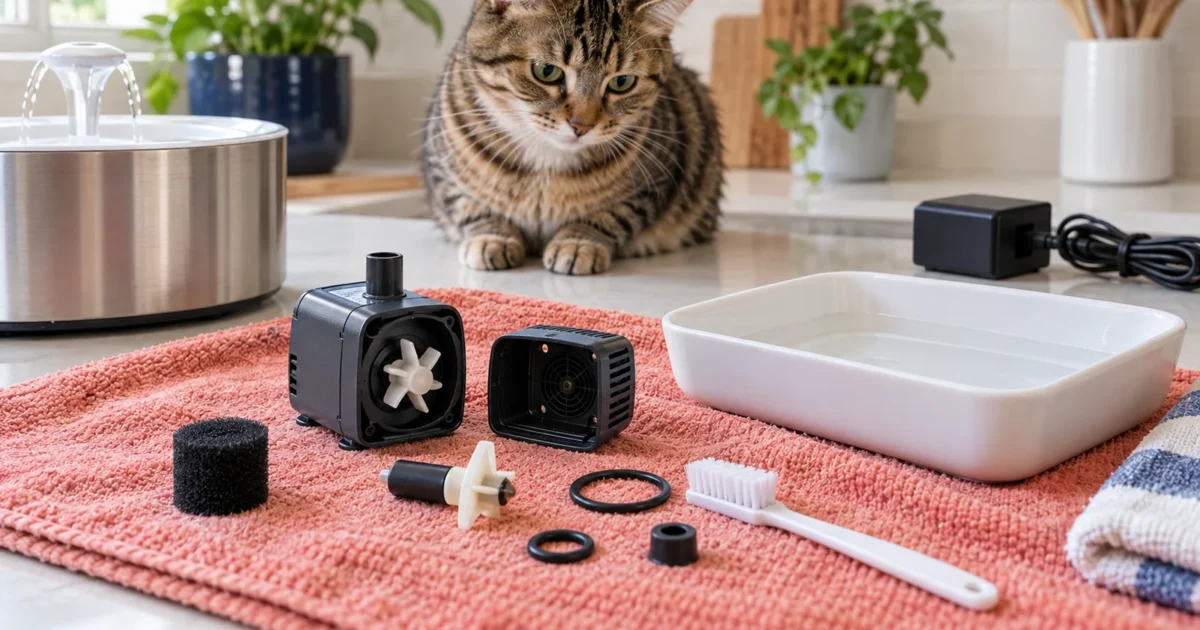
To clean a cat fountain pump, disconnect power, remove only the parts the manual allows, clear the intake and impeller chamber, rinse thoroughly and reassemble before refilling and restarting. Cleaning the outside of the pump alone can leave debris in the moving assembly. A wireless rotor or sealed unit may need a different procedure.
This guide focuses on the pump. Use our complete fountain-cleaning routine for the reservoir, tray, filter housing and surrounding area.
Before opening the pump
- Set out a separate bowl of clean water for your cat.
- Unplug the unit and disconnect the adapter as instructed. Turn off battery-powered models before removing washable parts.
- Find the exact manual and identify the removable cover, intake, impeller or rotor.
- Use a small soft brush, a clean tray for parts and the cleaner the manufacturer permits.
- Keep the adapter and powered base dry. Do not assume every part labelled “wireless” is washable.
A practical pump-cleaning sequence
1. Photograph the assembly
Take a picture before taking anything apart. Keep small seals and covers in the tray, away from the sink drain. This is particularly useful when the pump has several similar-looking covers.
2. Remove the approved access parts
Follow the model’s order. Stop if opening requires forcing a sealed housing or cutting a cable. A conventional removable impeller and a tank rotor driven from the base are not interchangeable designs.
3. Clean the moving assembly and intake
PetSafe’s general pump-cleaning instructions describe removing the accessible faceplate, stator and magnetic impeller, then brushing and rinsing the parts. Follow your own pump’s diagram; those part names and opening methods will not apply to every brand.
4. Deal with mineral deposits only as directed
Do not improvise a strong descaling mixture. PetSafe documents a vinegar-and-water approach for some pumps, but its model manuals specify differing dilutions and intervals. Use the directions for your exact model. Never combine cleaning chemicals.
5. Rinse and inspect before reassembly
Check for trapped hair, residue, damaged seals and visible wear. Do not reassemble a cracked component or a damaged cable and hope that cleaning has fixed it.
6. Refill before testing
Put the approved parts back in their original positions. Fill to the specified operating level, dry your hands and external connections, and restart as instructed. Watch the flow and look for leaks before leaving the fountain in service. Do not test by running a water-cooled pump dry.
How often should you clean the pump?
Follow the exact manual and inspect sooner if flow changes or debris accumulates. There is no one interval for every fountain. PetSafe’s general help page and its model-specific pump-maintenance instructions illustrate why a generic monthly schedule should not replace the model’s own instructions.
If cleaning does not restore the flow
Check water level, filter placement and the seal to the outlet before ordering parts. PetSafe’s weak-flow guide covers those checks for Seaside. For a different design, use its own troubleshooting path. Persistent failure belongs in the pump replacement guide, where the next decision is compatibility and repair cost.
People also ask about cleaning a fountain pump
These questions appeared in Google’s US People Also Ask results for “how to clean a cat water fountain pump” on September 22, 2026. Answers below are MeowBay’s source-based summaries.
Can I soak a cat fountain pump in vinegar?
Only if the manufacturer permits it for your exact pump, with the stated dilution and soak time. Keep the adapter and powered base dry, never mix cleaning chemicals, and rinse approved parts thoroughly before reassembly.
How to clean a fountain pump without removing it?
Cleaning only the visible exterior may leave debris around the impeller. If the manual allows pump removal and disassembly, follow that procedure. If the pump is sealed or integrated, use the model-specific instructions rather than forcing it open.
How to take apart a cat fountain pump?
Disconnect power and use the diagram for the exact model. Remove only the listed faceplate, cover, impeller or rotor parts, keep small seals organized, and stop if the housing is sealed or requires force.
How to keep a water fountain pump from clogging?
Maintain the specified water level, place filters correctly, remove hair and debris as the manual directs, and inspect flow changes early. A filter reduces debris but does not replace pump cleaning.
4 Comments on “How to Clean a Cat Fountain Pump: Impeller, Intake & Troubleshooting”