


Practical Care Guide · Content updated September 19, 2026
To clean a cat water fountain properly, empty and refresh the water daily, wash the drinking surfaces and reservoir regularly, and disassemble the pump often enough to remove hair and buildup around the impeller. A filter catches debris; it does not wash the fountain for you.
Scope: this is general household guidance based on feline-care sources and manufacturer instructions. The manual for your exact model takes priority. MeowBay is not providing veterinary diagnosis or electrical repair advice.
A practical schedule
| When | Action | Do it sooner when |
|---|---|---|
| Daily | Refresh water; remove visible hair and food; check level, smell, flow, and cable/base | Water looks cloudy, smells unusual, or contains debris |
| At least weekly | Unplug, empty, disassemble, wash reservoir/tray/spout, rinse thoroughly | Several pets use it, food is nearby, or slime appears |
| On the manual’s schedule | Open and clean pump/impeller; replace or rinse filter as directed | Flow weakens, pump grows louder, or buildup is visible |
| Monthly review | Inspect seals, scratches, cable, charging contacts, pump wear, and replacement supplies | Leaks, heat, damage, or unreliable operation appears |
This schedule is a starting point, not a substitute for the exact manual. VCA advises washing and rinsing bowls daily and cleaning fountain filters weekly or as directed. Cat Friendly Homes recommends fresh daily water and bowls washed ideally every day.
Why cleaning intervals differ by fountain model
PETLIBRO’s WF305 guidance describes weekly fountain cleaning and a two-week filter and pump interval for one pet, with more frequent care for multiple pets. Other models can differ: use the exact manual instead of transferring one brand-wide schedule. Read the model-specific maintenance instructions.
Which fountain design is easier to clean?
Design evidence checked September 19, 2026. Choose accessible parts over an “easy-clean” label. MeowBay has not timed these fountains or tested their hygiene; the comparison below describes manufacturer-documented access and our practical buying interpretation.
| Design example | Documented cleaning feature | Check before buying |
|---|---|---|
| PETLIBRO Dockstream 2 Smart Fountain | The current product page describes a pumpless design, detachable tank and dishwasher-safe steel tray | The tray’s permission does not apply to the powered base or every component. Do not use an older Dockstream pump tutorial for this model. |
| PetSafe Drinkwell Stainless Multi-Pet | Official instructions allow the bowl and center cone in the dishwasher when not heavily soiled; pump and intake tube need brush access | Allow time for small parts and separate pump cleaning. Verify your exact model’s assembly instructions. |
| A simple water bowl | No pump, filter housing or internal water path to disassemble | It still needs washing and fresh water. It can also provide backup while the fountain is apart. |
Sources: PETLIBRO Dockstream 2 product details and PetSafe Stainless Multi-Pet cleaning instructions.
The five checks that matter more than the finish
- Can your hand or brush reach the tank’s corners?
- Can you access all user-serviceable water channels?
- Does the manual clearly separate washable parts from electronics?
- Can you reassemble seals, covers and filters without guessing?
- Are the correct replacement filters and parts available locally?
How to compare cleaning effort honestly
If you already own a fountain, log the active minutes spent disassembling, washing, brushing and reassembling it. Record passive drying or dishwasher time separately, plus the number of parts and any difficult corners. Several routine cleans are more informative than timing one unusually dirty unit. We will label measured results separately if MeowBay performs this test.
Compare fountain designs and limitations → · Estimate filter and ownership costs →
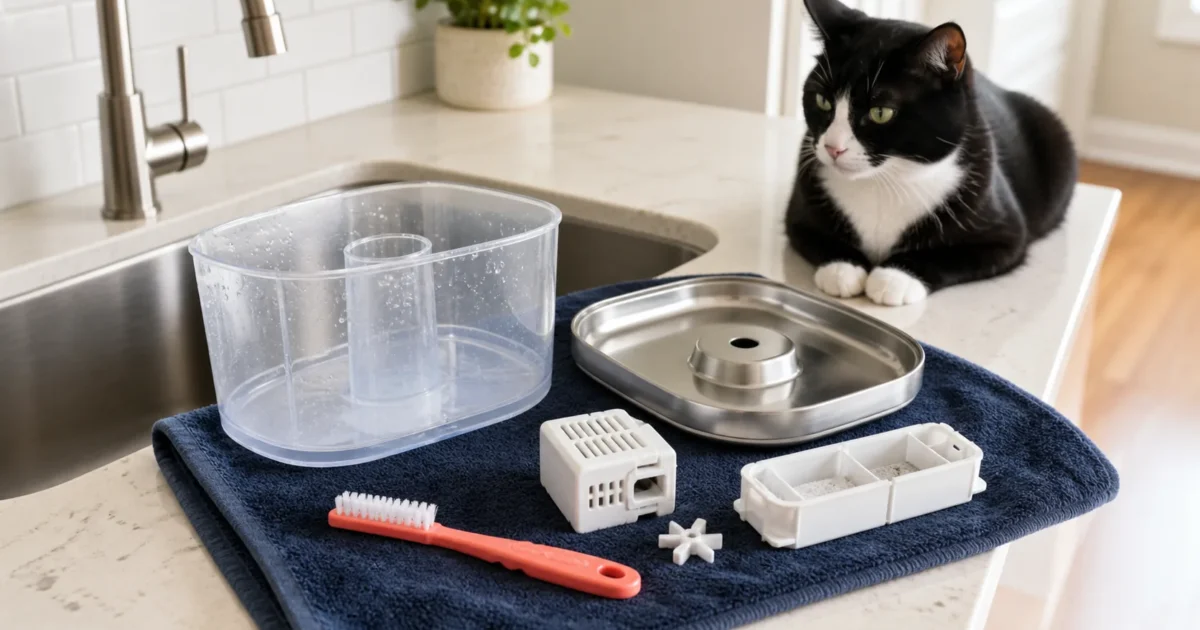
What you need
- The manual for the exact fountain model
- Clean sink or basin
- Mild, unscented dish soap if the manufacturer permits it
- Dedicated soft brush and small pump/impeller brush
- Clean towels or drying rack
- Replacement filter only when due or damaged
- A clean backup water bowl for your cat
Avoid abrasive pads that scratch surfaces. Do not use essential oils, perfumed cleaners, or an unapproved chemical disinfectant. Never immerse the powered base, adapter, battery, cable, or charging contacts unless the manual explicitly says a component is washable that way.
Step-by-step: deep-clean the fountain
1. Provide backup water and unplug
Set out a freshly washed bowl in another accessible location. Disconnect power before touching the pump or water path. For battery models, turn the unit off and follow the manual’s disassembly sequence.
2. Empty and photograph the assembly
Discard the old water. If the unit has several small seals, screens, or covers, take a quick photo before disassembly. This prevents a loose part or misaligned pump cover from causing leaks and rattles later.
3. Separate every approved washable part
Remove the tray, lid, spout, filter housing, reservoir, and pump parts the manual identifies. “Dishwasher-safe fountain” can still require removing electronics. Do not assume guidance for a similar model applies to yours.
4. Wash the reservoir and drinking surfaces
Use warm water, permitted mild soap, and a soft dedicated brush. Reach corners, underside channels, spout openings, seams, and the water line. Slippery film is a signal to clean more frequently, not merely to add fresh water on top.
5. Open the pump and clean the impeller
Follow the diagram in the manual. Many pumps have a front cover, intake plate, and removable magnetic impeller. Hair and mineral buildup around the rotor chamber can reduce flow and increase noise. Never force a sealed part or use a metal tool that could damage it.
6. Handle the filter correctly
Some new filters must be soaked or rinsed before installation; schedules and handling differ. Replace a filter on the manufacturer’s interval or sooner if damaged, clogged, or contaminated. Do not wash a disposable filter with soap unless the manufacturer specifically permits it.
7. Rinse thoroughly and air-dry where required
Remove all soap residue. Check that no brush bristle or debris remains in narrow channels. Dry the powered base and contacts completely according to the manual before reassembly.
8. Reassemble, refill, and observe
Use fresh water, stay within minimum and maximum fill lines, and run the fountain while watching for leaks, unusual heat, rattling, weak flow, or exposed cable damage. Wash your hands after handling old water and debris.
Stop using the fountain when
- The cable, plug, battery, base, or charging contacts are damaged or wet where they should remain dry.
- The pump overheats, smells burnt, repeatedly stops, or makes a new grinding sound after cleaning.
- The unit leaks near electrical components.
- Cracks, deep scratches, rust-like damage, or degraded seals cannot be safely corrected.
- Your cat shows a sudden change in drinking, urination, appetite, energy, vomiting, or diarrhea—contact a veterinarian rather than relying on the fountain or app.
How to remove slime and mineral buildup
For slippery film, shorten the cleaning interval and scrub all approved wet surfaces and pump parts. For mineral deposits, use only the descaling method allowed by the exact manufacturer. Do not mix cleaning chemicals. If your manual permits diluted vinegar, rinse repeatedly until no odor remains before returning the fountain to use.
Persistent rapid buildup can be influenced by water hardness, warm placement, food debris, several pets, and surface damage. A filter does not compensate for a scratched or inaccessible component.
Cleaning mistakes that shorten fountain life
- Topping up indefinitely instead of discarding old water
- Cleaning the bowl but never opening the pump
- Running below the minimum fill line
- Using one generic filter schedule for every model
- Putting electronics in the dishwasher because the listing says “dishwasher safe”
- Reassembling wet charging contacts
- Using fragrance or essential oils around drinking water
- Making the fountain the only water source in the home
Frequently asked questions
How often should I clean a cat water fountain?
Inspect it daily and start with a thorough wash at least weekly, then adjust sooner for visible film, debris, several pets, long hair, warm conditions, or manufacturer instructions. Pump and filter schedules are model-specific.
Can I use dish soap?
Use only a mild product and method allowed by the manufacturer, and rinse completely. Avoid fragranced or harsh products. The exact manual controls.
Can I put the fountain in the dishwasher?
Only the parts explicitly listed as dishwasher safe for your exact model. Remove the pump, base, battery, cable, adapter, and other electronics as instructed.
Why is the pump still noisy after cleaning?
Check water level, trapped air, impeller seating, filter alignment, loose covers, and surface vibration. If noise, heat, or stopping continues, discontinue use and contact the manufacturer.
Does filtered water mean I can clean less?
No. A filter can catch particles or affect taste, but the reservoir, drinking surface, channels, and pump still collect debris and film.
A reminder that another caregiver can follow
Keep the model number, manual link, last full-clean date, and next filter date together. Name the actual task—“wash fountain and inspect pump”—rather than using a vague “water done” checkbox. This prevents one person from assuming that topping up the reservoir completed the cleaning.
Comparing easier-to-maintain designs? See our stainless steel fountain comparison; a steel tray alone does not make the whole unit easy to clean.
Sources
- VCA Animal Hospitals: Tips to encourage cats to drink more water
- Cat Friendly Homes: Enhancing water intake
- Cornell Feline Health Center: Hydration
- Pioneer Pet: Raindrop maintenance instructions
- PETKIT: Eversweet Max 2 UVC user manual
Editorial scope: general fountain maintenance and feline-care education—not diagnosis, treatment, electrical repair, or individualized veterinary advice.
Budget for replacement filters
Once you know the replacement interval for your model, use our cat water fountain annual cost calculator to compare filter packs, electricity and first-year spending. Keep the required maintenance schedule when comparing costs.