


Practical Care Guide · Updated August 10, 2026
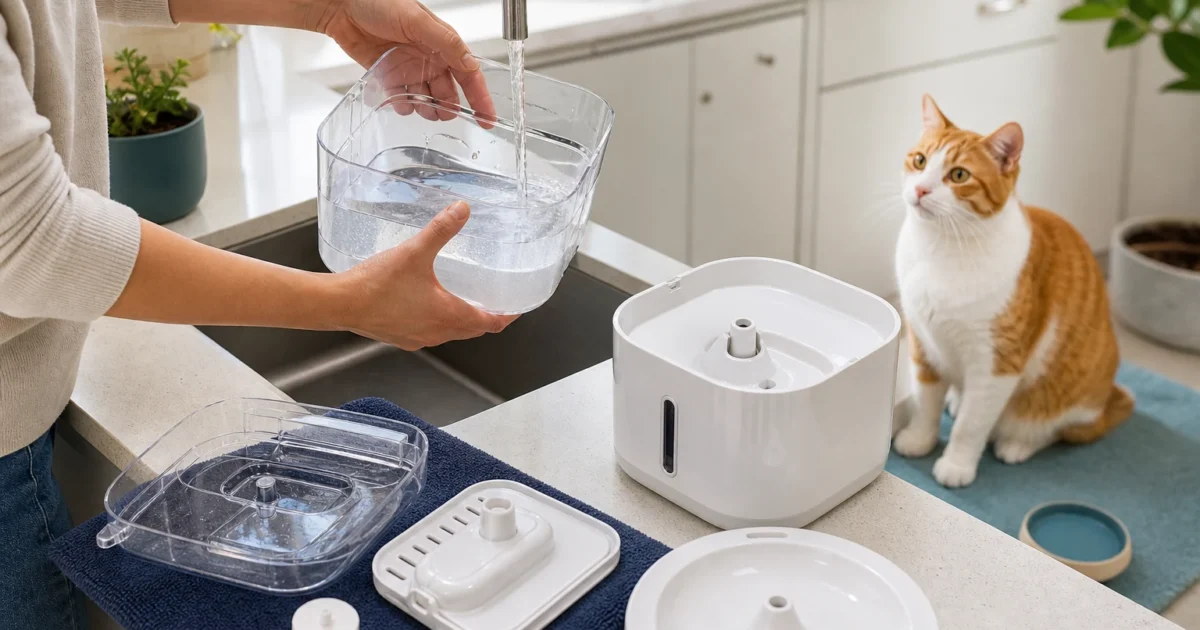
Give your cat fresh fountain water every day. Replace it sooner when you see food, hair, litter, slime, cloudiness, or odor, and expect more frequent changes in hot weather or a multi-cat home. A weekly deep clean is important, but it is not permission to leave the same water circulating for a week.
This is a conservative household routine synthesized from feline-care and manufacturer guidance. Always follow the manual for your exact fountain.
Simple schedule
- Every day: inspect, discard old water, rinse the drinking surface, and refill with fresh safe water.
- Immediately: change water after visible contamination, odor, slime, or a pump running low.
- About weekly: disassemble and wash the tank, tray, lid, spout, channels, and filter housing—or sooner if the manual or conditions require it.
- On the manual’s schedule: replace filters and open the pump to clean its cover, impeller, and cavity.
Why circulating water still gets dirty
Circulation moves water; it does not sterilize it. Every drinking visit can add saliva, hair, dust, and small food particles. Open reservoirs also collect airborne debris. Filters can trap selected particles or reduce some tastes and odors, but the housing, pump, and wet surfaces can still develop residue and biofilm.
Top up only after inspecting the water. Repeatedly adding clean water to a dirty reservoir dilutes the problem without washing it away.
Change it more often when…
- Two or more cats share the same fountain.
- The fountain sits close to food, litter, a sunny window, or a busy kitchen.
- Your cat drops food into the tray or plays with the stream.
- The weather is hot or the room is warm.
- The water level falls enough to change pump noise or flow.
- You see a film, foam, cloudiness, hair, dust, or discoloration.
A safe cleaning sequence
- Unplug the fountain or remove it from its charging base.
- Discard the old water and remove the filter according to the manual.
- Separate the tray, tank, lid, spout, filter holder, tubing, and pump.
- Wash approved parts with mild dish soap and warm water. Use a dedicated small brush for corners.
- Open the pump housing if the manual allows it; clean the impeller and cavity.
- Rinse thoroughly so no soap or loosened debris remains.
- Dry or reassemble as directed, install a correctly prepared filter, and fill with fresh water.
- Confirm normal flow and that the cord, battery, or charging base stays dry and safe.
Filter replacement is a separate job
A dark or clogged filter can reduce flow, but replacing it does not clean the reservoir. Use the exact filter model, rinse or soak it only as instructed, and follow the manufacturer’s interval. Pioneer Pet, for example, recommends replacing its fountain filter every two to four weeks and cleaning the pump monthly while cleaning the fountain weekly.
Intervals shorten with heavy use, hard water, visible debris, or several pets. Do not extend a filter schedule because the water still looks clear.
What if drinking suddenly changes?
A cleaner fountain can make access more inviting, but a sudden increase or decrease in drinking is not merely a product problem. Cornell notes that hydration needs and drinking patterns vary with diet, body size, environment, and health. Wet food can provide much of a cat’s water, so a wet-fed cat may drink less from the fountain than a dry-fed cat.
Contact a veterinarian if you notice a marked change in thirst or urination, repeated vomiting or diarrhea, weakness, poor appetite, tacky gums, or other signs of illness. Do not use an app estimate to rule out dehydration.
Frequently asked questions
Can I leave fountain water for a week?
That is not a good default. Provide fresh water every day and follow a separate schedule for full cleaning, filters, and pump care.
Is topping up enough?
No. Topping up restores volume but does not remove saliva, debris, or residue. Discard old water and rinse the drinking surface before refilling.
Should I use bleach or vinegar?
Use only cleaners and descaling methods allowed by the manual, at the stated dilution and rinse procedure. Never mix cleaning agents. When uncertain, mild dish soap and thorough rinsing are the safer general starting point.
How do I know the pump needs cleaning?
Reduced or uneven flow, new noise, visible debris, or the manual’s scheduled interval are reasons to inspect it. Unplug before handling.
Sources
- Cat Friendly Homes: fresh water and daily bowl washing
- VCA: cleaning and water guidance
- Pioneer Pet: official fountain, filter, and pump schedule
- Cornell Feline Health Center: Hydration
Editorial scope: general care guidance, not individualized medical advice.