


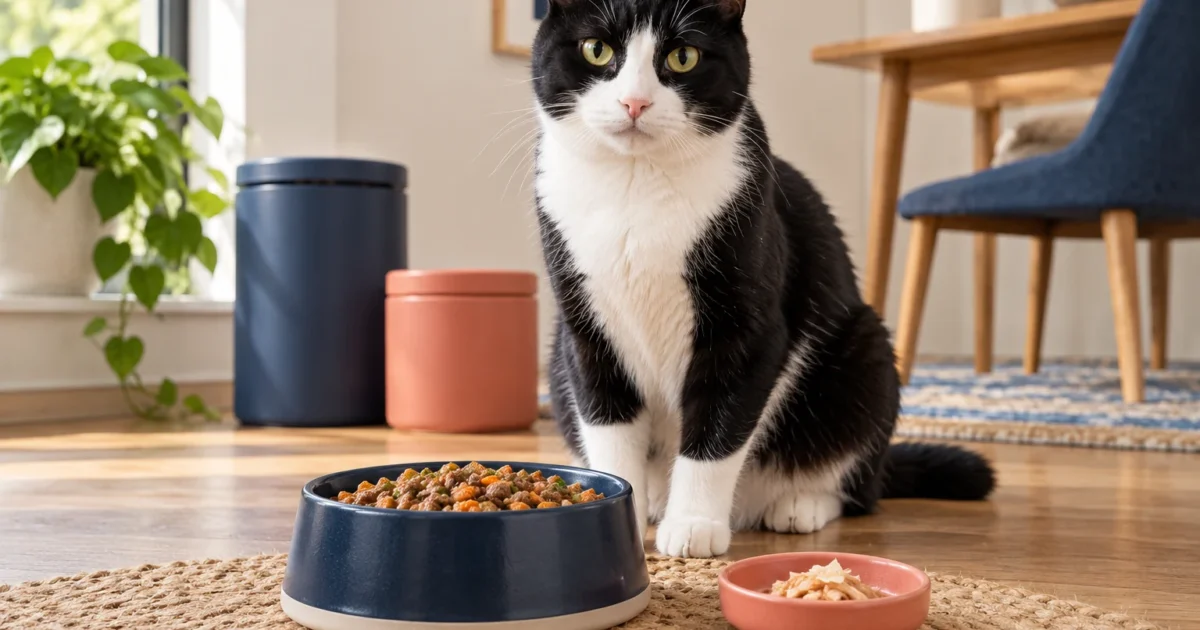
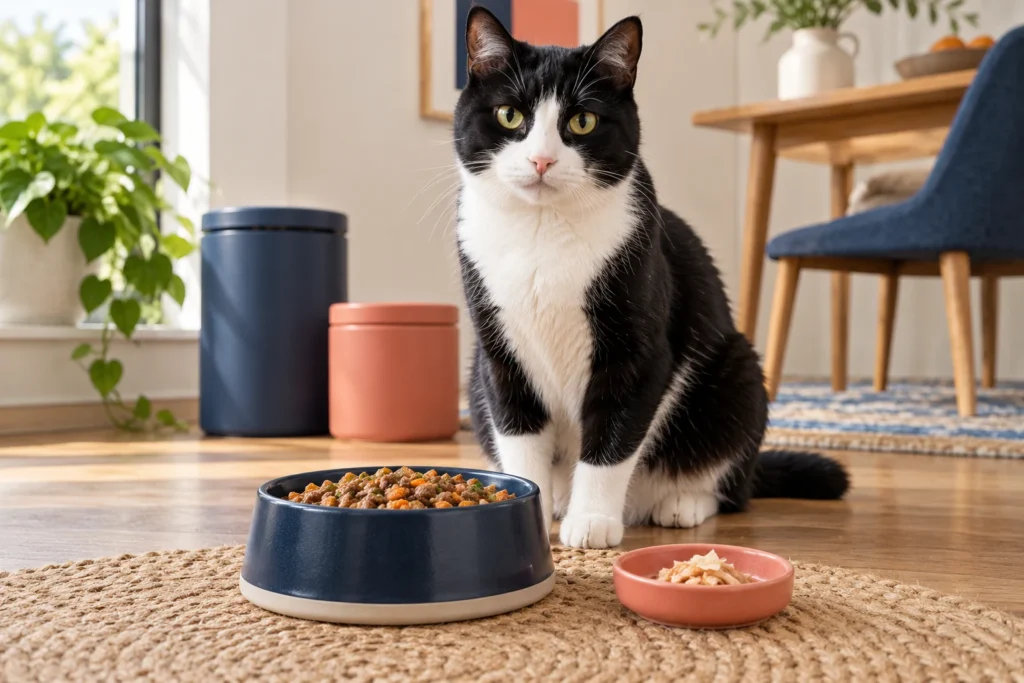
A complete cat food is formulated to provide the nutrients required for its stated life stage when fed as directed. A complementary food is intended to be combined with other food or used for a limited purpose, such as a topper, treat or supplement. The wording differs by market, so read the nutritional-adequacy or intended-use statement rather than relying on the front label.
Complete vs complementary cat food at a glance
| Label type | Intended role | What to check |
|---|---|---|
| Complete / complete and balanced | Can serve as the main diet for the stated species and life stage when fed as directed. | Life stage, feeding directions, calorie statement and any conditions of use. |
| Complementary / intermittent / supplemental | Used with another food or for a limited purpose. | How it should be combined, serving limit and whether it displaces the complete diet. |
| Treat or topper | Reward, palatability or variety rather than nutritional completeness. | Portion, calories and the effect on the rest of the day’s food. |
| Veterinary or therapeutic diet | Used for a defined medical or nutritional purpose. | Veterinary direction and the exact product instructions. |
How labels differ by region
United States and Canada
In the United States, look for the nutritional adequacy statement. It can identify a food as complete and balanced for a life stage or state that the product is intended only for intermittent or supplemental feeding. AAFCO model language informs many US state rules, while FDA requirements also apply. Canadian packaging may use different regulatory wording, so check the full intended-use and feeding information on the local package.
United Kingdom and European Union
FEDIAF uses the terms complete pet food and complementary pet food. Complete food supplies all daily nutrients when fed as instructed; complementary food has a high level of certain substances or is insufficient for a daily ration unless combined with other food.
Australia and other markets
Do not assume an imported product carries identical wording or formulation in every country. Check the package sold in your region, the local distributor and the directions for the exact formula.
A five-step label check
- Find the intended-use or nutritional-adequacy statement.
- Confirm the species and life stage.
- Read the feeding directions and calorie information.
- Check whether the product must be mixed with another food.
- Recheck after a formula or packaging change; the product name alone is not enough.
Can a topper become too much?
Yes. Toppers and treats add calories and can displace the complete diet. There is no universal portion that fits every product or cat. Follow the product directions and ask your veterinarian when the cat has a medical condition, is growing, is pregnant, is losing or gaining weight unexpectedly, or eats a therapeutic diet.
Next: estimate your real budget with the Cat Food Cost per Day Calculator or compare food formats in Best Cat Food.
Frequently asked questions
Can complementary cat food replace a complete meal?
Not unless the label specifically explains how it becomes nutritionally complete when combined. Many complementary foods are designed only as toppers, treats or part of a mixed ration.
Is every wet cat food complete?
No. Wet and dry describe format, not nutritional adequacy. Either format can be complete or complementary.
Is “premium” the same as complete and balanced?
No. Marketing language does not replace the nutritional-adequacy or intended-use statement.
Sources and verification
Last verified October 3, 2026. Always use the label on the exact product sold in your region.