


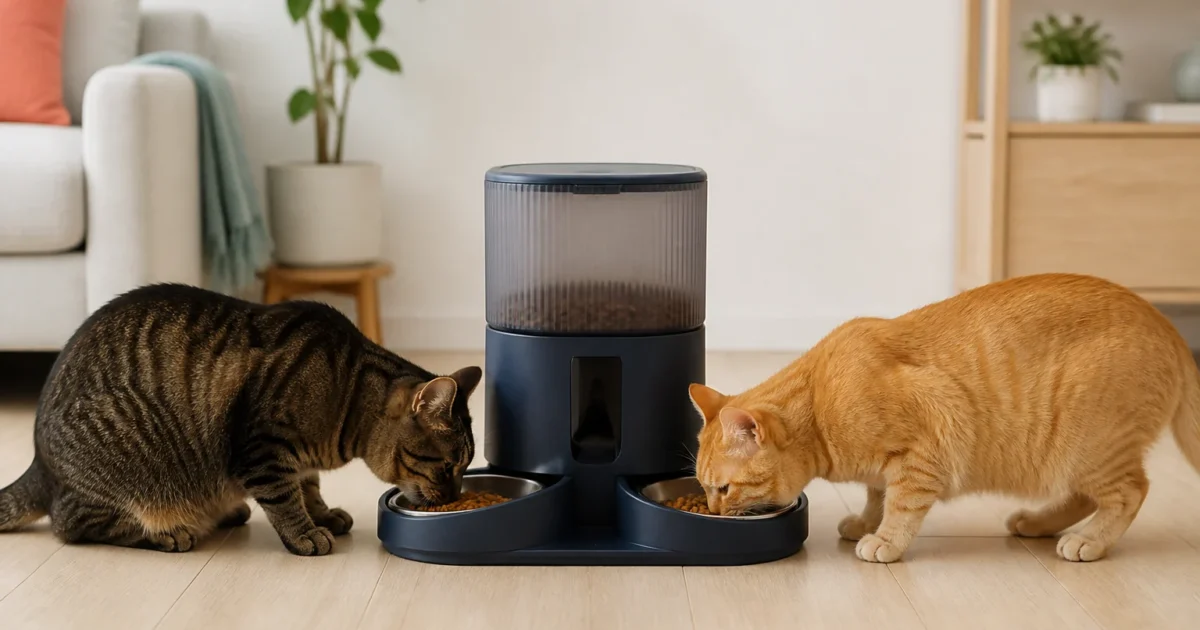
Two-cat household guide · Evidence-led
Two cats can sometimes share an automatic feeder, but sharing should be treated as a compatibility test—not the default setup. It works best when both cats eat the same food, have similar meal speed, remain relaxed, and can be observed receiving a fair share. Otherwise, use separate feeding stations.
The practical rule
A dual-bowl feeder solves “one machine, two bowls.” It does not solve food guarding, different diets, unequal appetite, or individual monitoring. If the goal is knowing who ate what, each cat needs a protected station or identity-controlled access.
When one feeder may work
- Both cats eat the same dry food and follow the same schedule.
- Neither cat guards the feeder, blocks the route, or hovers over the other.
- The cats eat at a similar pace and walk away after finishing.
- You can see or measure that both cats are maintaining an appropriate intake and body condition.
- The feeder has two distinct bowls rather than forcing both cats into one narrow eating position.
Even in this best-case scenario, a shared feeder is a household convenience. It is not individualized portion control.
When sharing is a bad idea
One cat finishes first and crosses over
A meal splitter can divide the dispense correctly and still produce unequal intake. The relevant moment is what happens after the faster cat finishes.
One cat looks tense or cautious
Visible fighting is not required for competition. Watch for staring, flattened or sideways ears, crouching, repeated scanning, waiting at a distance, leaving and returning, or approaching only after the other cat moves away.
The diets or calorie targets differ
Kittens, adults, seniors, cats on weight plans, and cats eating prescription diets may need different food or amounts. A shared hopper cannot enforce two plans.
You need to monitor appetite
If a cat’s intake matters medically, access and measurement must be individual. A camera can help you observe behavior, but it cannot reliably calculate intake from a shared bowl.
What feline guidance says
Cat Friendly Homes recommends each cat have a separate feeding station with distance and visual separation. The FelineVMA feeding consensus also supports multiple food and water stations, frequent small meals, and automatic or microchip feeders when appropriate to the household.
If one cat is losing weight, gaining weight, refusing food, vomiting, or needs a therapeutic diet, ask your veterinarian to set the feeding plan rather than solving it only with hardware.
Dual bowls vs identity-controlled feeders
| Design | What it controls | What it cannot control | Best fit |
|---|---|---|---|
| Dual bowl / meal splitter | One dispense divided between two bowls | Which cat eats each portion | Calm cats on the same dry diet |
| RFID scheduled feeder | Scheduled dry meals plus access for one collar tag | Implanted microchips on tag-only models | Food stealing with dry food |
| Microchip access bowl | Which cat can open the covered bowl | Automatic multi-meal dispensing | Different diets, wet food, or appetite tracking |
| Two timed trays | Independent opening schedules | Identity after a lid opens | Wet meals in separate rooms |
A simple seven-day sharing test
- Place two bowls with as much distance and visual separation as the design allows.
- Weigh several empty-machine test dispenses from each side.
- Observe every meal for the first few days, especially when one cat finishes.
- Record hesitation, guarding, bowl switching, leftovers, or repeated attempts to return.
- Check that both cats continue normal eating behavior and maintain the veterinarian-recommended daily amount.
- If there is tension or uneven access, stop the shared setup and move to separate locations or identity control.
Bottom line
Two cats can share an automatic feeder only when sharing is already easy for them. The feeder does not create fairness; it automates the existing relationship. For product-level options, compare our five researched feeder setups for two cats.
Choose by the problem—not the app
Same food and calm cats, food stealing, wet meals, and different diets each require a different setup.