


Researched & Compared · Updated August 8, 2026
The best feeder for two cats is not always one machine with two bowls. If both cats eat the same dry food calmly and at a similar pace, a shared dual-bowl dispenser can be simple and space-efficient. If one cat steals food, eats faster, needs a different diet, or must be monitored separately, two identity-controlled stations are the more appropriate setup to investigate.
Transparency: we compared current official specifications, manuals, access-control design, portion behavior, backup power, cleaning, and US/UK/Australian availability. This is a research-led comparison, not a hands-on feeding test. Clearly marked PETLIBRO and Amazon buttons are paid affiliate links; MeowBay may earn a commission at no extra cost to you. Other manufacturer and source links are unpaid. Merchant availability does not determine editorial ranking.
As an Amazon Associate I earn from qualifying purchases.
The short answer
For two calm cats eating the same dry food: the PETLIBRO Granary Smart Feeder with Dual Bowl is the cleanest shared setup. For cats that steal food or need separate portions: use one PETLIBRO One RFID feeder per cat for scheduled dry meals. For implanted-microchip access or wet food: use one SureFeed Microchip Pet Feeder per cat, understanding that it controls access but does not automatically dispense scheduled meals.
A dual tray divides food; it does not identify the eater. No camera, splitter, or app can guarantee fair intake when both cats can reach both bowls.
Two bowls side by side are not truly separate stations
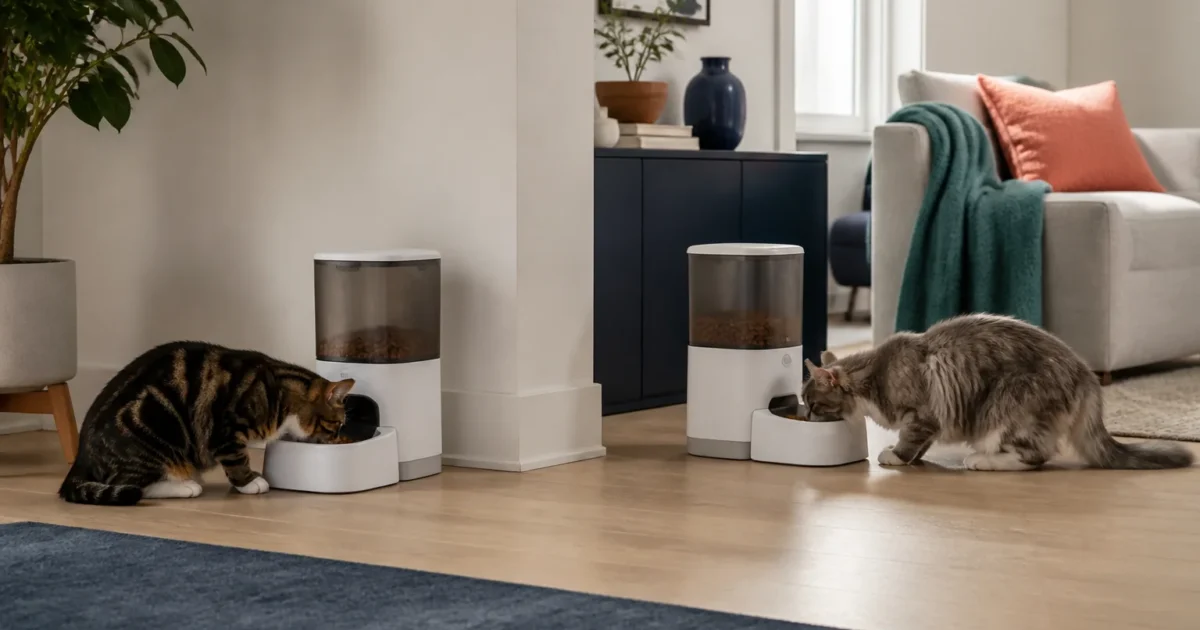
Cat Friendly Homes recommends a separate feeding station for each cat, with distance and visual separation. That matters because a cat can control access without obvious fighting: staring, blocking the route, hovering after finishing, or making the other cat approach cautiously can be enough.
A shared dual-bowl feeder is therefore a convenience option for compatible cats—not the default answer for food guarding, different diets, weight management, or medical needs.
PRACTICAL MULTI-CAT TOOLKIT
Food stealing still happening at home?
Turn the advice into a household plan with MeowBay’s 33-page printable and fillable toolkit. Identify the feeding conflict, map separate stations, and follow a practical seven-day reset.
Focused on routines and access—not calorie prescriptions or veterinary advice.
How we compared two-cat setups
We evaluated five practical configurations rather than pretending every household needs the same machine. Our criteria were: whether the cats share a diet, whether access is individual, how portions are divided, wet- or dry-food compatibility, schedule resilience, cleaning, total floor space, and regional support.
We did not award numeric scores. A product can be excellent for one household and structurally wrong for another—for example, a perfectly accurate dual-bowl feeder still cannot stop one cat from eating both portions.
Quick comparison
| Setup | Best for | Individual access? | Food | Main limitation |
|---|---|---|---|---|
| PETLIBRO Granary Dual Bowl | Calm cats sharing one dry diet | No | Dry | One cat can eat from both bowls |
| PetSafe Smart Feed + 2-Pet Splitter | Large-capacity equal shared meals | No | Dry or semi-moist | Splitter divides output, not access |
| 2× PETLIBRO One RFID | Separate scheduled dry meals | Yes, collar tag | Dry | Requires one full feeder per cat |
| 2× SureFeed Microchip Feeders | Food stealing, different diets, wet food | Yes, microchip or tag | Wet or dry | Controls access but does not dispense timed meals |
| 2× Cat Mate C500 | Timed wet meals without Wi-Fi | No | Wet or dry | Needs separate locations and daily loading |
Best shared dry-food setup
1. PETLIBRO Granary Smart Feeder with Dual Bowl
The Granary Dual Bowl is the most direct answer when two compatible cats eat the same kibble. PETLIBRO documents a 5-liter hopper, up to 10 meals or snacks, app scheduling, feeding logs, supported kibble from 2–15 mm, and battery backup for scheduled dispensing during a power interruption.
The crucial detail is how the portion is counted: PETLIBRO’s support documentation says the programmed amount is the total dispensed across the dual tray, not that amount per bowl. The splitter can distribute food between the bowls, but owners should weigh several test dispenses on both sides because kibble shape and alignment can affect the real split.
- One hopper and one schedule for two bowls
- Large 5-liter dry-food capacity
- Up to 10 scheduled meals
- App logs and battery backup
- No cat identification or food-theft prevention
- Both cats must share one food and schedule
- Total programmed portion is divided across the bowls
- Side-by-side bowls provide little visual separation
Best high-capacity splitter system
2. PetSafe Smart Feed + 2-Pet Meal Splitter
PetSafe’s official splitter is made for the Smart Feed and Healthy Pet Simply Feed. It adds a second stainless-steel bowl, divides the feeder’s output equally, and includes an optional privacy panel. Paired with the Smart Feed, the system offers a 24-cup / 5,678 mL hopper, up to 12 meals, flexible portions, slow-feed mode, and optional battery backup.
This is a well-documented shared system, but the privacy panel is a modest divider—not access control. It is appropriate only when both cats can safely eat the same food and neither routinely crosses over after finishing.
- Official accessory designed for two bowls
- Large hopper and flexible schedules
- Equal food split with a small privacy panel
- Dishwasher-safe splitter material
- No identity control
- Requires the feeder plus a separate accessory
- Equal split only; not different portions or foods
- Accessory availability varies by country
Best individualized scheduled dry-food setup
3. Two PETLIBRO One RFID Smart Feeders
The One RFID combines scheduled dry-food dispensing with identity-controlled access. PETLIBRO lists a 3-liter / roughly 13-cup hopper, up to 10 meals, app logs, 2–15 mm kibble compatibility, and battery backup that continues saved schedules when mains power fails.
For two cats, this is explicitly a two-unit system. Each feeder pairs with only one dedicated PETLIBRO collar tag; it does not read an implanted microchip or third-party tag. That creates meaningful individual control, but both cats must tolerate the supplied tag and you need floor space for two complete machines.
- One schedule, bowl, and activity log per cat
- Helps prevent routine food stealing
- Available in two-pack configurations in some markets
- Saved schedules continue on backup power
- One feeder and one proprietary tag per cat
- Does not read implanted microchips
- Dry food only
- Two units increase cost, cleaning, and floor space
Choose the required quantity: this setup uses one feeder per cat. A one-pack is not a two-cat bundle.
Best for food stealing, wet food, or different diets
4. Two SureFeed Microchip Pet Feeders
SureFeed opens for a registered implanted microchip or Sure Petcare RFID collar tag, making it the clearest access-control option when one cat steals food or the cats need different diets. The standard and Connect families support wet or dry food in a 400 mL bowl. The Connect version adds integrated scales, app monitoring, and one-gram portion guidance through a required Hub.
This is not a timed hopper. You manually load each cat’s bowl and the lid protects access. Sure Petcare’s own guidance for multi-pet homes is effectively one feeder per protected eater. That distinction matters: choose it for identity and diet separation, not unattended multi-meal dispensing.
- Reads common implanted microchips
- Supports wet and dry food
- Useful for different or prescription diets
- Connect model monitors individual eating behavior
- Does not dispense scheduled meals
- One feeder is normally needed for each cat
- Connect app functions require the Hub
- Some cats need gradual lid training
The linked listing is one feeder; the described two-cat setup requires two units.
Best no-Wi-Fi wet-food schedule
5. Two Closer Pets Cat Mate C500 Feeders
For two cats eating timed wet meals, two separate C500 trays offer a simple battery-powered setup. Each unit has five compartments—one available immediately and four future timed openings—plus twin ice packs, dishwasher-safe food-contact components, and AA-battery operation.
Separate the two units physically and place each in the cat’s preferred feeding area. The C500 does not identify the cat, so proximity alone will not stop theft. Its ice packs also provide passive cooling rather than refrigerator-equivalent storage.
- Works with wet or dry food
- No Wi-Fi, account, or power outlet
- Independent schedule for each cat
- Simple removable tray components
- No identity control
- Requires two devices and separate locations
- Only four future openings per loading
- Ice packs have temperature and time limits
The linked CP465 version includes a stainless steel bowl insert. This listing is one feeder; allow for two units for the described setup.
Choose the setup by household problem
Same dry food, calm relationship, similar eating speed
A dual bowl or official splitter can work. Calibrate the total dispense, weigh food from each side, and observe what happens after the faster cat finishes.
One cat steals or guards food
Use separate locations and identity-controlled access. Two adjacent bowls—even with a small divider—do not prevent a confident cat from moving across.
Different calories, diets, or medical needs
Use one protected station per cat. Ask your veterinarian to set the food amount and schedule when a medical condition or prescription diet is involved.
Wet food on a schedule
Two timed trays can provide independent schedules, but they do not identify the eater. If identity matters more than timing, two microchip-access bowls are the more relevant design. Our dedicated wet-food feeder comparison separates timed trays, active cooling, and access control.
How to set up two feeders without creating conflict
- Start in separate locations. Give each cat a clear approach and exit route, with visual separation where possible.
- Keep food, schedule, and device changes gradual. Let each cat eat from the new bowl while the machine is inactive before introducing movement or sound.
- Calibrate in grams. Weigh repeated dispenses with the actual kibble and record the combined daily total.
- Watch the handoff moment. The greatest risk of stealing often comes when one cat finishes first.
- Test power and network failure. Confirm which schedule functions continue locally and replace backup batteries before they expire.
- Keep a human check-in plan. Automatic feeders cannot confirm health, water, litter, or whether the intended cat ate the meal.
Make the setup work for both cats
- Stop one cat eating the other cat’s food: identify when bowl swaps happen before buying.
- Feed two cats different diets: organize food, stations and caregiver instructions.
- Introduce separate microchip feeders: progress at each cat’s pace.
- Troubleshoot unwanted microchip-feeder access: check pairing, placement and normal operation.
Before buying a feeder for two cats
Choose access first, then scheduling. Two bowls can serve the same meal, but they cannot identify who eats it. If diets or intake must stay separate, compare individual access-controlled stations rather than assuming a splitter solves food stealing.
| Household need | Setup to compare | Do not assume |
|---|---|---|
| Same dry food; both cats share calmly | Granary Dual Bowl or Smart Feed with compatible splitter | Each cat receives or eats exactly half |
| Separate dry diets with scheduled dispensing | Two One RFID stations | One unit provides two separately protected meals; verify tag compatibility |
| Protected wet or dry food access | Two SureFeed stations | Access control dispenses timed portions |
| Wet food served at different times | Two C500 units in separate locations | Ice packs provide verified refrigeration or stop food stealing |
Budget for the whole setup
Compare the cost of the required number of feeders, splitters or tags, batteries and replacement bowls—not just one advertised unit. Measure both feeding locations, including lid clearance and space for each cat to approach without being blocked.
Convert measured dispenser portions into grams per day → Use a kitchen scale to calibrate your own kibble; a portion setting is not a universal weight. The calculator does not determine your cat’s nutritional requirement.
Buying outside the United States?
Amazon.com buttons open the US marketplace. A US listing does not confirm delivery or warranty support in Canada, the UK, other European countries, Australia or Brazil. Before paying, check the exact model, local plug and voltage, app availability, replacement parts, return address and total delivered cost in your currency. Do not assume a similarly named regional model has identical features.
Content update: September 15, 2026 — clarified setup exclusions, household budgeting and regional buying checks. No new hands-on measurements.
Frequently asked questions
Can two cats use one automatic feeder?
Sometimes, if they eat the same food, remain relaxed, and you can verify that both receive a fair share. Separate stations are safer when either cat guards, steals, eats much faster, or needs a different diet. See our full guide to sharing one automatic feeder.
Does a dual-bowl feeder give equal portions?
It is designed to divide one dispense, but real distribution can vary with the splitter, surface level, and kibble. Weigh several samples from both bowls instead of assuming a perfect half.
Do I need two RFID feeders for two cats?
For the PETLIBRO One RFID, yes: each unit pairs with one proprietary collar tag. With SureFeed, a unit can remember multiple identities, but one feeder per cat is the practical setup when the goal is separate diets or individual intake.
Which setup is best for wet food?
Two Cat Mate C500 units provide timed tray openings. Two SureFeed units provide individual access to manually loaded wet food. Choose timing or identity based on the real problem, then compare the cooling and safety limits in our wet-food feeder guide.
Can a camera tell which cat ate?
It can show who approached the bowl, but it may not establish exact individual intake—especially when cats swap positions or share one tray.
Sources and verification
- Cat Friendly Homes: How to Feed a Cat
- FelineVMA: Feline Feeding Programs consensus resource
- Official product and regional pages linked in each setup; checked August 8, 2026.
Editorial note: specifications, bundles, stock, and country support change. Confirm the exact local model before buying. For a broader category comparison, return to Best Automatic Cat Feeders.