How to Feed Two Cats Different Diets Without Bowl Swaps
Written by Maya BennettCat Product Research Editor at MeowBay··
9 min read ·Content updated:
Research-Based
Disclosure: MeowBay may earn a commission from clearly identified affiliate links, at no extra cost to you. Ordinary source and manufacturer links are not paid, and editorial conclusions remain independent.
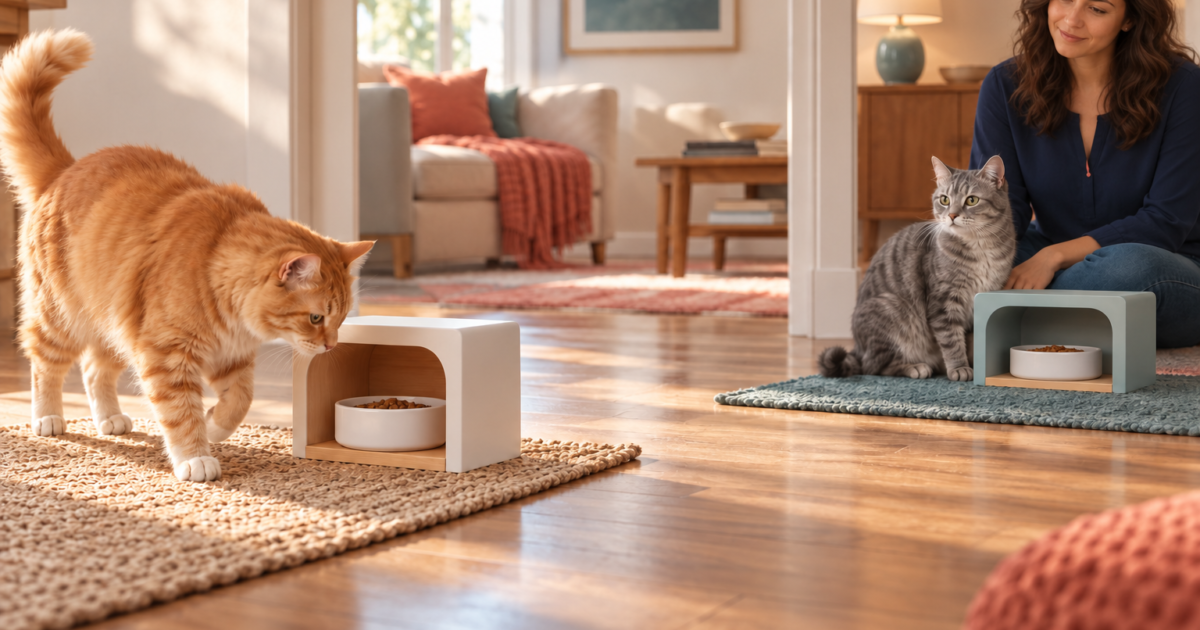
Give each cat a clearly identified food supply, a separate feeding station, and a routine that prevents access to the other meal. Where a veterinary diet is involved, ask the prescribing veterinarian how strict separation needs to be. A feeding device manages access; it does not decide which diet or amount is appropriate.
The overlooked problem is often the handover between people. One person measures correctly, another tops up the wrong bowl, and a sitter assumes the remaining food belongs to either cat. A good system should remain understandable when you are not home to explain it.
Build a two-cat feeding record
Create one short instruction card per cat. Keep it close to the relevant food, but out of reach of chewing or spills. Copy the actual feeding instructions rather than estimating portions from the cat’s size.
Field
What to record
Cat identification
Name and a clear photograph
Approved food
Exact product name; include formula, not just brand
Amount and timing
Your veterinarian’s or established feeding plan’s instructions
Location
The specific room or feeder
Leftovers
What the caregiver should do after the meal
Exceptions
Who to contact if food is refused or the wrong meal is eaten
Color coding can help, but names and photographs are more useful than color alone. Two products from the same brand can look nearly identical. Keep their original labels available and avoid an unlabeled shared food bin.
Choose a separation method you can actually maintain
Separate-room meals: Usually the simplest arrangement to understand. Prepare the meals, separate the cats, and check both before reopening access. It requires someone to manage the routine.
Protected grazing: Useful when one cat leaves food and returns later. The protected station must remain accessible to that cat without admitting the other. A selective feeder is one possible tool, not proof that the diet is fully protected.
Separate scheduled dispensers: May solve different meal times or quantities, but ordinary open bowls remain open to both cats. Scheduling and identity control are different requirements.
A combination: One cat may eat supervised meals while the other uses protected access. This can be more practical than buying two identical devices for two different needs.
Do you need two RFID feeders for two cats?
Not automatically. Count the meals that need protection rather than counting cats. If only one cat’s food needs protection and the other finishes supervised meals, one selective feeder may be sufficient. If both cats need independent protected access throughout the day, evaluate two separate stations.
Before purchasing, draw two arrows on paper: “Cat A can reach this food” and “Cat B can reach this food.” Add the hours when supervision is unavailable. Any unwanted arrow left on that diagram is a gap the proposed purchase still needs to solve.
Do not authorize both cats on the same selective feeder if the purpose is to keep their diets separate. Also verify the exact model’s identification system. Manufacturer terminology such as smart, automatic, and RFID is not interchangeable with implanted-microchip recognition.
What if one cat needs a prescribed diet?
Ask your veterinarian for a written response to three practical questions: what other food must be avoided, what to do after an accidental swap, and what changes in eating should trigger a call. Do not use a general website to decide whether a small amount of another diet is harmless.
The safest workable household arrangement may be supervised physical separation rather than a more sophisticated feeder. Do not downgrade separation simply because an app reports a meal or because the feeder opened for the correct tag.
Rehearse the sitter handover
Ask the person covering a meal to explain the instructions back to you: which food, which cat, which location, and what happens afterward. Watch an ordinary rehearsal while you are available to help. A written routine that cannot be followed without several verbal corrections is not ready for an unattended handover.
Keep the backup method equally clear. If a feeder stops working, the sitter should know how to provide the correct meal manually without changing the diet or improvising device settings.
What to buy—and what to skip
Buy for food compatibility, protected access, easy cleaning, and a manageable backup routine. Skip dual-bowl marketing when you need separate food supplies, and skip extra monitoring features unless they answer a real household question.
The record and handover process above are MeowBay editorial recommendations, not a prescribed diet plan. For feeding-environment guidance, see Cat Friendly Homes.
Use a diet-separation handover that names the food
Color-coded bowls help only if every caregiver knows what the colors mean. Pair the visual cue with exact written instructions.
Decision or record
How to apply it
Cat and food
Cat identity, exact recipe, measured portion and prescribed restrictions where applicable.
Location and access
Which room or protected station is used and when leftovers are collected.
Uncertain meal
What to do after a bowl swap or unknown intake, following veterinary instructions for medical diets.
Have a substitute caregiver explain the plan back before an absence. A photograph of packaging can prevent recipe confusion, but keep private health records and household access details in the private care handover.
Follow the food from package to the correct cat
Diet separation can fail before a feeder is involved. Map the supply, measuring tool, bowl, location and caregiver instruction for each cat. A protected opening cannot correct food loaded into the wrong device.
Keep the exact recipe identifiable
Record the full food name, variant and relevant package information. Retain the original label after any permitted transfer. Do not use an unmarked common container for two foods merely because both are dry and look similar.
If one diet is prescribed, ask the treating veterinarian about the separation and handling required. The significance of another food or an accidental exposure depends on the individual situation; a general article cannot decide that it is harmless.
Make measuring and serving unambiguous
Keep the appropriate portion instructions beside the food identity. A scoop color alone may be forgotten or exchanged. Written units and the actual individual plan matter more than a vague instruction such as “a little less for the smaller cat.”
Where dedicated tools or particular handling are part of the professional plan, make them easy to follow. Do not invent a universal cleaning or cross-contact protocol from the fact that two foods have different labels.
A double-check before food enters a feeder
Check
Confirm aloud or in the care note
Cat
Correct identity, including a clear photograph for unfamiliar caregivers.
Food
Exact recipe and appropriate nutritional role.
Amount
The established allocation and unit, including other daily food.
Station
Correct room or full device identity.
Afterward
Leftovers and completion record handled under the plan.
A brief check is particularly useful after a new bag arrives, another person restocks supplies or a device is moved for cleaning. Those ordinary events can break the connection between a familiar bowl and its intended contents.
Work through a fictional sitter rehearsal
The sitter receives two instruction cards and locates the actual food, stations and established amounts. Before relying on the arrangement, ask the person to explain which food goes where and how unwanted access is prevented.
If several verbal corrections are needed, improve the written instruction and labels. The rehearsal tests the clarity of the household system; it is not a test of whether the sitter remembers your private shorthand.
Include a stopped-device scenario
Ask where the correct manual meal would be supplied if the selective feeder were unavailable. Keep the appropriate bowl and instructions ready. The fallback should preserve diet separation rather than placing both foods in open bowls together.
Do not require the sitter to diagnose a reader or reinstall an account to provide care. They need the normal supported controls, clear stop conditions and a contact route for unresolved equipment concerns.
Handle an uncertain meal with facts
Record which food was involved, the possible amount, the time and which cat may have accessed it. Distinguish directly observed consumption from food merely missing. Contact the veterinarian according to the individual instructions, particularly for a prescribed diet or concerning signs.
Do not automatically double the next meal, withhold food or change treatment to compensate. A general worksheet cannot supply the appropriate response. Preserve the package and factual history needed for professional advice.
Prevent the same ambiguity reaching the next caregiver
A note such as “possible bowl swap; individual amount unknown; veterinarian contacted; follow the recorded instructions” is clearer than “feeding sorted.” Keep any professional advice exact and dated.
Record which routine is active afterward. If supervised separation temporarily replaces devices, everyone should know before the next meal. A silent switch can leave one person following old settings while another supplies a manual portion.
Choose the right amount of equipment
Count protected access needs rather than automatically buying one identical device per cat. One cat may finish appropriate supervised meals while the other needs continued access. Another household may need independently protected stations for both.
Compare the complete arrangement: accepted food format, identifier, location, comfortable use, supported cleaning and backup. A device that rejects the required food format or identifier cannot meet the plan through an app upgrade.
Do not confuse recognition with separation
A camera or tag log may identify an approach without preventing another cat reaching food. Confirm the actual access mechanism and its limitations. Observe what happens during eating and after the intended cat leaves.
Do not defeat protective lid behavior, authorize both cats on a diet-specific station or use improvised barriers to make the system appear ready. Preserve an appropriate alternative while support or training is ongoing.
Review the supply and instruction together
When a recipe, package size, portion plan or caregiver changes, update the corresponding card and station note at the same time. Remove obsolete instructions from the active care area while preserving any useful history separately.
Check the delivered package at reorder time. A similar-looking complementary product or different formula is not automatically the intended replacement. Clarify uncertainty before loading the food.
Keep private care information in the right place
The public article provides a general framework. The individual diet, professional instructions and household contacts belong in the private caregiver record. Share what the actual caregiver needs through an appropriate agreed route.
A good separation system remains understandable when the owner is absent. Its value comes from food identity, appropriate access and clear exceptions, not simply owning a pair of matching feeders.
Keep the refill handover as precise as the meal handover
State which exact package supplies each hopper or bowl and where its identity can be checked. If another person opens a new bag, have them compare the recipe and selected variant with the instruction card before filling. Do not assume that a matching brand color confirms the food.
Follow the food’s storage instructions and preserve relevant package and date information. A large hopper should not encourage combining unidentified leftovers from several bags. Keep the routine compatible with the individual feeding and handling plan.
Update the record after a change
If the veterinarian changes the diet or amount, replace the active instruction at the supply and station together. Tell each caregiver which version is current. An old note left beside a correct new bag can be as confusing as an unlabeled container.
Record the date of the change and any professionally advised transition or exception. This preserves a clear explanation if appetite, device output or acceptance differs afterward, without assuming that the other cat caused every problem.
Maya Bennett is MeowBay’s Cat Product Research Editor and is responsible for this research-led article. She evaluates manufacturer documentation, household fit, cleaning, and product limitations. This article does not replace advice from your veterinarian.
4 Comments on “How to Feed Two Cats Different Diets Without Bowl Swaps”



4 Comments on “How to Feed Two Cats Different Diets Without Bowl Swaps”