


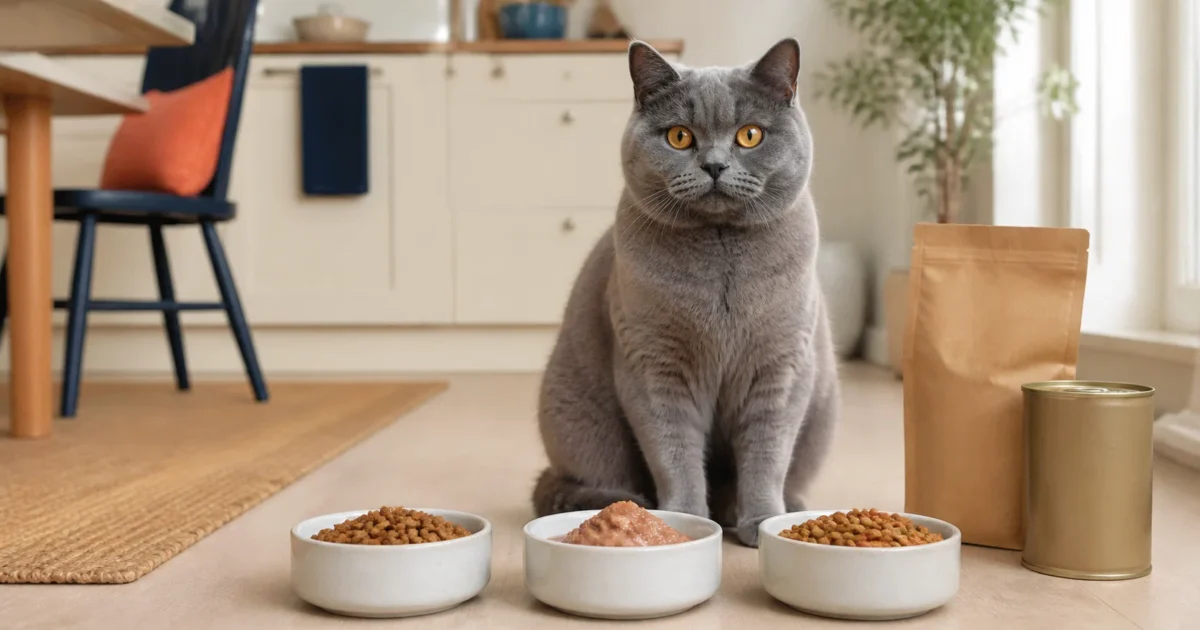
Short answer: For a healthy adult indoor cat, an affordable food should be complete and balanced for the correct life stage, easy to portion, consistently available, and sustainable for your monthly budget. Our five researched starting points are Purina Cat Chow Indoor and IAMS Proactive Health Indoor for lower-cost dry feeding, Purina ONE +Plus Indoor Advantage for a step-up dry option, Fancy Feast Classic Paté Chicken Feast for smaller wet-food cans, and Friskies Paté Chicken & Tuna Dinner for larger wet-food cans. We researched these foods; we did not buy, feed, or laboratory-test them.
Choose by your main priority
- Budget-focused indoor dry: Purina Cat Chow Indoor
- Lower-calorie indoor dry: IAMS Proactive Health Indoor
- Step-up indoor dry: Purina ONE +Plus Indoor Advantage
- Small-can wet option: Fancy Feast Classic Paté Chicken Feast
- Large-can wet option: Friskies Paté Chicken & Tuna Dinner
Want a broader shortlist? Start with our best cat food for indoor cats guide.
MeowBay evidence label: Researched & compared
- Hands-on tested by MeowBay: No
- Veterinarian reviewed: No
- Research basis: current US manufacturer labels and product pages, nutritional-adequacy statements, calorie data, feeding directions, and FDA, AAFCO, and WSAVA guidance
- Price policy: we do not name a permanent “cheapest” winner because prices, pack sizes, promotions, and formulas change
- Label check completed: August 13, 2026
Affiliate disclosure: No brand paid for inclusion or placement in this guide. MeowBay may earn a commission when you buy through clearly identified links, at no extra cost to you. This does not change our research criteria. As an Amazon Associate I earn from qualifying purchases.
This article is general educational information, not individualized veterinary advice. Ask your veterinarian before changing food for a kitten, a pregnant or nursing cat, a cat with a diagnosed condition, a cat taking medication, or a cat with persistent vomiting, diarrhea, appetite change, itching, or unexplained weight change.
Best affordable cat food: quick comparison
| Best fit | Exact food researched | Published calories | Why it is a value candidate | Main trade-off |
|---|---|---|---|---|
| Budget-focused indoor dry | Purina Cat Chow Indoor Hairball + Healthy Weight | 358 kcal/cup | Adult-maintenance adequacy statement, indoor positioning, large-pack availability | Calorie density still requires measured portions |
| Lower-calorie indoor dry | IAMS Proactive Health Adult Indoor Weight & Hairball Care Chicken & Turkey | 302 kcal/cup | Adult-maintenance statement, multiple bag sizes, lowest calories per cup among these dry options | Hairball and weight language is a manufacturer claim, not a MeowBay test result |
| Step-up indoor dry | Purina ONE +Plus Indoor Advantage | 372 kcal/cup | AAFCO feeding-test statement, clear calorie and feeding data | Higher calories per cup than the other two dry options here |
| Small-can wet food | Fancy Feast Classic Paté Chicken Feast | 91 kcal/3-oz can | Complete-and-balanced statement, portionable small cans, wet format | Not indoor-specific; daily can cost can exceed dry-food cost |
| Large-can wet food | Friskies Paté Chicken & Tuna Dinner | 176 kcal/5.5-oz can | Adult-maintenance statement, larger-can format, wet-food comparison point | Opened leftovers need safe refrigeration and some cats dislike stored texture |
Important: These are not five foods ranked from universally best to worst. They are five widely available US reference options that make different budget trade-offs. The right choice depends on your cat’s life stage, health, body condition, calorie needs, food preference, and the current price where you shop.
Outside the US? Formulas and regulatory wording can differ in Canada, the UK, Europe, Australia, and other markets. Use the local package—not a US web page—to verify that the food is complete for your cat’s life stage.
What “affordable” should mean
The lowest shelf price is not always the lowest feeding cost. A bigger bag may last longer, a calorie-dense food may require a smaller portion, and a rejected food is not a bargain at any price. Compare the cost of feeding the exact recipe, not only the package price.
Use cost per feeding day
Step 1: Estimate how many days the package will last:
Package amount ÷ your cat’s measured daily amount = estimated feeding days.
Step 2: Calculate the daily food cost:
Current package price ÷ estimated feeding days = estimated cost per day.
For example, if a hypothetical 7,200-gram bag costs $32 and your cat eats 60 grams daily, it contains about 120 feeding days. The estimated cost is about $0.27 per day. This is a calculation example, not a price claim for a product above. Use the current pack weight, price, and feeding amount from the food you are considering.
For a fairer wet-versus-dry comparison
Wet food contains much more water, so comparing price per ounce can be misleading. A practical household comparison is the cost of the calories your cat actually receives each day. First confirm the calorie value on the package, then compare the cost of your cat’s measured daily portion. Our wet vs dry cat food guide explains the format trade-offs in more detail.
How we chose these five options
MeowBay did not rank foods by front-of-pack words such as “premium,” by ingredient-list fashion, or by anonymous star ratings. We used seven practical checks:
- Nutritional adequacy: We looked for a manufacturer statement showing that the exact food is complete and balanced for an identified life stage. The FDA explains that this claim is supported by meeting an AAFCO nutrient profile or by passing a feeding trial using AAFCO procedures.
- Life-stage fit: Adult-maintenance food is not automatically appropriate for kittens, pregnancy, or nursing.
- Calorie transparency: A published calorie value makes portion and daily-cost comparisons possible.
- Feeding information: We looked for usable feeding directions, while recognizing that label amounts are starting points rather than personalized prescriptions.
- Manufacturer transparency: We favored accessible ingredient, analysis, contact, and product information.
- Availability and pack choice: Food that is usually available in several sizes can be easier to trial before buying a large pack and easier to source consistently.
- Trade-offs: Every option below has limitations. No adequacy statement or marketing claim proves that a food is ideal for every cat.
The FDA’s complete-and-balanced explainer and AAFCO’s label guide identify the nutritional-adequacy statement as a key label check. The WSAVA selection toolkit also recommends asking who formulates and manufactures the food, what quality-control systems are used, what research supports it, and whether the company can provide detailed nutrient information.
Purina Cat Chow Indoor Hairball + Healthy Weight
Best researched fit: a budget-focused dry-food starting point for healthy adult indoor cats.
The current US label states that Cat Chow Indoor Hairball + Healthy Weight is formulated to meet AAFCO Cat Food Nutrient Profiles for maintenance of adult cats. It lists 358 kcal per cup and provides weight-based feeding ranges. The recipe is positioned for indoor weight and hairball needs, but those benefits are manufacturer claims and should not be treated as medical outcomes.
Why it made the shortlist
- Complete-and-balanced statement for adult maintenance
- Published calories and feeding ranges
- Indoor-specific positioning and broad pack-size availability
Trade-offs
- It is dry food; provide fresh water and consider the cat’s total dietary moisture.
- It contains corn, soy, wheat, and animal by-product ingredients. An ingredient name alone does not determine whether the finished diet is nutritionally adequate, but this recipe will not match every owner’s preference or every cat’s diagnosed dietary restriction.
- A low package price can still become poor value if the food is overfed or the cat will not eat it.
Who it may suit: healthy adult indoor cats in households prioritizing dry-food convenience and a sustainable feeding budget.
Who should get veterinary guidance first: kittens, pregnant or nursing cats, underweight cats, and cats with a diagnosed medical or dietary condition.
Read the current manufacturer label →
IAMS Proactive Health Adult Indoor Weight & Hairball Care with Chicken & Turkey
Best researched fit: a lower-calorie-per-cup dry option for healthy adult indoor cats.
IAMS states that this recipe is complete and balanced for adult maintenance. Its current product page publishes 302 kcal per cup, a feeding guide, and several bag sizes. Among the three dry foods compared on this page, it has the lowest published calories per cup. That does not make it a weight-loss prescription, and it does not mean every cat should receive a larger portion.
Why it made the shortlist
- Complete-and-balanced adult-maintenance statement
- Published calorie value and feeding directions
- Multiple bag sizes for a smaller first purchase or larger household pack
Trade-offs
- The weight and hairball benefits are manufacturer claims, not independently tested MeowBay outcomes.
- Frequent vomiting should not automatically be dismissed as a hairball problem.
- Chicken-and-turkey and salmon versions can have different calories and ingredients; verify the exact bag.
Who it may suit: healthy adult indoor cats when measured dry feeding, calorie clarity, and budget are priorities.
Read the current manufacturer information →
Purina ONE +Plus Indoor Advantage
Best researched fit: a step-up dry option for owners who value a published AAFCO feeding-test statement.
Purina’s current label says animal feeding tests using AAFCO procedures substantiate that this food provides complete and balanced nutrition for maintenance of adult cats. It lists 372 kcal per cup. The label also states that it is not intended for kittens or pregnant or nursing cats.
Why it made the shortlist
- Published feeding-test adequacy statement for adult maintenance
- Clear calories, gram-based portions, and transition directions
- Higher stated crude-protein minimum than the other dry foods on this page, although guaranteed-analysis percentages alone do not prove overall superiority
Trade-offs
- At 372 kcal per cup, measured portions remain important.
- The indoor weight and hairball positioning does not guarantee a specific result for an individual cat.
- It is usually a higher price tier than basic supermarket dry food, so compare cost per day.
Who it may suit: healthy adult indoor cats whose owners want a feeding-test adequacy statement and clear calorie data.
Read the current manufacturer information →
Fancy Feast Classic Paté Chicken Feast
Best researched fit: a complete wet-food option in small cans.
The current US product page lists 91 kcal per 3-ounce can and describes the food as 100% complete and balanced. The package’s small format can make portioning and texture trials easier than committing to a large case of a new food. Compare the current cost of the number of cans your cat needs rather than assuming a low price per can means a low daily cost.
Why it made the shortlist
- Complete-and-balanced statement with published calories
- Wet paté format and small cans
- Public ingredient and feeding information
Trade-offs
- It is not specifically formulated for indoor cats.
- It is labeled for all life stages; that does not mean one portion works for kittens, adults, pregnancy, and nursing.
- Several small cans per day may cost more than a measured dry-food routine.
Who it may suit: households seeking a widely available complete wet food with a smooth paté texture and small cans.
Read the current manufacturer information →
Friskies Paté Chicken & Tuna Dinner
Best researched fit: a larger-can wet-food value candidate for healthy adult cats.
Purina’s current product page states that this 5.5-ounce recipe is formulated to meet AAFCO Cat Food Nutrient Profiles for maintenance of adult cats. It lists 176 kcal per can and recommends dividing the daily amount into two or more meals. A larger can may reduce price per ounce, but the real value depends on how much your cat eats and whether refrigerated leftovers are accepted.
Why it made the shortlist
- Complete-and-balanced statement for adult maintenance
- Published calorie content and feeding guidance
- Larger-can format for a practical wet-food cost comparison
Trade-offs
- It is not an indoor-specific formula.
- Opened leftovers require prompt refrigeration and clean food handling.
- The recipe will not suit every taste preference or diagnosed dietary restriction.
Who it may suit: healthy adult cats in households comparing a larger-can complete wet food against small cans or dry feeding.
Read the current manufacturer information →
Cat Food Cost per Day: Compare Wet, Dry & Mixed Feeding
Price three routines using your own package prices and measured portions. Enter each routine separately: the mixed routine should use its own wet and dry quantities, not automatically add two full daily rations.
This tool does not calculate calorie needs or recommend feeding amounts. Compare suitable foods and portions agreed for your cat. Check complete vs complementary food first.
Daily component cost = package price ÷ package amount × daily portion. Mixed cost = its wet component + its dry component. Thirty-day and yearly estimates assume unchanged prices and portions. Include taxes or delivery in package price if you want them counted. Waste, treats and other foods are excluded. Currency selection labels your inputs; no exchange conversion is performed.
Use the formula above for each component, then add the wet and dry costs of your mixed routine.
How to avoid false economy
Buy a trial size first
A giant bag is not a bargain if your cat refuses it. Test the smallest practical package, check the best-by date, and transition gradually according to the manufacturer’s directions.
Measure portions by weight when practical
Cups are convenient, but gram measurements are more repeatable. Use your veterinarian’s calorie target or feeding recommendation when available, then track body condition and weight rather than repeatedly cutting food without guidance. Our guide to how much to feed an indoor cat explains the process.
Count treats, toppers, and all household feeding
A food budget and calorie plan can fail when treats, table scraps, and food from another pet’s bowl are ignored. In a multi-cat home, separate feeding or a controlled feeder may prevent one cat from consuming another cat’s portion.
Store food correctly
Keep dry food in its original bag inside a clean sealed container so the lot number and best-by information remain available. Refrigerate opened wet food promptly and follow the manufacturer’s handling directions. Discard food that smells or looks abnormal.
Do not replace a prescribed therapeutic diet to save money without veterinary guidance
Foods intended for kidney disease, urinary disease, diabetes, allergies, or another diagnosed condition are a separate decision. Ask the prescribing clinic about safe alternatives, pack sizes, or feeding plans before switching.
Quick buying checklist
- Is the exact food complete and balanced for your cat’s life stage?
- Is it adult maintenance, growth, gestation/lactation, or all life stages?
- How many calories are in one cup, can, tray, or pouch?
- What daily amount will your cat actually need?
- What is the current cost per feeding day?
- Can you buy a small quantity before committing to a large pack?
- Can the manufacturer answer questions about formulation, quality control, and nutrient data?
- Will your cat reliably eat the texture and can you store it safely?
For the exact label fields to find, use our step-by-step guide on how to read cat-food labels.
Frequently asked questions
What is the best affordable dry cat food?
For healthy adult indoor cats, Purina Cat Chow Indoor and IAMS Proactive Health Indoor are budget-oriented dry starting points to compare, while Purina ONE +Plus Indoor Advantage is a step-up option with a published AAFCO feeding-test statement. There is no permanent cheapest or universally best winner. Verify the exact current label and calculate the cost of your cat’s measured daily portion.
What is the best affordable wet cat food?
Fancy Feast Classic Paté Chicken Feast is a useful small-can reference option, while Friskies Paté Chicken & Tuna Dinner is a useful larger-can comparison. Both publish complete-and-balanced statements and calorie information, but current local price and the number of cans your cat needs determine the real daily cost.
Can cheap cat food still be nutritionally complete?
Yes. Package price does not determine whether a food is nutritionally complete. Look for the nutritional-adequacy statement specifying the species and life stage. The FDA explains that “complete and balanced” claims are supported by an AAFCO nutrient profile or AAFCO feeding-trial procedures. Suitability for an individual cat is a separate question.
Is wet or dry cat food cheaper?
Dry food usually costs less per calorie and is convenient to store and measure. Wet food supplies more water and may suit some cats’ preferences, but it often costs more per feeding day. Compare the cost of the actual portion your cat needs rather than price per ounce.
Is grain-free cat food better?
“Grain-free” alone does not show that a food is complete, safer, or more suitable. Focus first on nutritional adequacy, life stage, calorie information, manufacturer transparency, and your cat’s individual needs. A veterinarian should guide restrictions for a diagnosed adverse food reaction.
How often should an indoor cat eat?
Many healthy adult cats do well with measured food divided into two or more meals, but age, health, behavior, and household routine matter. See our guide to how often cats should eat for practical schedules.
Should I change food if my cat is overweight?
Do not assume that buying an “indoor” or “weight” formula is enough. Ask your veterinarian to assess body condition, set a safe calorie target, and rule out health issues. Measure the full daily intake, including treats and food obtained from other pets.
Bottom line
The best affordable cat food is not simply the cheapest bag or can. It is a nutritionally complete food for the correct life stage that your cat can eat consistently, that you can portion correctly, and that your household can afford day after day. For dry feeding, begin by comparing Cat Chow Indoor, IAMS Indoor, and Purina ONE Indoor by current cost per feeding day. For wet feeding, compare Fancy Feast Classic Paté and Friskies Paté using the number of calories and cans your cat actually needs.
If budget is only one part of your decision, continue with our complete indoor-cat food research guide.
Sources and further reading
- US Food and Drug Administration: “Complete and Balanced” Pet Food
- AAFCO: How to Understand a Dog or Cat Food Label
- WSAVA Global Nutrition Committee: Guidelines on Selecting Pet Foods
- Purina Cat Chow Indoor product label
- IAMS Proactive Health Adult Indoor product information
- Purina ONE Indoor Advantage product label
- Fancy Feast Classic Paté Chicken Feast product information
- Friskies Paté Chicken & Tuna Dinner product information
Editorial note: Product formulas, calories, package sizes, and availability can change. Recheck the package you buy. This page was researched from the sources above and was not veterinarian reviewed.
2 Comments on “Best Affordable Cat Food for Indoor Cats (2026): 5 Researched Options”