


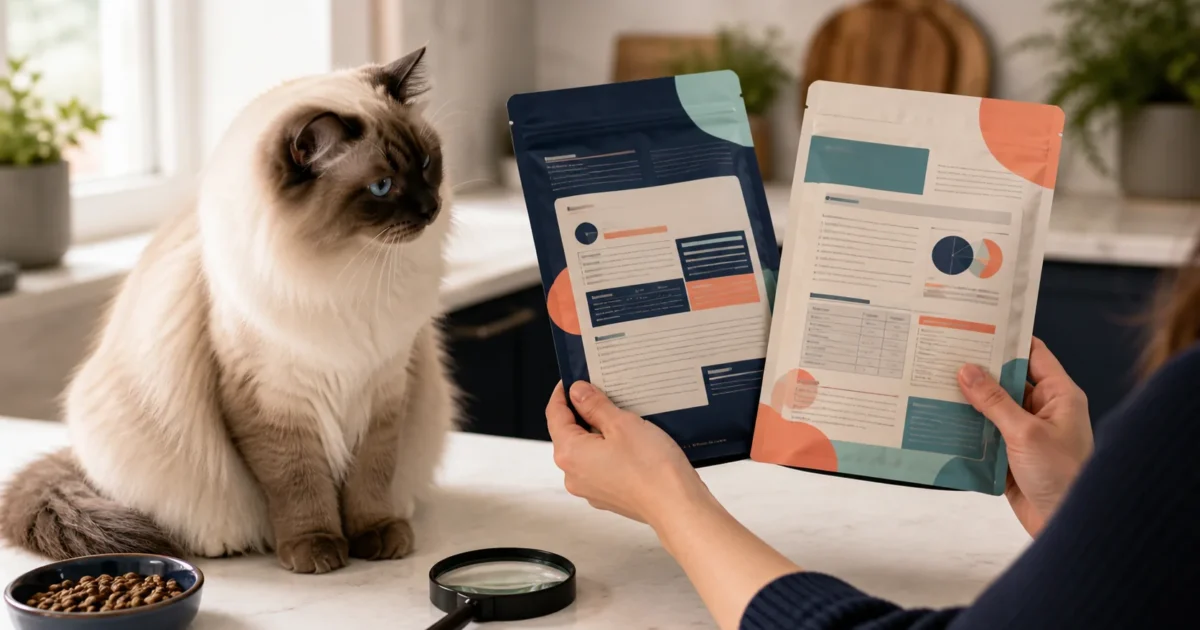
The most important line on a cat food label is usually not the first ingredient. Start with the nutritional adequacy statement, then confirm species and life stage, calorie content, feeding directions, guaranteed analysis, ingredient list, and the company responsible for the product.
This guide explains U.S.-style labels using FDA and AAFCO resources. Requirements and wording differ by market. A label cannot tell you whether a diet is right for a cat with a medical condition; ask your veterinarian.
1. Find the nutritional adequacy statement
Look on the back or side for wording that the food is “complete and balanced” for a named life stage. FDA explains that this claim is supported by meeting an AAFCO nutrient profile or passing a feeding trial using AAFCO procedures.
Match the statement to the cat:
- Growth: formulated for kittens.
- Adult maintenance: formulated for healthy adult cats.
- Gestation/lactation: designed for pregnancy and nursing.
- All life stages: meets the profile that includes growth and reproduction, which may not be the best practical fit for every adult.
“Intermittent or supplemental feeding only” means the product is not intended as the sole everyday diet unless used under professional direction. Treats and toppers commonly fall outside complete-and-balanced nutrition.
Complete vs Complementary Cat Food: Meals, Toppers & Treats
Complete food is intended to provide a full diet for the stated species and life stage when fed as directed. Complementary food is only part of a diet and should not be treated as a complete daily meal on its own. Read the nutritional statement on the exact recipe; the brand name, pouch format or visible pieces of meat do not answer this question.
| What the label says | What it tells you | Your next check |
|---|---|---|
| Complete / complete and balanced | The product is intended to supply the full diet for its stated use. | Confirm cats, the correct life stage, feeding instructions and suitability for your cat. |
| Complementary | The food does not meet nutritional needs when fed alone. | Follow its directions for use alongside other food; do not replace complete meals without an appropriate plan. |
| Intermittent or supplemental feeding only | This is not an ordinary sole daily diet. | Check the intended use; some products require professional direction. |
| Topper, broth, snack or treat | A marketing or use description is not enough to establish completeness. | Find the nutritional statement and feeding directions on that particular product. |
US wording and UK wording are different
For US products, the FDA explains the “complete and balanced” statement and its AAFCO profile or feeding-trial basis. UK Pet Food distinguishes complete from complementary products. These are useful label checks, not interchangeable legal wording for every country. In Canada, Brazil, Australia or elsewhere, use the locally sold package and ask the manufacturer to clarify any uncertain nutritional claim.
Can a topper replace a meal?
Do not assume it can. A product presented as a topper may have a different nutritional role from the main food. Check its actual adequacy statement. Adding an arbitrary amount of complete dry food to a complementary wet food does not establish that the total diet is balanced.
Does wet food need dry food to make it complete?
The format does not decide completeness. Check each recipe’s statement: a complete wet food and a complementary wet food have different roles. Mixing formats is a separate decision from meeting nutritional needs.
How should I compare the cost?
First select suitable foods and feeding amounts. Then use our cat food cost-per-day calculator to price wet, dry and mixed routines. A cheap complementary pouch is not a like-for-like substitute for a complete daily diet. The calculator measures spending, not nutritional adequacy.
For a cat on a therapeutic diet, or if you are unsure how a topper changes the overall ration, ask your veterinarian before altering meals.
Sources and verification for this section
Reviewed September 29, 2026.
2. Confirm it is cat food
A product must identify the intended species. Cats have nutrient requirements that differ from dogs, including taurine and preformed vitamin A. Dog food is not a complete regular diet for cats.
3. Read calories before cup recommendations
Find kilocalories per kilogram and per familiar unit such as a cup, can, pouch, or piece. The calorie statement lets you compare actual portions. Two foods can suggest similar-looking servings while delivering different energy.
Feeding directions are a starting point for an average animal, not a guaranteed prescription. Monitor weight and body condition and adjust with veterinary guidance. See our guide on how much to feed an indoor cat.
4. Understand the guaranteed analysis
AAFCO describes four basic guarantees: minimum crude protein, minimum crude fat, maximum crude fiber, and maximum moisture. “Crude” refers to the analytical method; it does not mean poor quality.
These are minimums and maximums, not a complete nutrient profile. They are also listed as-fed. When comparing wet and dry foods with very different moisture levels, convert both to dry matter or use the manufacturer’s typical nutrient analysis. FDA provides the formula:
Dry-matter nutrient % = as-fed nutrient % ÷ (100 − moisture %) × 100
Example: a food with 10% protein and 78% moisture has 22% dry matter. Its protein on a dry-matter basis is about 45.5% (10 ÷ 22 × 100). This calculation compares concentration; it does not decide whether the food is appropriate for an individual cat.
5. Read the ingredient list without common traps
Ingredients are listed in descending order by weight before processing. Water-rich meat can appear above a concentrated dry ingredient partly because of moisture. The list does not state the exact amount of each ingredient, overall digestibility, quality control, or whether the final recipe meets your cat’s needs.
A recognizable-sounding list is not enough. Vitamins and minerals may have technical names because they are supplying required nutrients. Evaluate the complete diet, not one ingredient isolated from context.
6. Treat front-of-bag claims as claims
Words such as natural, premium, indoor, sensitive, or ancestral can influence attention, but they do not replace the adequacy statement, calories, life stage, and company information. FDA separately reviews certain health-related claims. A diet marketed around a disease or urinary outcome deserves professional discussion.
7. Identify the responsible company
The label should identify the manufacturer or distributor. Useful questions include:
- Who formulates the diet, and what are their qualifications?
- Where is it made?
- What finished-product quality and safety testing is performed?
- Can the company provide typical nutrient analysis and calorie information?
- How does it handle questions and recalls?
These questions align with the WSAVA nutrition toolkit. WSAVA does not “approve” or certify brands; its guide helps consumers ask better questions.
A 30-second label check
- Cat food, correct life stage.
- Complete and balanced—not supplemental only.
- Calories visible per practical unit.
- Portion feasible for this cat.
- Responsible company clearly identified.
- Health claims discussed with a veterinarian when relevant.
Continue with wet vs dry cat food, compare five affordable cat food options, check meal frequency, or use our broader research-led cat food guide.