


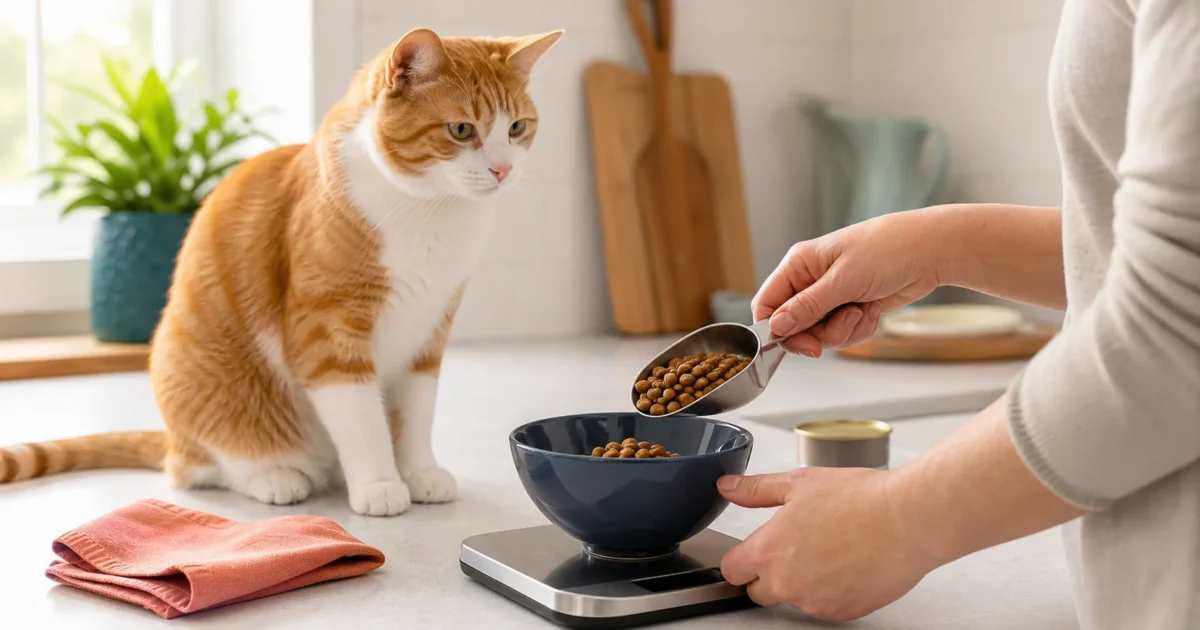
There is no reliable single cup or can amount for every indoor cat. Start with the food’s calorie statement and feeding guide, use the cat’s ideal weight and life stage, measure the full daily ration, and adjust according to weight and body condition with veterinary guidance.
Safety note: Do not crash-diet a cat. Rapid or prolonged food restriction can be dangerous, especially for an overweight cat. Contact a veterinarian promptly when a cat stops eating, eats much less than normal, loses weight unexpectedly, or has a medical condition.
Why two cats of the same weight may need different amounts
Calorie needs vary with age, neuter status, activity, body condition, muscle condition, health, environment, and individual metabolism. Merck Veterinary Manual notes that energy equations are starting points and that animals of the same weight can differ substantially.
Indoor status alone does not define the correct portion. A highly active indoor cat with climbing and play opportunities may need more energy than a sedentary cat of equal weight.
A practical five-step method
1. Identify the correct life-stage food
Confirm that the food is complete and balanced for the cat’s life stage. Kittens, pregnant or nursing cats, healthy adults, and cats with medical needs should not all be fed by the same generic rule.
2. Find calories on the package
Look for kilocalories per cup, can, pouch, or kilogram. If combining foods, treats, toppers, or supplements, include every source in the daily total. Our cat food label guide explains where this information appears.
3. Use the feeding guide as a starting point
Package directions are based on an average. Cornell notes that a less active cat may need less than the label suggestion, while another cat may need more. A veterinarian can estimate a calorie target using ideal weight, body condition, and health information.
4. Measure the full daily amount
A kitchen scale is usually more consistent than estimating a partly filled cup. Weigh or measure the day’s ration once, then divide it into meals and food puzzles. Do not keep topping up the bowl without counting what remains.
5. Monitor and adjust
Track body weight on a consistent scale and learn to use a body-condition score. WSAVA’s nine-point cat chart describes an ideal mid-range cat as well proportioned, with ribs felt under slight fat covering and a visible waist. Long hair and the normal abdominal pouch can make visual judgment difficult, so hands-on assessment and veterinary confirmation help.
Example of the portion calculation
Suppose a veterinary professional helps establish a starting target of 200 kcal per day, and the chosen food contains 400 kcal per cup:
200 kcal needed ÷ 400 kcal per cup = 0.5 cup per day.
If 30 kcal come from wet food or treats, the dry portion must be reduced to keep the same total. The 200-kcal figure here is only an arithmetic example—not a recommendation for your cat.
Wet food, dry food, and mixed feeding
Compare foods by calories, not bowl volume. Dry food is often more energy-dense, while wet food contains much more water. Mixed feeding can work, but divide the calorie allocation rather than serving the full label amount of each. See wet vs dry cat food for the practical trade-offs.
Multi-cat households need individual information
One shared bowl makes it difficult to know who ate what. Feed in separated locations or use an appropriate access-controlled system when needed. Watch for subtle guarding and food stealing. Our research-led guides cover feeders for two cats and microchip feeders; product pages explain documented features and are not substitutes for a nutrition plan.
When not to adjust food alone
- Sudden appetite loss or refusal to eat
- Unexpected weight loss or gain
- Vomiting, diarrhea, constipation, or swallowing difficulty
- Large changes in thirst or urination
- Pregnancy, growth, senior frailty, or diagnosed disease
Once the daily amount is clear, decide how often to offer meals. For choosing a complete everyday food, start with our best cat food research guide.