


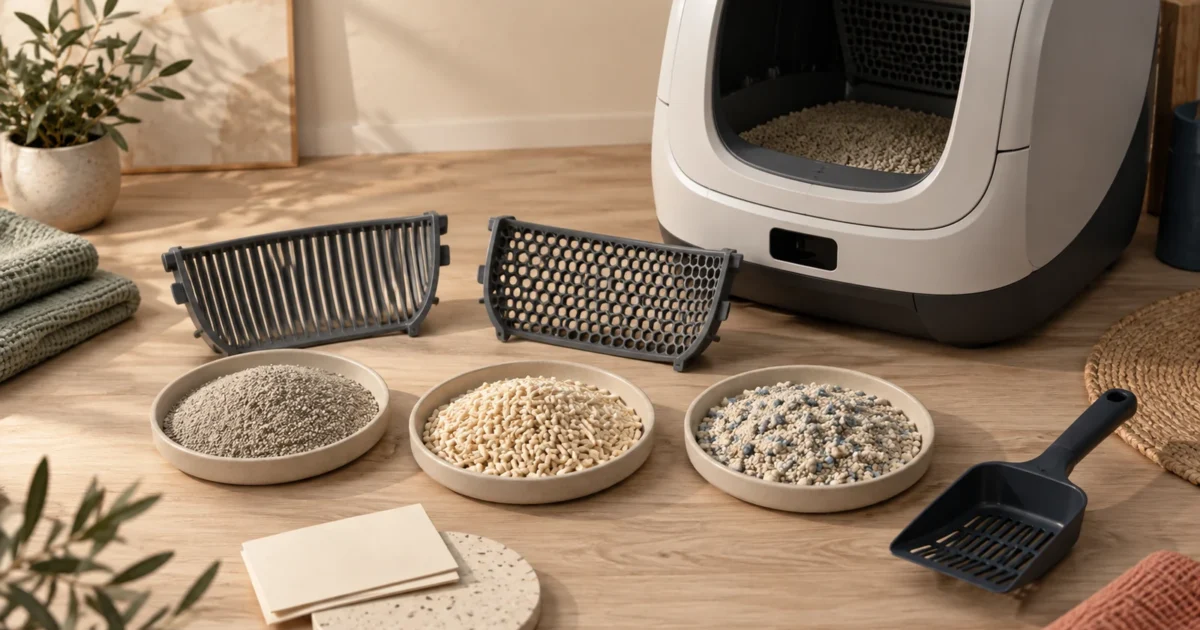
Most rotating automatic litter boxes need litter that clumps firmly and fits through the installed screen. “Clumping” is only the first check: particle size, pellet length, weight, dust, clumping speed and the exact sifter all affect what stays in the bed and what falls into the waste drawer.
Compatibility is based on manufacturer documentation. MeowBay has not independently tested every litter-brand and machine combination.
What is the best litter for an automatic litter box?
The best choice also has to be accepted by the cat. Preserve the familiar litter during transition where the manual allows it, avoid abrupt scent and texture changes, and keep a traditional backup box while verifying clump and screen performance.
Automatic litter box and litter compatibility chart
| Exact model | Documented compatible litter | Avoid / qualify | Screen or setup note | Official source |
|---|---|---|---|---|
| Litter-Robot 5 | High-quality, standard-weight clay-based clumping litter recommended | Do not assume non-clumping or large pellets will sift correctly | Fill only to the raised line; current guidance is about 4.5 kg / 3.7 L on the Canadian setup page | Whisker FAQ |
| Neakasa M1 Plus | Fast-clumping scoopable litter | Avoid highly absorbent non-clumping, loosely clumping, newspaper and wood pellets | Precision filter handles particles up to 3 mm diameter and 10 mm length | Neakasa specifications |
| PetSafe SmartSpin | US specifications list clumping litter; premium clumping recommended for optimal performance | “Any litter” marketing language should not override the clumping-litter specification or exact manual | Use Add Litter Mode and keep litter at or below MAX; do not block the drawer sensor with the liner | PetSafe product page |
| PETKIT PuraMax 2 | Clumping clay/mineral/bentonite or tofu/mixed litter | Particles longer than 12 mm can exceed the documented comparison limit | P99023 honeycomb sifter for fine mineral/clay; P99022 standard sifter for larger tofu/mixed particles | PETKIT manual |
| PetSnowy SNOW+ | Premium standard-weight clay clumping recommended; some silica beads/crystals, tofu and plant litter may work if they pass the screen | Plant litter may make less compact clumps and increase moisture in the drawer; highly absorbent litter is not recommended | Empty and clean the drawer more often when plant-based clumps stay moist | PetSnowy FAQ |
| PETLIBRO Luma | Clumping mineral/clay, tofu and mixed litter | No non-clumping crystal or pine; no ultra-fine grass-seed or cassava litter | Round-hole filter for small-grained clumping litter; long-pellet filter for tofu or mixed litter | PETLIBRO specifications |
This table records the manufacturer’s compatibility statement, not a universal endorsement of a litter brand. Formulas and model revisions can change.
Why do particle size and clump strength matter?
Screen fit
The screen should return clean litter while sending solid clumps to the drawer. Granules or pellets that are too large may be discarded. Material that is too fine can escape, dust sensors or behave differently around the screen.
Clumping speed
A cleaning cycle that starts before the clump firms can smear waste across a liner or break it into small pieces. Use the model’s cycle-delay options and a compatible fast-clumping formula.
Clump moisture
Soft plant-based clumps can hold more moisture in a sealed drawer. PetSnowy specifically notes that tofu or plant litter may require more frequent emptying and cleaning.
Fill level
Overfilling can waste clean litter, strain movement or affect calibration. Underfilling can leave the liner exposed and increase sticking. Level to the marked line.
Clay, tofu, mixed or crystal: which should you choose?
Clumping clay or mineral litter
This is the most broadly documented choice in the six-model group. Choose a standard-weight, low-dust, fast-clumping product whose granules fit the screen. “Lightweight” is not automatically compatible because lower mass can change sifting and tracking.
Tofu or mixed litter
Use it only where the model supports it and install the correct long-pellet or standard sifter. PETLIBRO Luma and PETKIT PuraMax 2 publish a dedicated option. Pellet length still matters, and wet clumps may require a longer delay or more frequent drawer care.
Crystal or silica litter
Compatibility varies. Luma explicitly excludes non-clumping crystal litter. PetSnowy says certain beads or crystals may work if they pass the screen. Do not transfer that permission to another model.
Pine, wood, paper and other non-clumping pellets
These are often unsuitable for rotating screens designed around firm clumps. Luma excludes pine, and Neakasa warns against wood pellets, newspaper and non-clumping material. A separate pellet-specific mechanism is a different product category.
How do I switch litter without causing rejection or jams?
- Verify before opening a new bag. Read the exact model manual, identify the installed screen and compare particle diameter, pellet length and clumping type.
- Change one variable at a time. Keep the old box available and transition texture or scent gradually only when the machine’s manual allows mixing.
- Run a controlled observation. Level to the fill line, watch several cycles, inspect returned clean litter, discarded litter, liner smears and drawer moisture. Stop if the mechanism behaves abnormally.
Why is clean litter going into the waste drawer?
The usual causes are an incompatible particle size, the wrong filter, overfilling, broken clumps or a cycle that begins too soon. Check whether the good litter in the drawer is individual granules, long pellets or fragments of wet clumps; that distinction tells you whether to address the screen or the clumping process.
- Whole large pellets: use the compatible long-pellet screen or change litter.
- Loose fine granules: check overfill, screen seating and the manual’s particle guidance.
- Wet fragments: improve clump strength or increase the permitted delay.
- A sudden change with the same litter: inspect screen seating, liner, humidity and formula changes; record the bag lot if contacting the litter maker.
If the problem persists, use the automatic litter box troubleshooting guide.
Does scented litter improve odor control?
Fragrance can mask odor without correcting a full drawer, urine path, damaged seal or weak clump. Some cats avoid strong scent. Start with compatible unscented litter when possible, empty the drawer before it is packed and clean the parts the manual identifies. Compare the entire odor system in MeowBay’s odor-control guide.
Automatic litter questions
Can I use tofu litter in an automatic litter box?
Only if the exact model supports it. PETLIBRO Luma and PETKIT PuraMax 2 document tofu or mixed litter with the correct filter. Pellet dimensions and clump moisture still matter.
Can I use crystal litter in a rotating litter box?
It depends on the model. Luma excludes non-clumping crystal litter. PetSnowy says some silica beads or crystals may work if they pass its screen. Check the exact manual.
Is lightweight clumping litter safe for every robot?
No universal rule supports that. A lighter formula can sift or track differently. Use the manufacturer’s current guidance and observe several cycles.
How high should I fill an automatic litter box?
Use the unit’s fill line or manual quantity, never a generic scoop count. Level the bed and recalibrate if the manual requires it after adding litter.
Can I mix old and new litter?
Only within the machine’s compatibility limits. Mixing can help a cat recognize the new box, but it can also create an incompatible particle range or weaker clumps.
Treat a litter change as a compatibility change
Record the litter and installed screen together. A bag with a familiar material name can still have different particle dimensions, clumping behavior or additives.
| Decision or record | How to apply it |
|---|---|
| Before change | Exact product, sifter, fill level and normal waste/clean-litter pattern. |
| Documentation | Confirm the replacement is permitted by the exact model instructions; preserve any particle-size limits. |
| After change | Observe approved operation, clean-litter loss, residue and the cat’s use while a familiar backup remains available. |
Do not change the litter, sifter and cycle settings simultaneously unless the manual requires it. Separate changes make a problem easier to interpret and prevent a single good cycle from being mistaken for established compatibility.
Sources and editorial method
MeowBay records what each exact-model manufacturer says about litter, filters and setup, then labels limitations instead of converting them into a generic brand ranking. Sources were checked October 8, 2026. This is specification verification, not hands-on testing.
Open the compatibility database · Troubleshoot a failure · Compare six automatic litter boxes
8 Comments on “Which Litter Works in Automatic Litter Boxes?”