


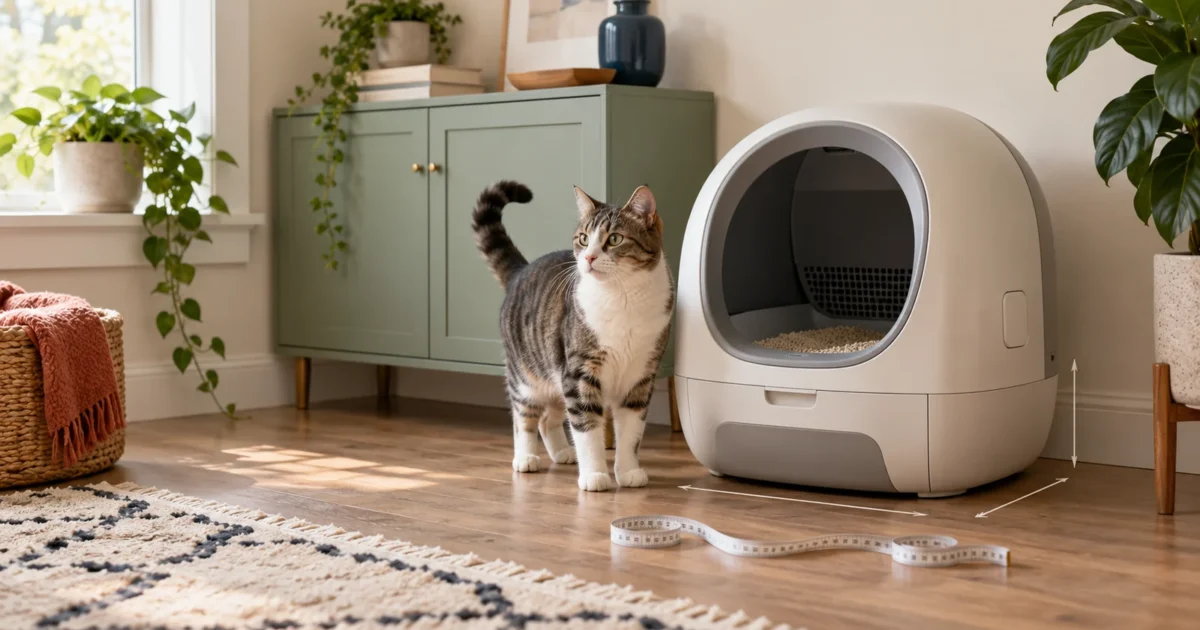
A weight limit alone cannot tell you whether an automatic litter box fits your cat or your room. Compare the exact model’s entry, exterior footprint, cat-weight range, litter limits and floor requirements before you buy.
Specification-based research. MeowBay has not hands-on fit-tested every model with every cat.
What size automatic litter box does my cat need?
The six machines below use different shapes, sensors and definitions. A 30 lb maximum does not prove that a long-bodied cat can turn inside. A low entrance does not prove that a cautious cat will accept an enclosed drum. Treat the chart as a screening tool, then use the return trial to confirm real acceptance.
Automatic litter box compatibility database
| Exact model | Exterior dimensions (H × W × D) | Entry / access | Published cat range | Litter and floor constraints | Evidence |
|---|---|---|---|---|---|
| Whisker Litter-Robot 5 LR5 · enclosed globe |
29.50 × 22.00 × 27.25 in | 15.75 × 15.75 in opening; 15.10 in floor-to-entry | 3–30 lb | Standard-weight clay clumping recommended. Integrated carpet tray supports different floor types; keep unit clear of walls. | Manual verified Official manual |
| Neakasa M1 Plus M1 Plus · open top |
20.20 × 20.67 × 23.26 in | Open top; 13.86 in entry height | 2.2–33 lb | Fast-clumping scoopable litter; screen handles particles up to 3 mm diameter and 10 mm length. Stable setup and current firmware matter. | Specs verified Official product page |
| PetSafe ScoopFree SmartSpin PAL00-17985 · rotating drum |
About 20.9 × 18.9 × 26.4 in on regional documentation | 12 in from floor; confirm the exact regional model | Up to 25 lb; minimum not published on US page reviewed | Official US specs list clumping litter and recommend premium clumping litter. Calibrate empty on a stable surface. | Regional check Official US page |
| PETKIT PuraMax 2 P9902 · enclosed cylinder |
21.73 × 24.41 × 21.18 in | 7.87 in entry height; opening about 7.87 × 10.03 in | 3.3–22 lb; cats older than 6 months | Use the sifter that matches clumping clay/mineral or tofu/mixed litter. Firm, level floor; avoid soft carpet. | Manual verified Official manual |
| PetSnowy SNOW+ SNOW+ · enclosed walkway |
25.60 × 20.00 × 29.50 in | Walkway entry 14.9 in high × 9.05 in long | 3.3–20 lb | Premium clay clumping recommended. Some silica, tofu or plant litter can work with screen and cleaning caveats. Hard, flat surface. | Specs verified Official product page |
| PETLIBRO Luma PLLB001 · enclosed drum |
28.10 × 22.50 × 23.30 in | 17.4 in entrance height; step included | Best for adult cats 2.2–22 lb | Clumping, tofu or mixed litter with the correct filter. No crystal, pine or ultra-fine grass-seed/cassava litter. Hard flat floor; 4 in clearance. | Specs verified Official product page |
All dimensions are manufacturer specifications and can vary by market or revision. Empty cells and qualified ranges are intentional. Checked October 8, 2026.
Download the data
The CSV includes exact model codes, dimensions, weight ranges, litter guidance, floor requirements, source URLs, verification status and the hands-on-testing disclosure.
MeowBay’s original compilation and editorial notes are available under CC BY 4.0 with attribution. Manufacturer material and trademarks remain their owners’ property.
How should I measure my cat and the room?
- Measure the cat without forcing a pose. Record standing height, shoulder width and nose-to-rump length. Weight the cat separately; do not use body weight as a substitute for dimensions.
- Measure the complete use zone. Tape the unit’s width and depth on the floor. Add the open drawer, ramp or step, front approach, lid removal, wall clearance and cable route.
- Test movement during the return window. Keep a familiar traditional box. Confirm repeated comfortable entry, turning, digging, elimination and exit before depending on automatic mode.
Which models screen best for common constraints?
Large or cover-averse cat
Neakasa M1 Plus removes the enclosed ceiling and publishes the widest weight range here, but its 13.86-inch step can rule it out for limited mobility. Compare it with the large-cat guide.
Low entry
PuraMax 2 has a low documented entry, but its opening is narrower than Litter-Robot 5. Low entry and roomy interior are separate measurements.
Carpet placement
Litter-Robot 5 documents an integrated carpet tray. Luma specifically requires a hard, level floor. Do not improvise a platform that rocks or touches the weighing base.
Small room
Compare the installed zone, not product width alone. SNOW+’s walkway makes it the deepest option in this chart. Use the small-apartment guide.
Why weight limits do not prove physical fit
Weight thresholds mainly describe the sensing or automatic-operation range. They do not describe shoulder width, body length, turning style, mobility, fear of enclosed spaces or whether another cat blocks the exit. This is why MeowBay records the opening, step and design beside the weight range rather than creating one misleading “fit score.”
For kittens below a model’s automatic threshold, follow the manufacturer’s manual or semi-automatic guidance. Never transfer a threshold from one model generation to another.
What should I verify immediately before buying?
- The exact model code and the current manual for your country.
- Minimum weight or age for automatic mode, plus the maximum published range.
- Opening dimensions, usable interior and step height.
- Hard-floor, carpet-tray and wall-clearance requirements.
- Compatible litter and included sifter or filter.
- Return period, return freight, warranty and replacement-part support.
- A separate accessible litter box during transition, cleaning and failures.
Then compare price and recurring supplies with the litter-box cost calculator.
Automatic litter box size questions
What is the biggest automatic litter box for a large cat?
No single exterior measurement answers that question. Neakasa M1 Plus offers an open top and a documented 2.2–33 lb range; Litter-Robot 5 documents a 15.75-inch-square opening and 3–30 lb range. Measure the individual cat and preserve a return option.
Can an automatic litter box go on carpet?
Only when the exact model permits it. Litter-Robot 5 has an integrated carpet tray. PETLIBRO Luma requires a hard, level floor. A soft or unstable surface can affect weight readings and safety logic.
Is a lower entrance always better?
A lower step can help mobility, but opening width, headroom, turning space, enclosure and exit visibility also matter. Evaluate the entire route.
Can two cats share one automatic litter box?
They may both use it, but one machine remains one location that can be blocked or unavailable. Keep enough separate litter resources and monitor each cat directly.
Label a compatibility answer as confirmed or incomplete
A database row is a starting point for the exact model in your country. Preserve missing information rather than turning an incomplete entry into a positive fit recommendation.
| Decision or record | How to apply it |
|---|---|
| Confirmed | Manual-supported automatic-mode eligibility, dimensions and floor instructions with the model identity. |
| Requires measurement | Actual cat entry and turning needs, room clearance and maintenance access. |
| Unknown | Unpublished interior dimensions, variant differences or unclear local support. |
If the unknown is essential to the decision, ask for a manufacturer answer before purchase. A cat below the maximum stated weight does not automatically fit the enclosure, use its entrance comfortably or accept the design.
Sources and editorial method
MeowBay transcribed exact-model facts from the linked manufacturer manual or product page and preserved qualifications where a minimum, dimension or regional specification was unavailable. The database was checked October 8, 2026. Product pages can change; confirm the current manual before purchase.
Read the safety checklist · Open the troubleshooting guide · Compare automatic litter boxes
8 Comments on “Automatic Litter Box Size, Weight and Compatibility Chart”