How to Stop One Cat Eating the Other Cat’s Food: A Practical Plan
Written by Maya BennettCat Product Research Editor at MeowBay··
9 min read ·Content updated:
Research-Based
Disclosure: MeowBay may earn a commission from clearly identified affiliate links, at no extra cost to you. Ordinary source and manufacturer links are not paid, and editorial conclusions remain independent.
The most dependable starting point is to feed your cats in separate spaces, supervise the meal, and remove access to the other cat’s leftovers. If one cat needs to graze while you are away, an identity-controlled feeder may help. A timer or two bowls alone cannot decide which cat is allowed to eat.
Before buying anything, identify when the swap happens. A cat that pushes into another cat’s bowl needs a different setup from one that quietly finishes leftovers an hour later. The goal is not simply two full bowls: it is a reliable way for each cat to receive their own food without being displaced.
Choose your next step: separate meals or selective access?
Start with the routine below. If you still need equipment, compare the access method before choosing a brand.
Need meal scheduling for two cats?Compare two-cat feeder setups before assuming that two bowls prevent food stealing.
Before ordering: confirm the exact model, accepted food, identification requirements, total number of feeders needed, and local return terms.
Find the failure point before choosing a solution
Observe an ordinary meal without allowing a confrontation. Note which cat approaches first, whether either cat leaves when the other arrives, and whether the theft happens during or after eating. Do not stage a conflict to collect evidence.
What you observe
First change to try
What to check afterward
One cat immediately moves between bowls
Feed in separate rooms with doors closed
Both cats can finish without interruption
A slower eater loses leftovers
Protect that cat’s feeding space between meals
Food remains accessible to its intended eater
One cat blocks a doorway or feeder
Move stations out of the same approach route
Each cat has a comfortable route to food
Swaps happen only when you are away
Arrange supervision or evaluate controlled access
The setup works during observed meals first
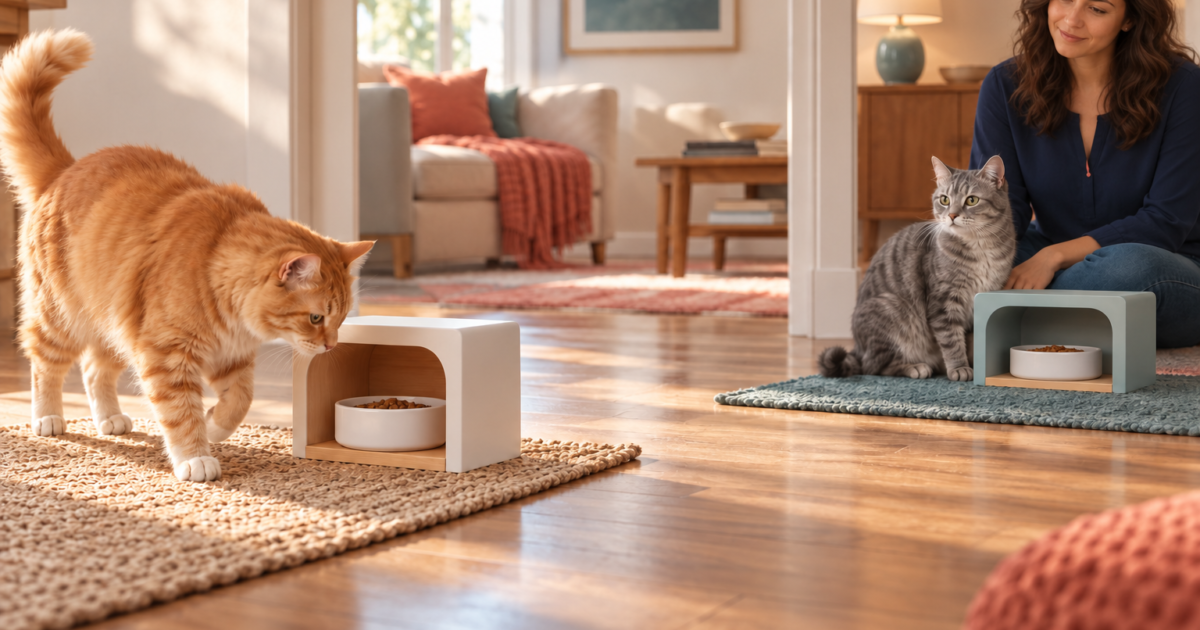
The feline-veterinary organization behind Cat Friendly Homes recommends separate feeding stations with distance and visual separation. Side-by-side bowls do not provide that separation. Read its feeding guidance.
Start with a low-cost meal routine
Prepare both meals before inviting the cats into their feeding areas. Use clearly distinguishable bowls and consistent locations so another household member can repeat the routine. If the cats have prescribed diets or feeding instructions, keep those instructions with the food rather than relying on memory.
Let each cat eat without the other hovering nearby. Reopen the shared space only after both meals are managed. For a cat that normally eats little and often, ask your veterinarian how to preserve an appropriate feeding pattern; do not abruptly remove access for long periods just to make separation convenient.
Record a few ordinary meals using four fields: food offered, food left, interruptions, and changes made. This is a household observation tool, not a nutritional assessment. A photograph of the bowl before and after can help your pet sitter understand the routine, but it cannot establish an exact calorie intake.
When a selective feeder makes sense
Consider identity-controlled access when separation works but cannot be maintained throughout the day. Check three things before purchasing: the food type it accepts, how it recognizes the cat, and whether the other cat can approach the open bowl alongside the intended eater.
A scheduled dispenser answers “when does food appear?” Selective access answers “who can reach it?” Some products combine those functions; others do not. Decide which problem you actually have before comparing app features.
For example, PETLIBRO states that One RFID uses a compatible collar tag, not an implanted microchip. A cat already being microchipped does not make this feeder automatically compatible. Manufacturer compatibility explanation.
Does a dual-bowl feeder solve food stealing?
Not by itself. Dividing dispensed food between two bowls does not reserve one bowl for each cat. Even if the machine distributes equal amounts, one cat can still eat from both sides.
Use a dual-bowl setup only when observed behavior supports shared access and the feeding arrangement suits both cats. If different diets must stay separate, a shared hopper is the wrong starting point. Compare the access arrangements in our two-cat feeder guide, rather than choosing on bowl count alone.
Avoid these expensive mistakes
Buying a larger hopper when the real problem is access control.
Assuming a feeding notification proves which cat ate.
Moving both bowls a few inches apart but leaving one cat in charge of the same narrow route.
Punishing the cat for approaching food instead of changing the setup.
Treating new appetite changes as a gadget problem. If a cat stops eating, appears unwell, or has an unexplained change in appetite or weight, contact your veterinarian promptly.
The practical recommendation
Start with separation and observation. Buy a selective feeder only when it solves a specific gap in that routine, and verify acceptance before relying on it unattended. For a broader setup covering feeding, water, and litter access, use our two-cat household guide.
Research-based guidance; not a hands-on product test or individualized veterinary advice.
Identify which stage permits the food theft
Observe a normal supervised meal and record where separation breaks down. The answer determines whether a new feeder is even relevant.
Decision or record
How to apply it
Before eating
Is one cat blocking the approach or reaching both bowls first?
During eating
Does one cat displace the other or follow through a selective lid?
After eating
Is leftover food left accessible once the intended cat walks away?
Choose the response for that stage: layout and supervised separate meals, a correctly trained access system, or a defined leftovers routine. Do not assume two bowls or a second app automatically protect two different diets.
Match the remedy to the moment food becomes available
Separate the meal into preparation, eating and leftovers. A setup can protect one phase and fail in another. Write when the unwanted access happens so the response changes the actual opportunity rather than merely the bowl’s appearance.
Before either cat starts
Prepare the correct meals before opening access to the feeding areas. If one cat follows the person carrying both bowls, consider how the meals reach their separate locations without inviting a race. Keep the cats’ ordinary resources and comfort available during the routine.
Use the established individual amounts and food identities. A cat arriving first should not determine which food is placed in which bowl. Make the preparation sequence understandable to another caregiver.
While the slower cat is eating
Observe whether the faster cat finishes and approaches the second station. A door or suitable supervised separation can preserve the meal, but the arrangement must be practical and comfortable. Do not encourage a confrontation to teach the cats whose bowl is whose.
If the slower cat repeatedly pauses or leaves, record the context and consider health or access concerns. Do not assume every unfinished meal is theft or that every cautious approach is a personality trait.
After the intended cat leaves
Agree on a leftovers routine compatible with the individual feeding plan and food-handling instructions. A cat that appropriately returns to food later needs a plan preserving that access, not an abrupt long restriction chosen for the owner’s convenience.
When medical or dietary needs affect the routine, ask the veterinarian how to manage access and an accidental swap. The general goal of preventing theft does not supply a catch-up meal or permission to change prescribed timing.
Two worked household scenarios
Both cats finish supervised meals
In an illustrative home, separate appropriate locations allow both cats to eat without interruption. The caregiver checks each station before normal shared access resumes. A selective device may add little if the practical routine already solves the problem consistently.
Keep a short handover for days someone else feeds. The benefit comes from a repeatable arrangement, not the owner’s presence as the only person who understands the cats.
One cat returns to food throughout the day
A second illustrative home needs to preserve access to leftovers while the other cat is active nearby. Here, a suitable protected station or another maintained separation arrangement addresses a real gap. A timer releasing more open food would not reserve it for the intended cat.
Evaluate the complete protected routine under observation. Check the supported identifier, comfortable approach, closure or barrier behavior and the fallback. Do not rely on pairing alone or remove suitable ordinary feeding while training continues.
Keep food identity separate from bowl identity
Color can help people, but attach names, exact recipes and the appropriate plan to the actual supply. Two bags from the same brand may not be interchangeable. Keep original package information available after any permitted transfer.
Use the same care with portions used in puzzles or training. Food supplied outside the main bowls can bypass an otherwise careful separation plan. Include every caregiver who offers edible extras.
A handover sentence that exposes a gap
“Cat A’s planned meal was supplied in the study; Cat B ate separately in the kitchen; Cat A’s individual consumption was not observed” is more useful than “both fed.” It distinguishes delivery from intake and identifies what another person may need to check.
Do not fill that uncertainty by dividing a shared disappearance total. If knowing individual intake is important, choose an appropriate observation method and seek veterinary advice for concerns.
Evaluate equipment by the remaining access route
Proposed purchase
Remaining question
Two-bowl splitter
Can the faster cat still reach the other side after finishing?
Camera
Does it only document the swap, or is another arrangement needed to prevent it?
Selective cover
Can unwanted access still occur while the intended cat is present?
Second open timed feeder
Can either cat visit both stations after release?
There is no need to buy every layer. Choose the lowest-complexity supported arrangement that resolves the relevant gap and can be maintained. Keep return terms and the manual alternative ready if acceptance or access remains unresolved.
Review after a diet, relationship or schedule change
A previously workable arrangement can become inadequate when one cat needs a different food or eats differently. Revisit the individual plan and access route instead of simply changing both feeder settings.
If appetite, weight or behavior changes, obtain appropriate veterinary advice. Equipment may explain an access failure but cannot diagnose why the cat is eating differently. Keep the factual timeline and avoid assigning the entire change to the other cat.
Keep the goal practical
The goal is appropriate food reaching each cat without displacement, with a clear routine when equipment or supervision changes. It is not making the cats share politely or producing equal-looking app records.
When the current setup repeatedly fails that goal, return to an appropriate supervised individual arrangement while resolving the cause. Convenience is useful only when it preserves the actual feeding requirements.
Check a closed room as carefully as a device
Separate-room feeding still needs an appropriate arrangement for each cat and a reliable person managing access. Identify which room belongs to which meal and how the caregiver confirms both cats are comfortable before normal access resumes.
Do not use prolonged isolation or an abrupt feeding restriction as a shortcut. If a cat’s normal pattern requires a different approach, discuss a suitable plan with the veterinarian. The physical door solves only the access task during the period it is managed.
Include the room in the handover rather than saying “feed separately.” A guest, closed door or changed furniture can alter the familiar route. Reviewing the actual space prevents the low-cost solution from becoming an undocumented routine only one person can maintain.
Maya Bennett is MeowBay’s Cat Product Research Editor and is responsible for this research-led article. She evaluates manufacturer documentation, household fit, cleaning, and product limitations. This article does not replace advice from your veterinarian.
4 Comments on “How to Stop One Cat Eating the Other Cat’s Food: A Practical Plan”



4 Comments on “How to Stop One Cat Eating the Other Cat’s Food: A Practical Plan”