Cat Stealing From a Microchip Feeder? 5 Checks Before You Replace It
Written by Maya BennettCat Product Research Editor at MeowBay··
9 min read ·Content updated:
Research-Based
Disclosure: MeowBay may earn a commission from clearly identified affiliate links, at no extra cost to you. Ordinary source and manufacturer links are not paid, and editorial conclusions remain independent.
Yes, it can still happen. A selective feeder recognizes an authorized pet, but the surrounding setup also matters: another cat may approach while the bowl is open, reach from an exposed angle, or take advantage of an incorrectly configured lid. Investigate the access route before assuming the reader itself has failed.
Treat selective feeding as a system with three parts: the right identity is recognized, the food opening behaves correctly, and the intended cat can eat without being crowded out. Passing only the first check does not prove the whole arrangement works.
Work out how the food is being reached
Observe from a comfortable distance during an ordinary meal. If you record video, aim it at the bowl and approach route, not just the cat’s face. Do not encourage the other cat to intrude for a test, especially when a prescribed diet is involved.
Observation
What to investigate
Safe next step
Wrong cat opens the closed feeder alone
Stored identities and pairing
Review the authorized-pet list using the manual
Wrong cat joins while the right cat eats
Shared access around the opening
Separate stations and ask support about approved barriers
Food remains exposed afterward
Training mode, obstruction, lid seating
Check the exact model’s normal operating procedure
Intended cat leaves when the other approaches
Location and social pressure
Return to supervised separation
Problem began after cleaning
Reassembly or a misplaced part
Reassemble according to the manual before reuse
This is a troubleshooting checklist, not a diagnosis of a particular unit. Mechanical damage, unreliable recognition, or abnormal movement should go to the manufacturer rather than being worked around.
Training mode can look like a security failure
During introduction, a feeder may intentionally leave the opening less restricted so the cat can learn to use it. That is different from its normal access-control behavior. Sure Petcare provides a staged training function for its Microchip Pet Feeder; use the instructions for the exact device instead of a button sequence copied from another model. Official support.
Before declaring the feeder ready, confirm that it has exited training mode and that the correct cat uses it comfortably in normal operation. Do not rush this transition simply because food protection is urgently needed. Keep meals physically separated while training continues.
Placement matters, but do not build a trap
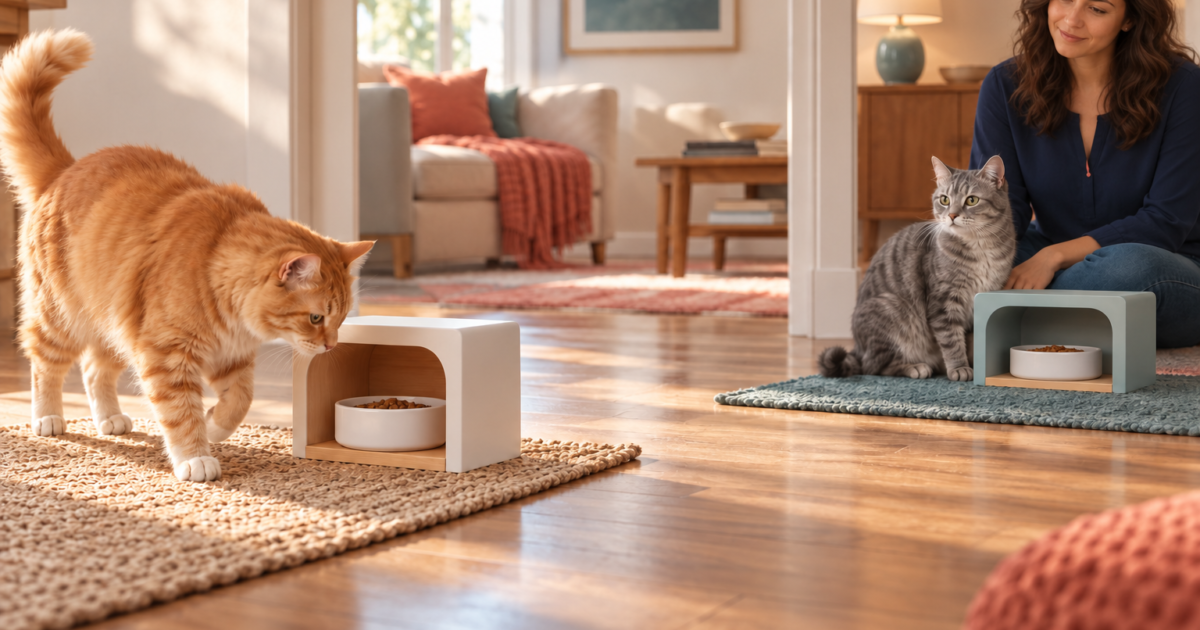
A station should not become a narrow corner where the intended cat cannot comfortably withdraw. Avoid positioning the two feeders as a single shared resource that one cat can guard. Give each station its own practical approach space.
If the manufacturer offers a rear cover or another compatible accessory, check its intended use and exact model fit with support before buying. Do not assume every cover blocks every type of intrusion. Avoid homemade lid weights, taped sensors, sharp barriers, or modifications to closing mechanisms. Those changes may introduce a new problem while hiding the old one.
Microchip and collar-tag compatibility are not the same
Read the identification requirement before troubleshooting. A collar-tag system is not necessarily an implanted-microchip reader. PETLIBRO’s One RFID, for example, requires its supported collar-tag approach and does not recognize implanted microchips according to its official compatibility FAQ.
That distinction matters when replacing a lost tag or moving from a different brand. Do not assume an existing tag will pair because both products use the term RFID.
What evidence should you send support?
Send the model number, a short description of the access route, the operating mode, and a short video if requested. Explain whether the wrong cat opens the feeder alone or reaches in only while the intended cat is present. Those are different problems.
Include when the behavior started and whether cleaning, battery replacement, pairing, or a settings change preceded it. Avoid factory-resetting repeatedly before support has reviewed the symptoms; you may remove the configuration information needed to understand the issue.
When to stop relying on it
If unwanted access continues, return to supervised separation while you investigate. Do not keep a failed setup in service merely because the product description promises food protection. A feeder is useful only if the actual household arrangement works.
A feeder “not working” report is more useful when it explains how the wrong cat reaches the food. Observe without creating a confrontation or trapping either cat.
Decision or record
How to apply it
Recognition
Which tag or microchip was present, whether training mode was active and the indicator state.
Access route
Front, rear, side or following the intended cat through; photo or safe video if available.
Setup
Exact model, approved accessories, placement and the last change before the problem.
Provide the protected meal by another supervised method until access can be trusted again. Keep diagnostic facts separate from assumptions about whether a reader, lid or positioning fault is responsible.
Write the failure as a sequence, not a label
“The microchip feeder was bypassed” can describe several events with different remedies. Record whether the bowl started closed, which identifier was present, how it opened and where the unwanted cat reached the food. Preserve the normal care arrangement while investigating.
Case 1: the wrong cat opens the closed bowl alone
Check the exact model and authorized identities through its current instructions. Confirm whether the device uses implanted microchips, a dedicated collar tag or another supported identifier. Do not assume that a product sold as smart recognizes the cat in the way you expected.
Save the current mode and relevant indicators before changing settings. If stored access does not explain the event, send the sequence to official support. Avoid repeated resets that erase useful configuration without identifying the problem.
Case 2: the correct cat opens it and the other joins
The reader may have performed its intended job while the physical access arrangement failed. Observe whether unwanted access comes from the front, side or rear without staging another encounter. A clearer camera view may document the route but does not block it.
Ask about an officially supported accessory where appropriate and check its exact fit. Keep the intended cat able to approach and withdraw comfortably. Do not create a narrow homemade tunnel or alter the lid to make access more restrictive.
Case 3: the bowl remains exposed afterward
Record whether the device is in its intended normal mode and whether closure encounters an obstruction or abnormal behavior. Follow the exact instructions rather than applying another brand’s button sequence.
If closure or movement is damaged or unreliable, keep the protected meal available through an appropriate supervised alternative. A device remaining open is not fixed by a successful pairing message.
Use a support packet that answers the first question
Evidence
Useful detail
Identity
Full model, regional manual and supported identifier.
Starting state
Closed, training stage, open or another observed mode.
Sequence
Which cat approached first and how the food became reachable.
Recent change
Cleaning, supply replacement, configuration or placement change.
Current care
Protected manual arrangement while the fault is unresolved.
A short safe-distance video can be useful when it shows the relevant route and normal event. Do not lure the wrong cat toward a prescribed diet to prove the issue. Existing observations and photographs may be enough for the first support question.
Describe observations without diagnosing components
“The correct tag was nearby; the lid opened; another cat reached from the side” is more informative than “the chip sensor is broken.” The latter conclusion may send troubleshooting toward a component that worked.
Keep private account and device information within the official support route. A public review can describe the experience without publishing credentials or household access details.
Review reassembly after cleaning
If the issue began after permitted cleaning, compare the assembly with the exact diagram. Identify user-removable pieces, seating and supported accessories. Stop if a part is damaged or does not fit normally.
Do not add weight, tape a sensor or force a cover into place to obtain closure. Contact support for the appropriate part or procedure. An improvised apparent repair can hide the original fault and introduce a different concern.
Verify the original problem after a correction
Check normal supported operation without creating conflict or using a cat as a test obstruction. Record whether the earlier unwanted access recurs during ordinary observation. A single normal opening is not the same as an established protected routine.
If the diet separation is medically important, follow the veterinarian’s required level of protection and response to uncertainty. Do not downgrade that requirement because equipment is inconvenient to manage.
When the route problem is social rather than electronic
A correctly opening feeder may still be difficult for the intended cat to use if another animal waits nearby. Observe approach and withdrawal. A cat leaving its meal when followed is useful context even without visible fighting.
Provide suitable separate locations and professional help where conflict persists. Do not assume that a faster closing lid alone resolves a blocked doorway or a cat that is uncomfortable approaching the station.
Decide whether to repair, reposition or replace
Use the identified failure to choose the next step. A supported configuration correction, appropriate layout change or correct replacement part may solve a specific problem. A different product is relevant only if it addresses the unmet requirement.
Keep the applicable return deadline separate from the support conversation. Preserve packaging and written instructions as required. A device that cannot deliver the needed household protection should not remain the only feeding option while an indefinite trial continues.
Keep the final instruction understandable
Write the verified model, active mode, correct identifier, appropriate food and manual alternative. Tell each caregiver what remains uncertain. If supervised separation is currently required, state that plainly at the food supply and station.
The goal is protected appropriate access in real use. Recognition, closure and comfortable feeding must work together; no single indicator is a substitute for that complete arrangement.
Before replacing it, name what the replacement changes
A replacement should address the identified failure rather than simply offering a newer app. Write the missing requirement and ask the proposed supplier for a model-specific answer.
The identifier is unsuitable
If a required collar tag is not a workable choice for the individual cat, another tag-only model may preserve the same problem. Compare the actual supported recognition method and discuss relevant collar or health concerns appropriately before ordering.
The food format is incompatible
A dry-food dispenser cannot become an appropriate wet-food station through a subscription or a larger bowl. Match the selected device to the required food and its handling instructions. Keep nutritional suitability and access as separate requirements.
The other cat crowds the opening
Ask how the proposed design changes the documented access route and what approved accessories exist. Do not treat a stronger marketing promise as evidence of bypass resistance. Household placement and observed comfortable use still need evaluation.
Price the complete arrangement, including any additional protected station and supported supplies. A low first-device price may not describe the setup required for two diets. Preserve the applicable trial terms and a workable manual routine.
Finally, keep the old support record. It explains which requirement failed and helps you avoid repeating the same unsuitable purchase. A useful replacement decision is based on that specific gap, not a general conclusion that every selective feeder works or fails alike.
Maya Bennett is MeowBay’s Cat Product Research Editor and is responsible for this research-led article. She evaluates manufacturer documentation, household fit, cleaning, and product limitations. This article does not replace advice from your veterinarian.
2 Comments on “Cat Stealing From a Microchip Feeder? 5 Checks Before You Replace It”



2 Comments on “Cat Stealing From a Microchip Feeder? 5 Checks Before You Replace It”