


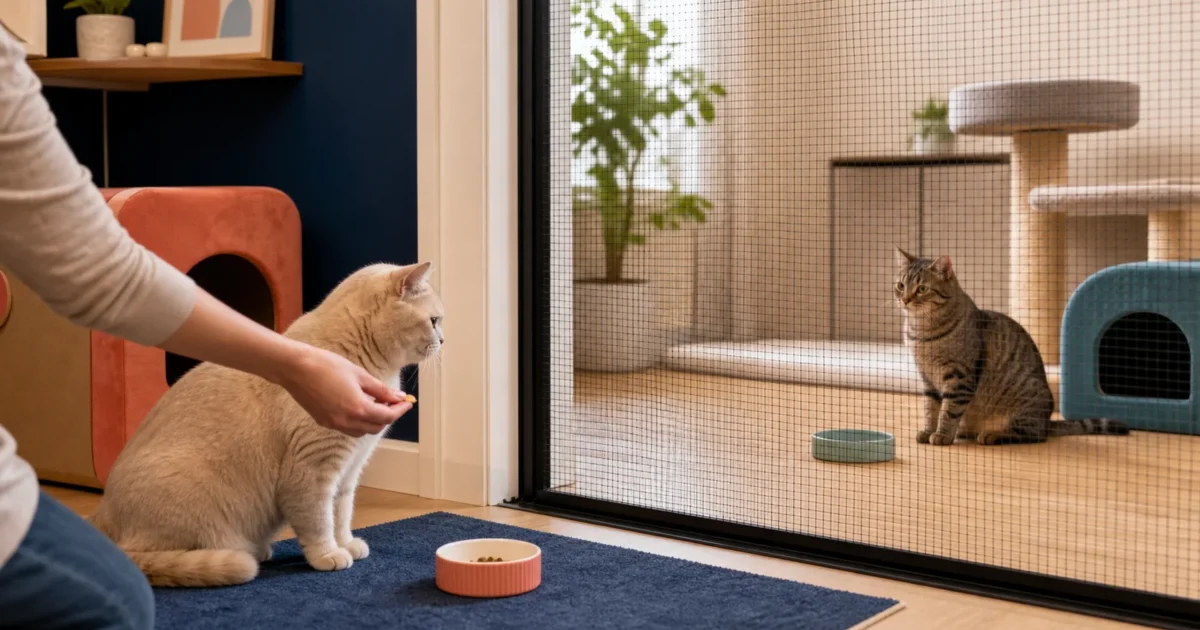
Introduce two cats gradually through separate spaces, scent, site swapping, protected visual contact, and short supervised proximity. Move forward only when both cats remain comfortable. The goal is safe coexistence; not every pair will become friends.
Safety note: Cats with injuries, intense fighting, persistent fear, appetite or litter-box changes, or severe tension need veterinary and qualified behavior support. Do not put your hands between fighting cats or pick up a highly aroused cat.
Before the new cat arrives
Consider the resident cat’s health, history, age, play drive, and response to other cats. FelineVMA notes that intercat tension is common and often begins with a new-cat introduction. Prepare before arrival:
- A private transition room with food, water, litter, scratching, rest, hiding, perch, and toys
- Multiple separated resources throughout the home
- A secure mesh or screen barrier for later visual sessions
- Solid visual barriers available if staring starts
- Individual play and attention for both cats
FelineVMA’s caregiver guide suggests ideally one of each essential resource per cat plus one extra, dispersed rather than lined up together. More important than the formula is that neither cat can block the other’s access.
Step 1: Complete separation
Place the new cat in the transition room and let it settle. The resident cat keeps the rest of the home. Do not hold either cat at the cracked door or force nose-to-nose contact. Each cat should eat, rest, groom, play, and use the litter normally before the next stage.
Step 2: Build safe scent familiarity
Swap bedding or soft items carrying each cat’s cheek and body scent. Place the item at a distance and let the other cat approach or avoid it. Pair calm investigation with something the cat values. Do not rub one cat with an item and push it into the other’s face.
Step 3: Site swapping without direct contact
Secure one cat in a comfortable room while the other explores its space, then reverse. This lets both investigate scent and layout without social pressure. Keep each cat’s refuge available.
Step 4: Protected visual contact
Use a secure tall mesh barrier at a distance where both cats can stay relaxed, eat small rewards, play, or look away. Keep early sessions brief. End before either cat escalates.
Watch for fixed staring, blocking, crouching, stalking, tail twitching, flattened ears, fleeing, hissing, growling, or refusal to eat. A hiss is information that the distance or duration may be too difficult; it is not a reason for punishment.
Step 5: Supervised proximity
When protected sessions are repeatedly calm, allow short shared-room sessions with escape routes, vertical space, and two people if possible. Engage the cats separately rather than luring them into close contact. End on a calm note.
Step 6: Gradually extend shared time
Increase duration slowly while maintaining separate resources and individual attention. If tension appears, separate calmly and return to the previous successful stage. FelineVMA specifically advises going back a step rather than pushing forward through tension.
What relaxed coexistence can look like
Success may mean cats pass each other, share a room at a distance, or use preferred areas at different times without staring, blocking, chasing, or fear. Sleeping together and grooming one another are friendly signs, but they are not required.
Common introduction mistakes
- Opening the carrier in the resident cat’s main room
- Holding cats close so they “get used to each other”
- Feeding cats side by side before they are comfortable
- Providing duplicate bowls and boxes in one crowded location
- Punishing hissing, growling, or hiding
- Leaving cats together unsupervised too early
- Assuming absence of fighting means absence of tension
If a fight occurs
Do not grab the cats. Use a large opaque object such as cardboard to block eye contact from a safe distance, then move them into separate spaces when possible. Check both for injury and contact a veterinarian. A serious fight usually requires a structured reintroduction, not another immediate meeting.
Support both cats with the five pillars of a healthy indoor environment. Related guides explain hiding, redirected biting, and scratching and territorial communication.