


Multi-cat litter guide · Updated August 2026
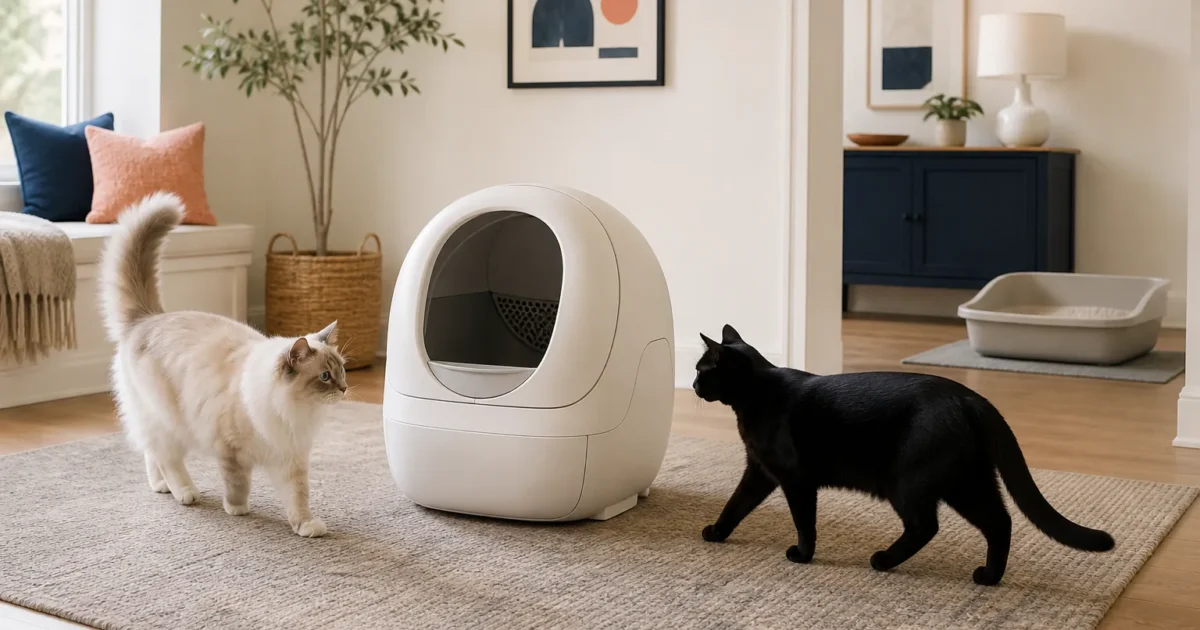
Two cats may both use one automatic litter box, but one robot is still one location, one entrance, and one point of failure. It does not automatically replace the extra litter resources recommended for multi-cat homes. The safer plan is one automatic unit plus clean backup boxes in separate accessible locations, adjusted to the cats’ relationship and behavior.
The practical answer
If the cats are relaxed together, use the same litter, have similar mobility, and never block one another, a large reliable automatic box can become a shared resource. Do not remove every other box. Cornell and AAFP guidance commonly uses one box per cat plus one extra as a starting point, placed in separate areas rather than grouped as one station.
Manufacturer statements such as “up to five cats” describe capacity or intended use; they do not prove that one location meets the behavioral needs of five individual cats.
When sharing is more likely to work
- Both cats already share traditional boxes without guarding or avoidance.
- The entrance and interior comfortably fit the larger cat.
- The unit finishes cycles before the next cat commonly needs it.
- The waste drawer and litter level are checked for two-cat volume.
- Both cats are above the automatic-mode threshold.
- Weight or camera recognition is not being treated as perfectly reliable identification.
- Other clean boxes remain available in different locations.
When one shared robot is a poor plan
- One cat waits, stalks, ambushes, or blocks the entrance.
- The cats need different entry heights or box styles.
- One cat is a kitten below the automatic threshold.
- One cat avoids enclosed boxes or motor noise.
- The cats have similar weights and the app cannot identify them reliably.
- The box is in a dead end with no second exit route.
- Either cat has urinary, digestive, mobility, or house-soiling concerns that require clearer observation.
- The household cannot provide a backup during failure, washing, or travel.
Does one self-cleaning box count as two boxes?
No. Automatic sifting may refresh the litter bed after a visit, but it does not create a second location. If one cat controls the hallway, doorway, or entrance, the other still has no alternative. If the unit stops, overfills, is being washed, or frightens one cat, both lose the same resource.
Read how many litter boxes two cats need for placement and small-apartment compromises.
What multi-cat monitoring can and cannot tell you
Weight sensors and cameras may help associate visits with individual cats. Identification becomes less certain when cats have similar weights, enter together, interrupt a cycle, or approach without eliminating. A visit log does not prove urine or stool volume, and no consumer app diagnoses disease.
Use app patterns to trigger observation: check the drawer and litter bed, watch the cats, and contact a veterinarian for straining, repeated unproductive trips, crying, blood, sudden avoidance, constipation, diarrhea, or major output changes.
Capacity claims versus a real two-cat routine
| Model | Manufacturer multi-cat positioning | Useful two-cat feature | Still verify |
|---|---|---|---|
| Litter-Robot 5 | Up to five cats | Weight and visit tracking; large drawer | Individual recognition and access competition |
| Neakasa M1 Plus | Multi-cat positioning; 11.23 L bin | Open top and broad cat range | High entry and current firmware |
| PetSafe SmartSpin | Single or multi-cat households | Sealed six-liter drawer and usage data | Faster drawer filling and regional manual |
| PETKIT PuraMax 2 | Multi-cat positioning | Usage logs and sealed system | 22 lb maximum and similar-weight recognition |
| PetSnowy SNOW+ | Manufacturer recommends up to four cats | 10 L drawer and Pet IDs | Enclosed entry acceptance and cycle backlog |
“Up to” assumes conditions the manufacturer controls in its estimate. Two large cats, frequent elimination, humid litter, or soft stool can shorten drawer intervals dramatically.
A safer two-cat setup
- Place the automatic unit where both cats can approach and leave without being cornered.
- Keep at least one familiar box during introduction; preserve multiple locations long term when possible.
- Introduce the machine powered off and wait for voluntary use.
- Track each cat’s use manually before trusting app labels.
- Empty the drawer based on two-cat reality, not the one-cat maximum claim.
- Check for waiting, guarding, stalking, edge perching, or elimination near the box.
- Maintain a permanent failure plan for outages, errors, deep cleaning, and travel.
Small-apartment compromise
Three full-size boxes may feel impossible, but placing two boxes together often functions like one location. Use different rooms or visually separated areas when possible. A compact traditional tray under furniture, a low-entry bathroom box, and an automatic unit in another room can provide more meaningful choice than two devices side by side. See automatic boxes for small apartments.
Compare multi-cat-ready designs
Our main guide compares cat range, entry, waste capacity, monitoring, odor, cleaning, and the limitation beside every manufacturer claim.
Frequently asked questions
How often will I empty an automatic box for two cats?
Often about twice as frequently as a one-cat estimate, but waste volume, litter, drawer design, humidity, and stool consistency change the interval. Check daily and empty before the drawer compresses waste or affects sealing.
Can an app tell which cat used the box?
It may infer identity from weight or camera features, but similar weights and interrupted visits reduce certainty. Verify behavior directly.
Should two cats use two automatic boxes?
Two automatic units in separate locations provide more access than one, but cost and maintenance double. A robot plus well-placed traditional boxes is often the more practical starting setup.
Sources
- AAFP/ISFM: litter-box number, size, and placement guidance
- Cornell Feline Health Center: multi-cat access and house-soiling guidance
- Whisker: Litter-Robot 5 multi-cat and tracking claims
- Neakasa: M1 Plus multi-cat specifications
- PetSafe: SmartSpin multi-cat positioning
- PETKIT: PuraMax 2 multi-cat specifications
- PetSnowy: SNOW+ cat capacity and drawer estimates
1 Comment on “Can Two Cats Share an Automatic Litter Box? The Safer Setup”