


Multi-cat home guide · Updated August 9, 2026
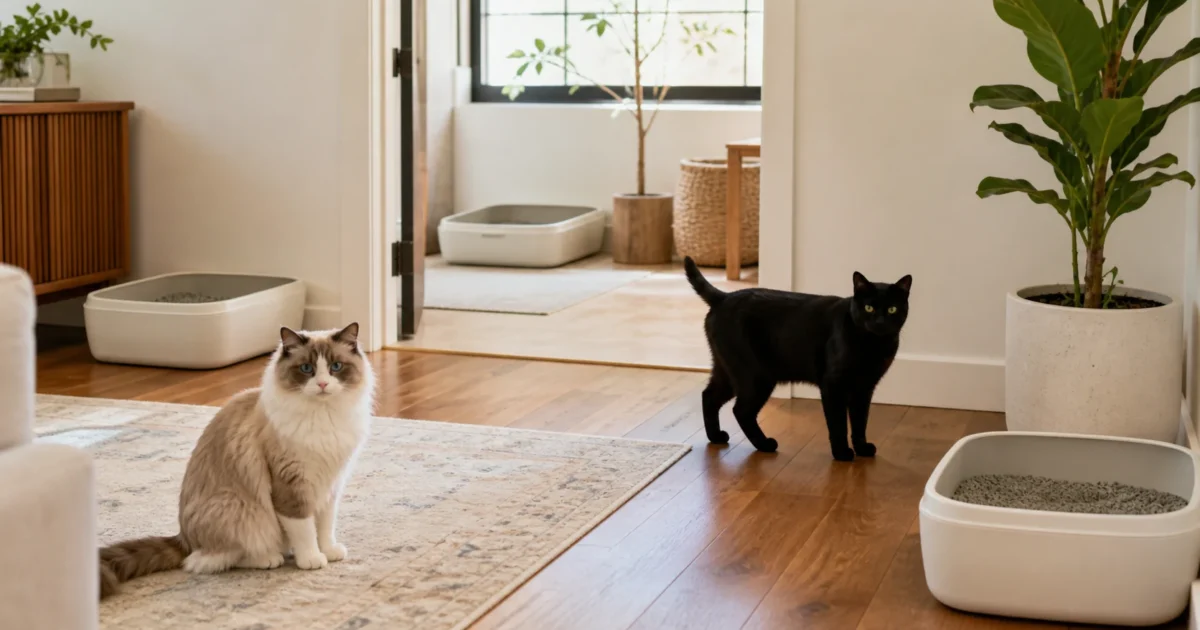
For two cats, three litter boxes in separate accessible locations is the standard starting point: one box per cat, plus one extra. The locations matter as much as the number because three boxes lined up together can function like one guarded resource.
The short answer
Start with three boxes for two cats. Spread them across different quiet areas, provide more than one approach or exit where possible, and make sure one cat cannot block every option. Some bonded cats may comfortably share fewer, but behavior—not floor space alone—should guide any reduction.
Why “cats plus one” is a starting point
Cornell and feline-friendly guidance use one box per cat plus one as a practical general rule. Extra locations reduce competition, give each cat a cleaner option, and provide a fallback when a box is being washed, is temporarily inaccessible, or has become associated with noise or stress.
The rule is not permission to ignore the individual cats. A confident cat may guard a hallway without obvious fighting. Watch for waiting, staring, chasing, ambushing, rushing out, or one cat using only one distant box.
Where should three boxes go?
- Different rooms or zones: avoid placing all three side by side.
- Quiet but accessible: not beside a loud washer, furnace, or slamming door.
- Away from food and water: cats generally prefer separation between eating and elimination areas.
- More than one escape path: avoid tight dead ends where another cat can wait outside.
- Across levels when practical: give a cat an option without crossing another cat’s territory.
Does an automatic litter box count as more than one?
No. Frequent self-cleaning may improve surface cleanliness, but the unit remains one physical location with one entry route. If one cat dislikes the machine or guards it, the automatic cycle does not create another resource.
For two cats, a sensible setup may be one automatic box plus two spacious traditional boxes in separate areas. Keep the manual boxes while both cats learn the automatic unit.
Small-apartment compromise
When three ideal rooms are impossible, prioritize separation and sight lines. A bathroom box, a living-area furniture-style enclosure with safe ventilation, and a bedroom-adjacent tray can work better than three trays in one laundry closet. Never trade accessibility for hiding the box.
When to add another box
Add or relocate a box if either cat eliminates outside the box, waits for access, is chased, avoids a level of the home, or suddenly changes habits. A veterinary problem can also cause house soiling, straining, frequent trips, or pain. New elimination problems deserve a veterinary check, not only a furniture rearrangement.
Considering one automatic box?
Treat it as one resource and compare the entry, cat-size guidance, cleaning, and backup plan.
2 Comments on “How Many Litter Boxes Do Two Cats Need? The Practical Answer”