


Decision guide · Updated August 2026
Choose an automatic litter box when reduced scooping is worth the purchase price, maintenance, compatible-litter limits, and mechanical risk—and when your cat comfortably accepts the entry and movement. Choose a traditional box for simplicity, low cost, direct waste observation, flexible size, and easier access.
The short answer
An automatic box reduces one repeated task: separating clumps from clean litter. It does not eliminate daily checks, drawer emptying, refilling, sensor cleaning, deep washing, troubleshooting, or backup boxes. A large uncovered traditional tray is often better for kittens, seniors, mobility-limited cats, enclosure-sensitive cats, and households that want the clearest view of urine and stool.
For many homes, the best system is hybrid: one well-chosen automatic unit plus traditional boxes in separate locations.
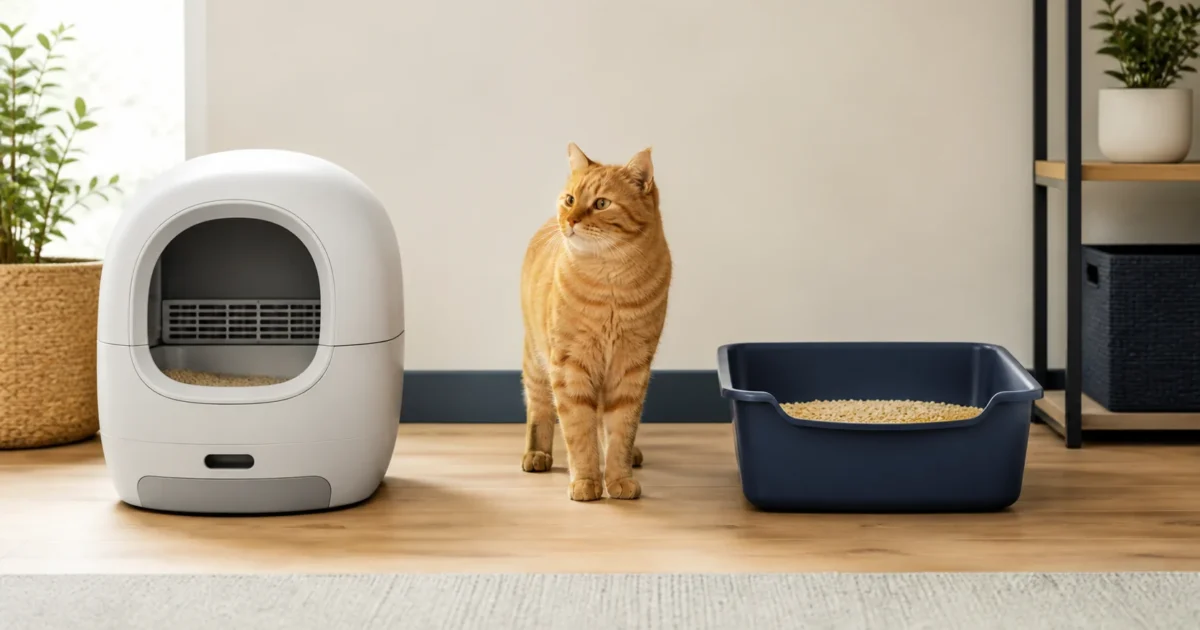
Automatic vs traditional litter box
| Factor | Automatic litter box | Traditional litter box |
|---|---|---|
| Daily work | Less scooping; still inspect and empty | Manual scooping at least daily |
| Upfront cost | Often hundreds of dollars | Usually tens of dollars |
| Cat access | Fixed opening, step, and interior | Many sizes, uncovered designs, and low sides |
| Safety | Sensors, moving parts, firmware, and placement rules | No automated movement or sensor threshold |
| Litter choice | Restricted by screen and mechanism | Broad flexibility |
| Waste observation | Clumps move quickly into a drawer | Urine and stool remain directly visible |
| Odor | Prompt containment can help | Depends on scooping, litter, and ventilation |
| Power / app | May lose features or stop during failure | No power or cloud dependence |
| Cleaning | Globe, liner, screen, sensors, seals, and drawer | Tray, scoop, and surrounding floor |
| Replacement | Parts, warranty, and regional support matter | Simple and inexpensive to replace |
When an automatic litter box is worth it
- You reliably scoop but want to reduce the physical repetition.
- The cat fits the documented weight, entry, and interior dimensions.
- The cat is comfortable with the enclosure style and motor sound.
- You will still inspect waste and the machine daily.
- You can maintain compatible litter and replacement parts.
- The home has a firm, level placement with safe entry and exit.
- You can afford a backup box and a failure plan.
- The trial and return policy lets the cat decide.
Compare current models in Best Automatic Litter Boxes for Indoor Cats.
When a traditional litter box is better
- Kittens below an automatic threshold: a simple tray has no minimum sensing weight.
- Senior or mobility-limited cats: low sides can be easier than a fixed step.
- Very large cats: oversized storage-style trays can offer more usable floor than an enclosed globe.
- Cover-averse or timid cats: an uncovered box offers a 360-degree view and no cycle noise.
- Medical monitoring: direct clump and stool observation is simpler.
- Budget limits: the money may be better spent on more boxes in better locations.
- Non-compatible litter: pellets, non-clumping materials, or special litter may not sift.
- Weak regional support: a robot without parts or authorized service can become expensive waste.
The automatic box can hide work instead of removing it
Traditional scooping is frequent and visible. Automatic ownership shifts labor into less frequent but more complex tasks: removing waste bags, cleaning a globe or rake, wiping urine residue, clearing a screen, cleaning sensors, replacing filters, updating firmware, troubleshooting errors, and drying large parts.
Before buying, watch the official deep-cleaning video and ask where you will wash and dry the parts. A small apartment without a suitable sink or shower may make a compact-looking robot harder to maintain than a simple tray.
Odor: faster containment versus easier washing
An automatic unit can move waste into a sealed drawer soon after use. A traditional box can be scooped immediately and fully scrubbed with fewer hidden surfaces. Neither wins under every condition. Litter, clumping speed, drawer seals, ventilation, soft stool, urine spray, and cleaning frequency determine the result. See automatic litter boxes for odor control.
Multi-cat homes need locations, not only capacity
A manufacturer may describe one robot as suitable for several cats, but it remains one location. One cat can guard the entrance, and every cat loses access during a failure or deep clean. AAFP and Cornell guidance commonly starts with one box per cat plus one extra in separate locations. Read whether two cats can share one automatic litter box.
Total ownership cost
- purchase price and tax;
- return shipping if the cat refuses it;
- liners, bags, filters, deodorizers, sprays, and litter restrictions;
- steps, ramps, mats, carpet trays, or furniture clearance;
- replacement liners, screens, sensors, globes, or drawers;
- subscription app features;
- extended warranty and post-warranty repair;
- the traditional backup boxes you should keep.
A low-stress transition plan
- Place the automatic box near the familiar box without blocking either entrance.
- Use familiar compatible litter if the manual permits it.
- Leave the machine powered off at first.
- Let the cat investigate voluntarily; never force entry.
- Wait for repeated comfortable use before enabling cycles.
- Start with a longer delay and supervise initial cycles.
- Keep a traditional resource available long term, especially in multi-cat homes.
A simple decision rule
Buy the automatic box only if the cat fit, safety documentation, return policy, placement, cleaning route, litter compatibility, and support all work before app novelty enters the decision. If any one of those fundamentals fails, choose a better traditional setup.
If you choose automatic: options to research
Start with your cat’s size, preferred access and the space available in your home.
Paid links: MeowBay may earn a commission from qualifying purchases. As an Amazon Associate, we earn from qualifying purchases.
Additional premium option
PETLIBRO Luma

Automatic cleaning · Enclosed design · App
Limitation: Adult cats 2.2–22 lb; needs a hard, level floor and generous clearance.
Open-top alternative
Neakasa M1 Plus

Open top · Large-cat option · App
Limitation: Allow room around the unit and follow current firmware guidance.
Lower-profile enclosure
PetSafe ScoopFree SmartSpin

Enclosed design · App · Clumping litter
Limitation: Verify interior fit, entry height and the exact regional model.
Ready to compare automatic designs?
See five researched options with safety, dimensions, odor control, market limits, and the main trade-off beside each recommendation.
Frequently asked questions
Do automatic litter boxes save money?
They may reduce wasted clean litter in some systems, but the purchase, consumables, repairs, and replacement parts usually make them more expensive than a simple tray. Their main value is convenience, not guaranteed savings.
Do automatic litter boxes need daily cleaning?
They need daily inspection and prompt spot cleaning. Drawer emptying and deep washing follow the model, number of cats, litter, and real waste load. See the cleaning schedule.
Will every cat use an automatic litter box?
No. Enclosure preference, entry height, noise, movement, litter, location, cleanliness, and previous experiences affect acceptance. Use a real trial policy and keep the familiar box.
Sources
- AAFP/ISFM: litter-box size, number, placement, and litter guidance
- Cornell Feline Health Center: access, cleanliness, preferences, and house soiling
- Whisker: Litter-Robot 5 specifications and care information
- PETKIT: PuraMax 2 specifications and maintenance information
- Neakasa: M1 Plus specifications and cleaning information