


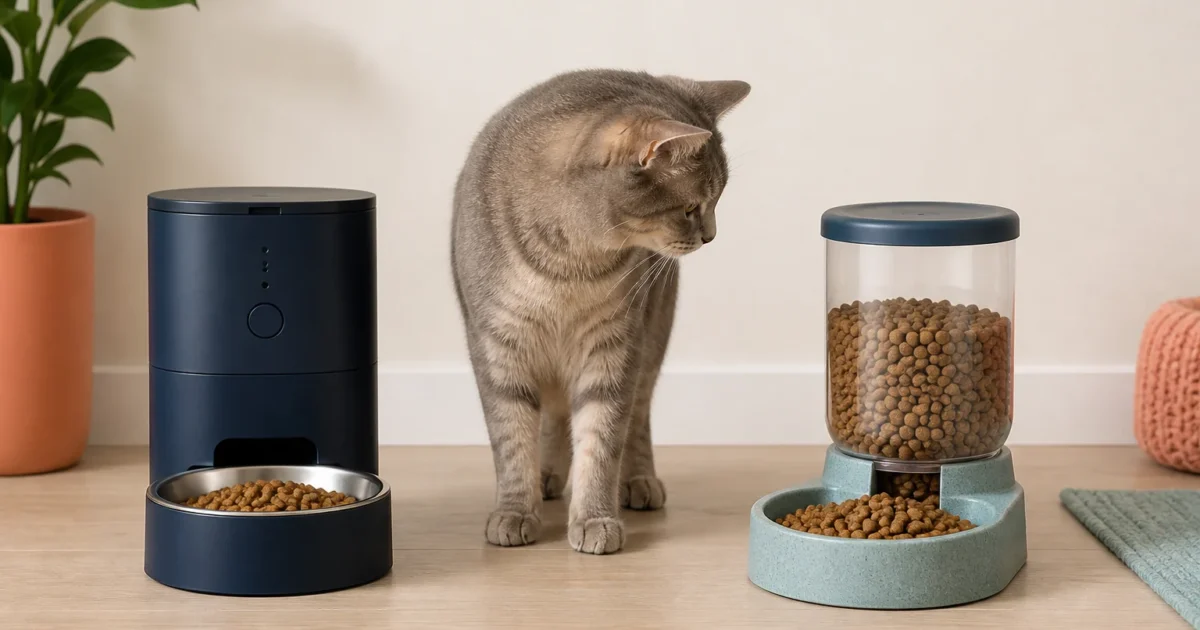
Simple comparison · Indoor cats
A programmable automatic feeder is usually the better tool for measured meals. A gravity feeder is simpler and cheaper, but it keeps replacing food as the bowl empties and offers little control over timing or individual intake.
Automatic feeder vs gravity feeder at a glance
| Question | Programmable automatic feeder | Gravity feeder |
|---|---|---|
| Controls meal time? | Yes, on scheduled models | No |
| Controls daily amount? | Better, after calibrating real dispense weight | Poor; bowl refills as food is eaten |
| Needs power? | Usually batteries, mains power, or both | No |
| Can jam? | Yes, in the motor or food path | Yes, food can bridge in the chute |
| Useful for wet food? | Only a tray or cooled model designed for it | No |
| Prevents food stealing? | Not unless it uses identity-based access | No |
| Best use | Measured, timed dry meals | Short-term dry-food availability for a cat that self-regulates |
Why timing and portions matter
A gravity feeder solves an empty-bowl problem by maintaining access. It does not solve overeating, food competition, or the need to monitor appetite. If you cannot tell how much food left the reservoir and which cat ate it, a change in appetite can be easy to miss.
A programmable feeder releases a defined amount at defined times. That supports several small meals and makes the daily allowance easier to audit, but only after you weigh what the machine actually dispenses.
Reliability: simple does not mean failure-proof
A gravity feeder has no motor, battery, app, or network. That is a real advantage. Yet irregular kibble can still bridge above the chute, food can become stale, and a cat can knock or contaminate the bowl. A programmable feeder has more failure points but may offer alerts, backup power, and local schedules.
Whichever design you choose, daily observation is more important than the feature list.
What about two cats?
Neither basic design controls identity. A confident cat can monopolize a gravity bowl or wait beside an automatic feeder. Separate feeding areas, visual barriers, or microchip-controlled access are better when you need to know who ate.
When a gravity feeder can make sense
- Your cat reliably self-regulates dry food and has no weight or medical concern.
- You need a no-power backup for a limited period.
- You can still inspect and clean it daily.
- You measure the total food loaded and remaining rather than continually topping it up.
When to choose a programmable feeder
- You want several small meals from one measured daily amount.
- Early-morning demand is disrupting the household routine.
- You need repeatable meal times despite work schedules.
- You want logs or alerts and understand their limits.
Neither is a treatment plan
If the goal is weight loss, diabetes management, or monitoring a sick cat’s appetite, ask a veterinarian to set the food amount and schedule. A machine can deliver the plan; it cannot diagnose changes or confirm that the intended cat ate.
If automatic feeding fits your goal
Compare current designs by food type, schedule, backup plan, cleaning, and multi-cat control.