


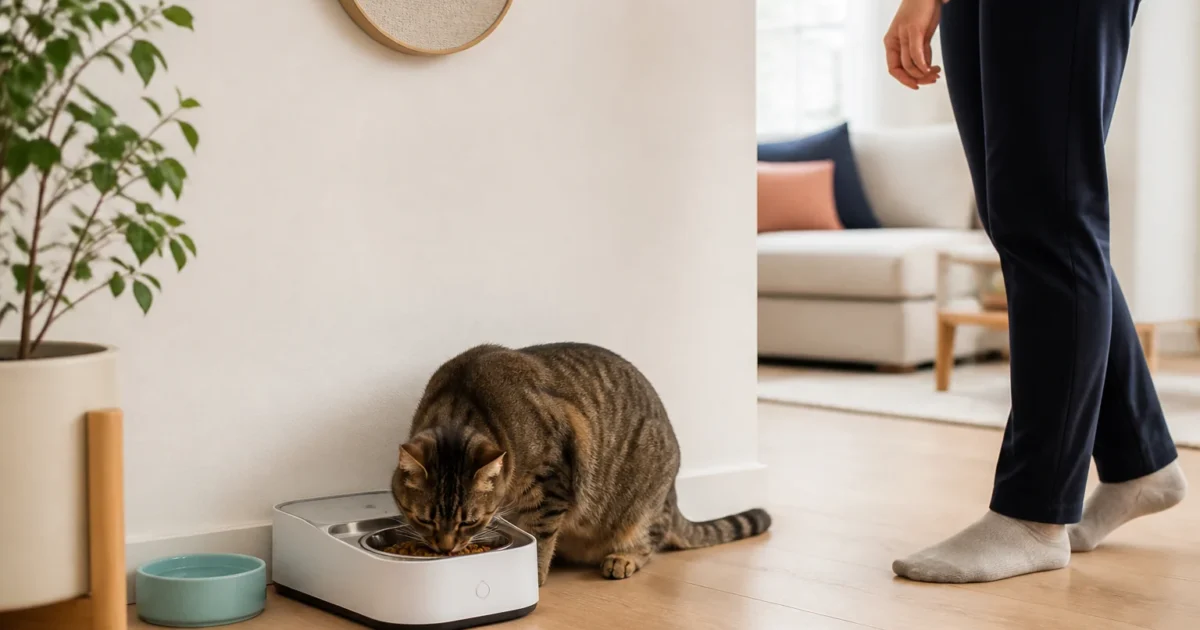
Indoor Cat Living · Evidence-led guide
Yes—automatic feeders can be good for cats when they improve meal timing, portion consistency, or access to several small meals. They are not automatically healthier, and they do not replace daily observation, clean bowls, fresh water, or a person checking the cat.
Where an automatic feeder genuinely helps
1. Several small meals without an all-day open bowl
The American Association of Feline Practitioners notes that cats naturally eat multiple small meals and recommends feeding approaches that support normal hunting and foraging behavior. A programmable feeder can divide the same measured daily allowance into smaller events; it should not add extra calories.
2. More consistent timing
A feeder can reduce large variations caused by work or sleep schedules. That consistency is convenient, but the meal plan still needs to match the cat’s life stage, body condition, diet, and health.
3. Portion awareness
Good feeders let you control the amount released. Measure several dispenses on a kitchen scale because motor “portions” can vary with kibble size and shape. Compare the daily total with the food label and your veterinarian’s target.
4. Enrichment and routine
A small meal scheduled away from the main bowl—or paired with a puzzle feeder—can add movement and predictability to an indoor cat’s day.
When an automatic feeder is a poor fit
- One cat steals another cat’s food. A shared hopper does not identify the eater. Separate locations or a microchip feeder may be better.
- Your cat needs close medical monitoring. Diabetes, kidney disease, appetite loss, food allergies, and prescription diets need a veterinarian-guided plan.
- The cat is frightened by the motor. Sudden movement and sound can make a cautious cat avoid the bowl. Introduce the device gradually while the old bowl remains available.
- You need to store wet food for long periods. A covered tray or cooling claim does not remove food-safety limits.
- You plan to leave the cat unattended. A feeder cannot notice vomiting, illness, spilled water, litter problems, or a cat that has stopped eating.
A useful feeder can still fail
Kibble can bridge in a hopper, an outlet can lose power, batteries can die, and a scheduled app command can fail. Test the feeder while you are home, inspect the bowl at least daily, and keep a simple backup plan. A camera is helpful evidence, but it does not prove that the intended cat consumed the full meal.
How to introduce one safely
- Place the new feeder near the familiar feeding spot, unplugged and open.
- Serve food from its bowl for a few days without activating the motor.
- Trigger a small dispense while you are present and pair the sound with something positive.
- Confirm the real portion weight and program only part of the daily allowance at first.
- Watch each cat separately, especially in a multi-cat home.
- Clean and dry food-contact parts according to the manual.
The bottom line
An automatic feeder is good when it solves a defined problem and you can verify that it works. It is not a babysitter, a weight-loss treatment, or proof that a cat ate. For product-level differences, see our researched comparison of automatic cat feeders.
Ready to compare designs?
Match food type, household setup, backup power, and cleaning—not just app features.