


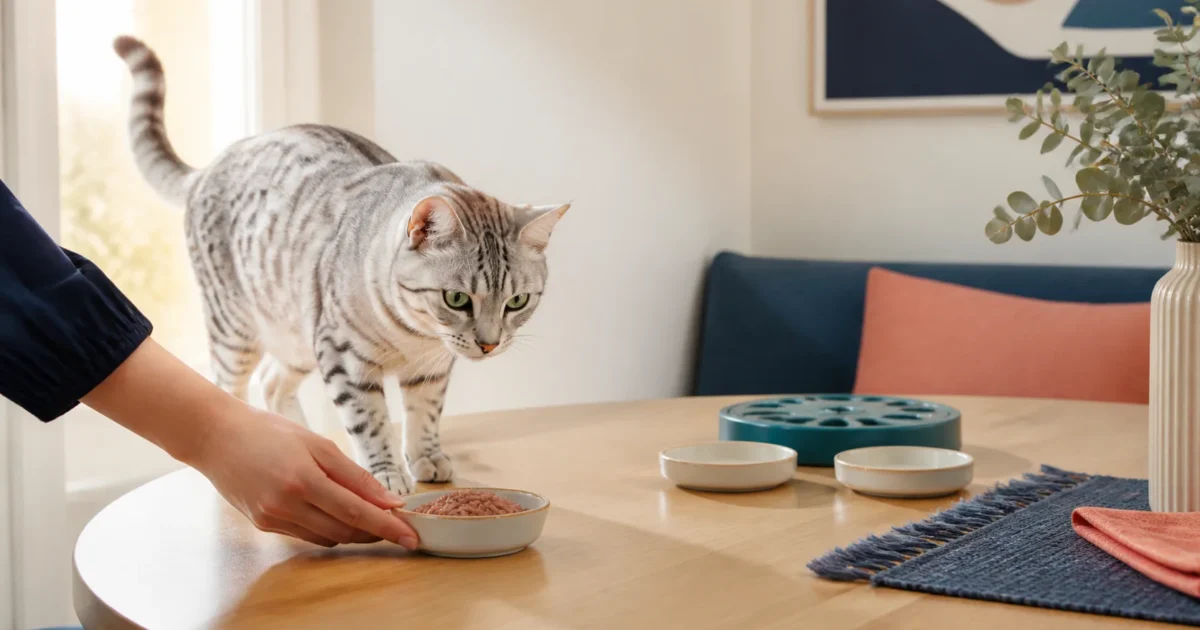
Most healthy adult cats can be fed at least twice daily, while many cats benefit from several smaller measured meals. The best schedule depends on age, health, food type, appetite, household routine, and whether the cat maintains an appropriate body condition. Frequency and total daily calories are separate decisions.
Health note: Kittens and cats with diabetes, gastrointestinal disease, medication schedules, pregnancy, weight concerns, or other medical needs may require a veterinarian-designed schedule. A cat that stops eating or eats markedly less needs prompt attention.
Why cats often prefer smaller meals
Cats naturally tend toward multiple small eating events. Cornell notes that meal frequency depends on age, health, and preference, and that a healthy adult schedule must also fit the household. The aim is to create predictable opportunities without leaving unlimited calories available.
A practical schedule by life stage
Kittens
Kittens have growth needs and smaller stomach capacity, so they commonly need more frequent feeding than adults. Use a complete and balanced kitten food and ask a veterinarian for an age-appropriate amount and schedule.
Healthy adult cats
Twice-daily feeding is workable for many adults. If the cat wakes the household, eats too quickly, vomits after large meals, or seems more comfortable with small portions, divide the same daily calories into three or more opportunities. Do not increase the total simply because frequency increases.
Senior cats
Age alone does not dictate one schedule. Dental discomfort, reduced smell, medication, disease, or muscle loss can change needs. A senior cat’s appetite or weight change should be assessed rather than dismissed as normal aging.
Meal feeding vs free feeding
Meal feeding makes portion control and appetite monitoring easier. It also lets you turn some meals into predictable play-and-eat routines.
Free feeding dry food may work for some cats that self-regulate, but Cornell and Merck note that constant access can contribute to overeating in others. It also makes appetite changes harder to detect and creates uncertainty in multi-cat homes.
A middle option is to measure the complete daily ration in the morning and distribute it through bowls, puzzles, or a timed feeder. When it is gone, the day’s allocation is gone.
How wet and dry food affect the schedule
Dry food is easy to divide into timed portions and food puzzles. Wet food provides more moisture but needs appropriate handling; follow the package storage instructions, refrigerate unused opened portions promptly, and do not leave perishable food sitting out for extended periods.
Wet-food automatic feeders can be useful only when their temperature-control method and safe-use window match the food and household. Read documented instructions rather than assuming every ice pack or refrigerated feeder works for an entire day. See our wet-food automatic feeder guide.
Should you feed before or after play?
A short hunting-style play session followed by a measured meal can create a useful routine. Let the cat stalk and catch the toy, then offer food. The pattern is optional, not a medical requirement, and the intensity should fit the individual cat.
Signs the schedule may need adjustment
- The cat regularly leaves large amounts or seems unable to finish the portion.
- One cat steals food or blocks another cat’s access.
- Weight or body condition is changing.
- Large meals are followed by regurgitation or vomiting.
- Hunger-related behavior persists despite an appropriate calorie plan.
- Medication or a health diagnosis changes meal timing needs.
Do not solve every appetite issue by adding food or buying a feeder. First calculate how much the cat should receive daily, confirm the food label, then divide that amount. Our automatic feeder research guide can help when measured scheduling is the remaining problem.