


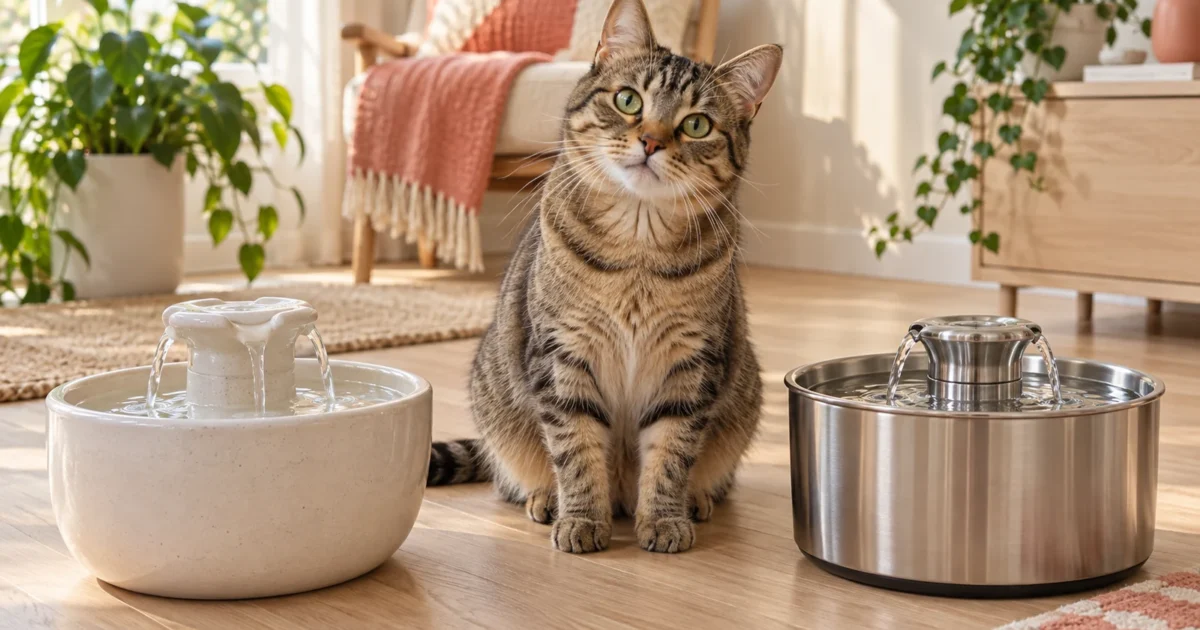
Choose ceramic or stainless steel by the parts you can actually clean, lift and replace. A ceramic fountain can suit a household that wants a substantial bowl and is comfortable handling it at the sink. Stainless steel can suit an owner who prefers a metal drinking surface. Neither label tells you whether the tank is plastic, whether the pump is accessible, or whether your cat will use it.
This is a researched buying guide, not a material safety ranking or a hands-on comparison. For a model shortlist, start with Best Cat Water Fountains.
Ceramic vs stainless steel: compare the complete fountain
| Decision | Ceramic: check this | Stainless steel: check this |
|---|---|---|
| Water-contact parts | Identify the bowl, glaze, plastic housings and seals separately. | Check whether only the tray is steel or whether the reservoir is also steel. |
| Handling | Check the empty weight, full weight and grip before choosing a large unit. | Compare exact weight and stability; metal does not automatically mean light or tip-proof. |
| Condition | Inspect for chips, cracks and damaged glaze; ask the maker about replacement parts. | Inspect for rough edges, surface damage and inaccessible seams. |
| Washing | Follow the exact component instructions; ceramic is not blanket permission to use a dishwasher. | A dishwasher-safe tray does not make the base, pump or electronics dishwasher safe. |
| Recurring costs | Price compatible cartridges and replacement pump parts. | Use the same calculation; material alone does not predict running cost. |
When ceramic is worth considering
Consider a ceramic model if you like its drinking shape, can handle the filled bowl comfortably, and can buy the particular bowl or tower separately if it is damaged. Before paying, check how it will fit in your sink and where you can put the parts down without knocking them together. These are practical handling checks, not evidence that every ceramic fountain is fragile or heavy.
When stainless steel makes more sense
Choose a stainless model when its exact design fits your cleaning routine and available space. Ask which surfaces stay wet. For example, PETLIBRO lists both ABS and stainless steel for Dockstream 2; a steel tray does not turn the complete unit into an all-metal fountain. See the manufacturer’s material specifications and our stainless steel comparison.
Cleaning access matters more than a material slogan
Look for clear instructions for removing the pump cover, reaching the impeller or rotor, cleaning the water channel and reinstalling seals. Ask whether each of those components can be replaced. If a listing only shows a clean bowl, it has not answered how to clean the moving parts.
PetSafe’s Seaside cleaning instructions provide a useful model-specific example: approved bowl, tower and housing parts can go on the top rack, while the pump, adapter and filters must stay out of the dishwasher. Do not transfer those instructions to another fountain.
Does one material make cats drink more?
There is no universal winner for every cat. Cornell’s hydration guidance notes that responses to fountains vary. Keep another clean water source available and observe whether your cat drinks comfortably. A new fountain is not a treatment for a sudden change in thirst or signs of dehydration.
People also ask about fountain materials
These questions appeared in Google’s US People Also Ask results for “ceramic vs stainless steel cat water fountain” on September 22, 2026. Answers below are MeowBay’s source-based summaries.
What is the best material for a cat water fountain?
There is no universal best material. Choose an intact, food-contact surface in a fountain you can fully disassemble, clean and maintain. Verify every water-contact part, because a steel tray or ceramic bowl may still use plastic housings, tubing and a pump.
Is ceramic or stainless steel better for cats?
Neither is automatically better for every cat. Ceramic adds weight but can chip or break; stainless steel resists breakage but may transmit vibration. The complete design, cleaning access, stability and your cat’s willingness to drink matter more than the label alone.
Which water fountain is the healthiest for cats?
A product cannot be declared the healthiest from material alone. Prioritize fresh accessible water, intact surfaces and a cleaning routine you can follow. Keep another clean water source available, and ask a veterinarian about sudden thirst changes or dehydration concerns.
Do cats prefer to drink from stainless steel or ceramic?
Preferences vary by cat. Cornell notes that responses to fountains differ, so observe actual use instead of assuming a material preference. Bowl shape, water movement, noise, location and cleanliness can all affect acceptance.
3 Comments on “Ceramic vs Stainless Steel Cat Fountains: Cleaning, Materials & Cost”