


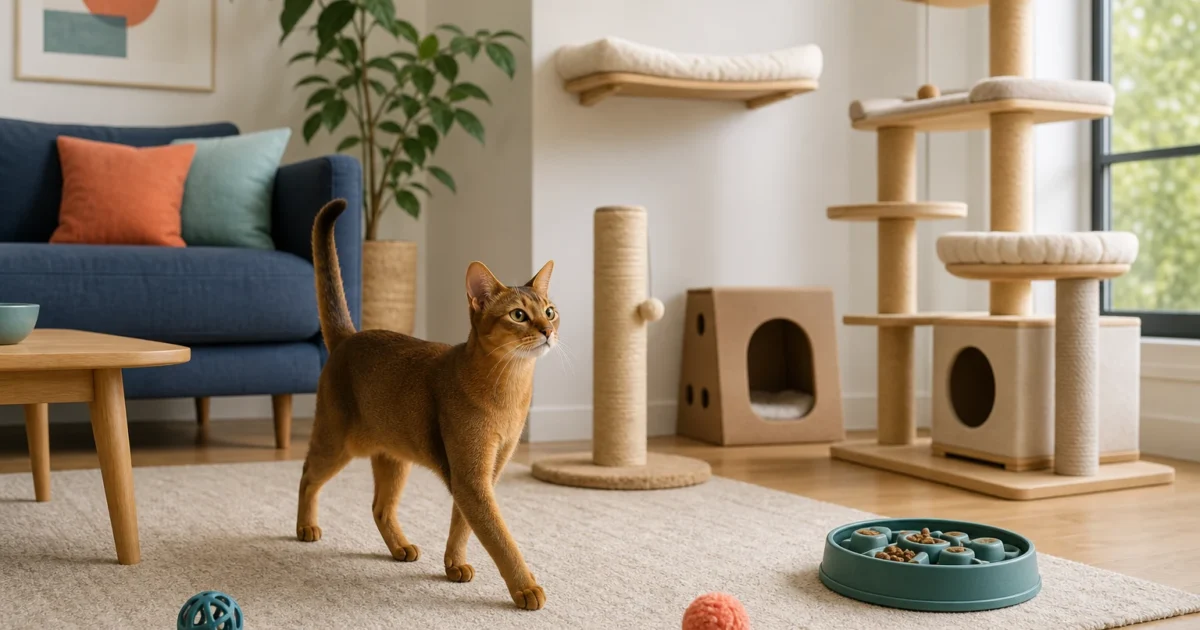
Quick answer: A happy indoor cat needs more than food and a clean litter box. Build daily life around five foundations: a safe retreat, separated resources, opportunities to hunt and play, predictable positive interaction, and a home that respects feline senses. Give your cat choices, introduce changes gradually, and watch how the individual cat responds.
Editorial note: This guide is based on published feline-environment guidance and practical household research. It is not individualized veterinary advice. Sudden changes in appetite, activity, grooming, litter-box use, sleep, or social behavior deserve a veterinary conversation.
What actually makes an indoor cat happy?
Indoor life can protect cats from traffic, predators, infectious disease, and other outdoor hazards, but safety alone does not create wellbeing. Cats also need control, variety, movement, and ways to express normal behaviors. The Feline Veterinary Medical Association organizes these needs into five environmental pillars. They are a useful framework because they focus on the cat’s experience rather than on how many products a household owns.
1. Create a safe place your cat can choose
A safe place is somewhere a cat can rest without being followed, handled, or surprised. It may be a covered bed, an open carrier, a quiet shelf, a cardboard box, or a perch with more than one escape route. In multi-cat homes, one refuge is rarely enough.
- Place at least one retreat in a quiet, low-traffic area.
- Offer both elevated and ground-level options when possible.
- Teach children and visitors that a cat in the refuge should be left alone.
- Keep the refuge away from noisy appliances and ambush points.
A refuge works because the cat controls access. Pulling a hiding cat out usually removes the very benefit the space was meant to provide.
2. Separate important resources
Food, water, litter boxes, scratching surfaces, sleeping places, and play areas should not all be crowded into one corner. Separation gives cats options and reduces the chance that another pet, a person, or a noisy machine blocks access.
Put water away from litter, provide more than one water location, and position litter boxes where a cat can see the approach and leave easily. In multi-cat households, duplicate key resources in different areas rather than lining identical bowls and boxes side by side.
3. Make hunting and play part of every day
Indoor cats still have a strong sequence of watching, stalking, chasing, pouncing, and capturing. Safe interactive play lets them perform that sequence. Use wand toys under supervision, move the toy like prey, and let the cat catch it regularly. Store string-like toys after the session.
Food puzzles and scattered portions can add searching and problem-solving to meals. Start with an easy puzzle so the cat succeeds, then increase difficulty gradually. For more options, see our indoor cat enrichment ideas and our guide to indoor-cat exercise.
4. Keep human interaction positive and predictable
Many cats enjoy interaction, but the preferred type and duration vary. Some seek lap time; others prefer sitting nearby, cheek rubs, training, grooming, or play. Invite contact and let the cat disengage. A predictable routine can reduce uncertainty without making the household rigid.
Short sessions distributed through the day are often easier to sustain than one long session. A simple rhythm might include a morning meal puzzle, a brief play session later in the day, and a calm evening check-in. Our indoor cat routine guide shows how to build this around real schedules.
5. Respect smell, sound, touch, and visual comfort
A cat experiences the home differently from a person. Strong fragrances, sudden noise, dirty litter, unfamiliar animals outside a window, and forced handling can all matter. Avoid heavily scented litter and cleaning products around feline resources. Keep familiar bedding available during changes, and do not remove every familiar scent during a major clean.
Window access can be enriching, but it can also be stressful if outdoor cats repeatedly appear close to the glass. Observe the response: relaxed watching is different from tense staring, tail lashing, redirected aggression, or hiding.
A practical indoor-cat happiness audit
- Safety: Can the cat retreat without being disturbed?
- Access: Can the cat reach food, water, litter, rest, and scratching areas without conflict?
- Vertical space: Is there at least one stable elevated observation point?
- Play: Are there short, catchable play opportunities most days?
- Foraging: Can some food be found or worked for safely?
- Choice: Can the cat choose distance, surface, room, and interaction?
- Predictability: Are meals and important interactions reasonably consistent?
- Observation: Do you notice changes in normal behavior early?
Common mistakes to avoid
- Buying many toys but never rotating or using them interactively.
- Using hands or feet as prey, which can encourage painful play.
- Placing every resource in one convenient human location.
- Forcing a shy cat to socialize before it is ready.
- Assuming a quiet or sleeping cat is automatically content.
- Changing food, litter, furniture, and routine all at once.
How to tell whether the plan is working
Look for trends in the individual cat: relaxed resting, normal grooming, confident movement through the home, regular use of resources, interest in play or exploration, and the ability to settle after activity. Do not compare every cat with a highly social or athletic ideal. Age, health, history, and temperament affect what comfortable behavior looks like.
Possible signs of under-stimulation include persistent attention-seeking, destructive scratching, restless pacing, or reduced interest in the environment, but those signs are not specific. Pain, illness, fear, and inter-cat conflict can look similar. Sudden or persistent changes should not be treated as a boredom problem alone.
Start with three changes, not thirty
- Add one safe retreat or stable elevated perch.
- Schedule one short interactive play session at a time your cat is naturally alert.
- Move or duplicate one key resource to create more choice.
Observe for a week, keep what helps, and adjust what the cat avoids. A good indoor environment is not a finished shopping list; it is a system that responds to the cat living in it.
Related MeowBay guides
- Indoor Cat Enrichment Ideas
- Signs Your Indoor Cat Is Bored
- How Much Exercise Does an Indoor Cat Need?
- How to Build an Indoor Cat Routine
- How to Take Care of a Cat