


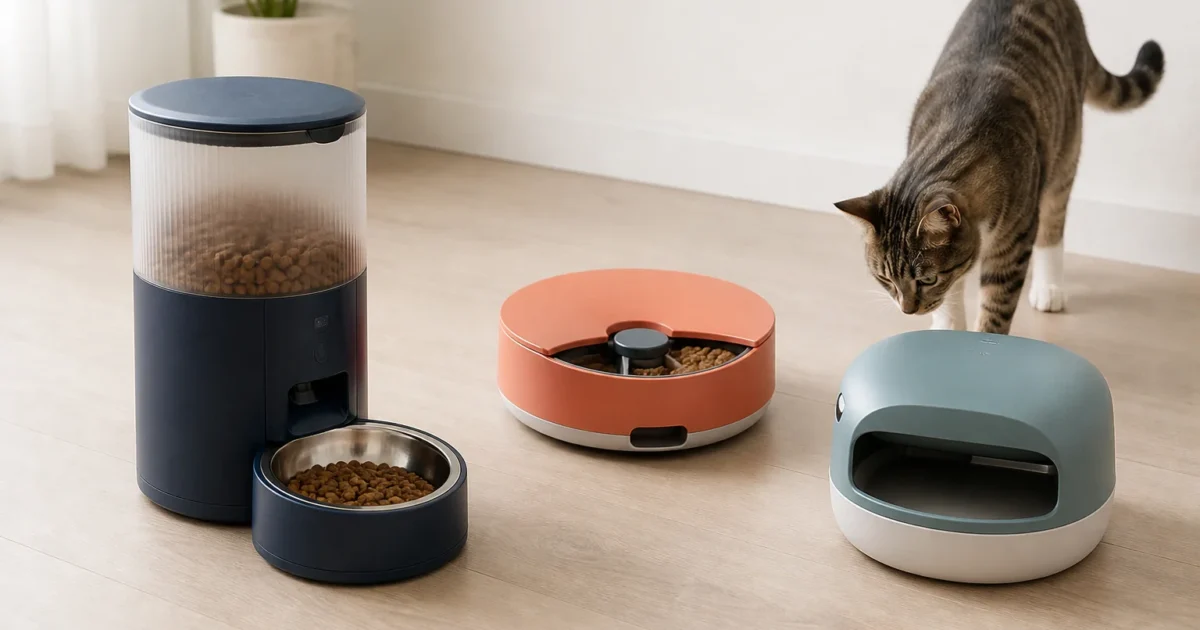
Automatic feeder buying guide · Updated August 2026
Choose an automatic cat feeder by matching it to your cat’s food, required meal size, household access problem, and the way it behaves when power or Wi-Fi fails. App features come later. A simpler feeder that dispenses the right food reliably is usually a better fit than a “smart” model built around features you will not use.
Quick answer: For dry food, start with portion range, kibble compatibility, local scheduling, backup power, and cleaning. For wet food, start with temperature control and how long the food will sit out. For cats that steal one another’s meals, choose controlled access or separate feeding stations before considering cameras or voice recording.
How this guide was prepared: This is a research-led decision guide based on manufacturer documentation and the independent sources listed below. MeowBay has not hands-on tested every feeder mentioned across this cluster. Specifications, apps, warranties, and regional availability can change, so verify the current manual and product page before buying.
Choose the feeder type first
| Your main need | Start with this feeder type | Most important check |
|---|---|---|
| Dry food on a regular schedule | Motorized hopper feeder | Minimum serving size and offline schedule |
| A few timed wet-food meals | Rotating tray with ice packs or cooling | Safe holding method and cleaning |
| One cat steals another cat’s food | Microchip or collar-tag access feeder | Recognition reliability and entry design |
| Two cats need the same dry food | Two separate feeders or a dual-bowl system | Fair access and bowl placement |
| You want visual check-ins | Feeder with camera | Camera angle, privacy, storage, and subscription |
| You only need gravity-fed backup | Gravity feeder | No portion or timing control |
If you already know your household type, go directly to our guides for wet-food feeders, feeders for two cats, microchip feeders, or camera feeders.
1. Match the feeder to the food
Food type is the first filter because it changes the mechanism you need. Most hopper feeders are designed for dry kibble. Rotating trays may accept dry or wet portions, while refrigerated or actively cooled models are built specifically for wet food.
Do not assume that the words “wet-food feeder” guarantee safe temperature control. Check what actually keeps the food cool, the manufacturer’s stated operating conditions, and the time between loading and serving. Our guide to how long wet food can stay in an automatic feeder explains the variables without pretending that one time limit fits every feeder and room.
2. Translate “portions” into grams
A brand’s “portion” is not a standard unit. The weight dispensed can change with kibble diameter, thickness, shape, and density. Before buying, find the documented minimum and maximum serving range and compare it with the meals you intend to serve.
After setup, dispense the same programmed serving several times into a kitchen scale. That simple check tells you more than the portion number in an app. Recheck if you change kibble. An automatic feeder should support the feeding amount you have chosen with your veterinary professional; the device should not decide that amount for you.
3. Check the real schedule—not just “up to 10 meals”
Count the meals you actually need, then inspect the schedule rules. Can meal times differ by day? Can one meal be skipped without deleting the schedule? Is a manual feed recorded? Can another household member change the plan? More slots are useful only when the minimum serving size still works for your cat.
If you only need continuous access rather than timed portions, compare an automatic feeder with a gravity feeder before paying for connectivity.
4. Separate power failure from Wi-Fi failure
These are two different failure modes. Battery backup may keep the motor running during an outage. A locally stored schedule may keep meals dispensing when the internet is down. App notifications, remote controls, video, and cloud logs may still stop.
- Confirm whether batteries are backup-only or can power normal use.
- Check whether the schedule is stored on the feeder or depends on the cloud.
- Look for a visible low-battery or low-food warning.
- After setup, perform a controlled power and Wi-Fi test while you are home.
For travel, an automatic feeder is a scheduling tool—not a substitute for a person who can check the cat, water, litter, and device.
5. Verify kibble size and jam visibility
Compare your kibble with the manufacturer’s supported size and shape. Large, flat, very small, or irregular pieces may behave differently in the rotor. Features such as a transparent hopper, low-food alert, bowl sensor, or anti-jam routine can reduce uncertainty, but none removes the need for daily visual checks.
6. Inspect every part you will need to clean
Look beyond a removable bowl. Food oils and crumbs can collect in the hopper, rotor, chute, tray edges, seals, and cooling compartment. Prefer food-contact parts you can remove and reach without special tools. Confirm which parts are dishwasher-safe; “washable” does not always mean dishwasher-safe.
Also price the maintenance items: replacement bowls, desiccant packs, filters, ice packs, rotor parts, and lids. A modest feeder with parts available locally may be a better long-term purchase than a premium model you cannot maintain.
7. Solve multi-cat access before adding smart features
A large bowl does not guarantee fair access. One cat may eat faster, guard the feeder, or take food intended for another cat. If both cats eat the same food and coexist comfortably, separate bowls or feeders placed apart may be enough. If diets differ—or one cat steals food—controlled access is the more relevant feature.
Use our guide to decide whether two cats can share one automatic feeder. For prescription diets, allergies, or persistent bowl swapping, compare microchip-access feeders for multi-cat homes and discuss the feeding plan with your veterinarian.
8. Evaluate the bowl, footprint, and sound
Measure the feeder with its lid fully open, not only its base. Check the cable route, wall clearance, stability, and whether you can place it away from litter boxes and busy walkways. A cautious cat may need gradual introduction if the motor sound is sudden.
Look at the actual bowl dimensions and observe how your cat eats. The bowl should be stable, easy to clean, and comfortable for your cat’s normal posture. If food consistently scatters or your cat avoids the bowl, the design may be a poor fit even if the electronics work perfectly.
9. Treat the camera as a separate purchase decision
A camera can help confirm that a cat approached the bowl, but it cannot prove how much one cat ate unless the view and household setup make that clear. Compare field of view, low-light performance, motion alerts, clip storage, subscriptions, account sharing, microphone controls, and deletion settings.
If video is important, use our automatic feeder with camera comparison. If it is not, spend the budget on portion fit, reliability, cleaning, and replacement support first.
10. Confirm the exact regional model
Model numbers, plugs, voltage, app functions, subscriptions, warranties, and included accessories can differ between the US, UK, Australia, and other markets. Check the exact seller, model number, warranty provider, return window, and spare-part availability for your country. Do not assume that a review of a US model describes every regional version.
11. Compare total cost—not the launch price
Add the feeder, batteries, filters or desiccants, replacement cooling packs, cloud subscription, and expected spare parts. Then ask whether the premium feature solves a real problem in your home. Our affordable automatic feeder guide focuses on useful trade-offs rather than the cheapest sticker price.
The 60-second buying checklist
- Food: dry, wet, or both?
- Meal: what gram range must it dispense?
- Access: one cat, shared diet, or diet separation?
- Failure plan: battery backup and offline scheduling?
- Cleaning: can you remove and reach every food-contact part?
- Maintenance: are spares and consumables available locally?
- Placement: enough space, stable surface, acceptable sound?
- Smart features: do the camera or app solve a real problem?
- Proof: current manual, regional model, warranty, and returns checked?
Features that are easy to overvalue
- Voice recording: pleasant for some owners, but it does not improve portion accuracy.
- Very large hopper: capacity is useful only if food remains fresh and the machine stays clean.
- Maximum meal count: irrelevant if the smallest serving is too large.
- Camera resolution alone: framing, notifications, privacy, and storage matter too.
- “Smart” branding: verify what still works without internet or a subscription.
Frequently asked questions
Are automatic feeders good for cats?
They can support consistent meal timing and measured portions when the device fits the food and household. They do not replace fresh water, daily observation, cleaning, enrichment, or veterinary care. See the fuller guide: Are automatic feeders good for cats?
How accurate are automatic cat feeders?
Accuracy varies with the mechanism and kibble. Treat the programmed portion as a starting point, weigh several repeated dispenses with your own food, and recheck after changing kibble.
Will a smart feeder work without Wi-Fi?
Some models continue a locally saved schedule while remote controls and notifications stop; others depend more heavily on connectivity. Confirm this in the current manual and test it at home.
Can two cats use the same automatic feeder?
Possibly, if they eat the same food and both have calm, reliable access. Separate feeders or controlled access are safer choices when one cat guards food, eats much faster, or needs a different diet.
What size automatic feeder should I buy?
Choose by meal-size range, days between refills, food freshness, and available space—not maximum hopper capacity alone. A larger hopper is not automatically more reliable.
Ready to compare current options?
See six research-led options mapped to dry food, wet food, multi-cat access, cameras, and different budgets—with the limitation shown beside each strength.