


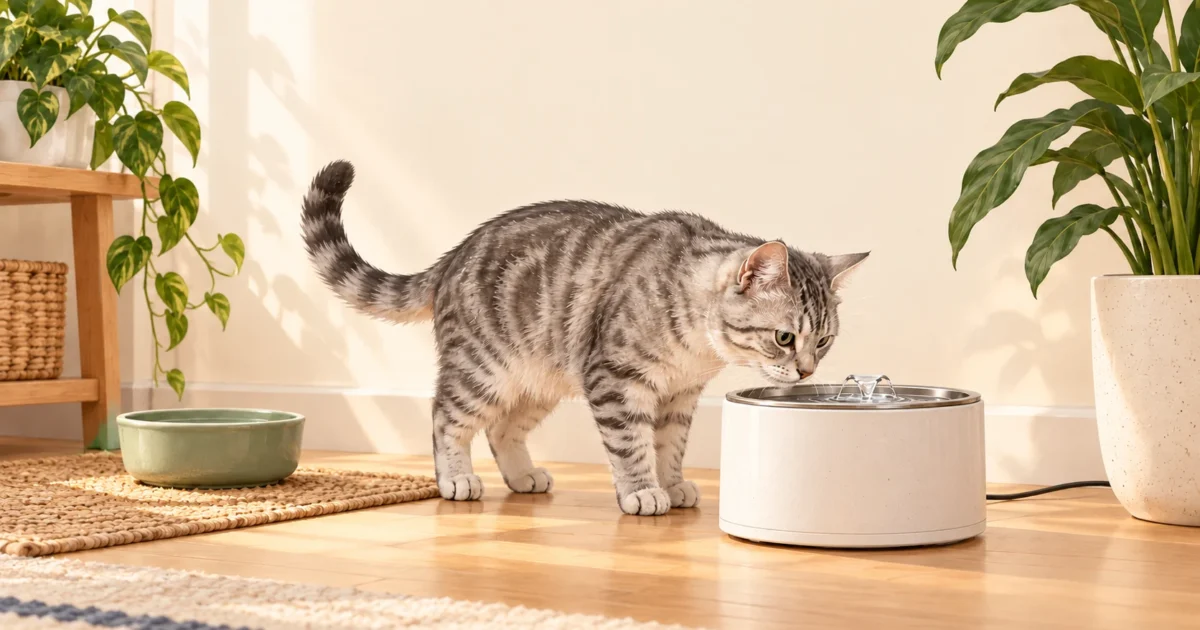
To help a cat use a water fountain, keep their familiar water bowl available, introduce the fountain gradually, and change only one thing at a time. Begin with a quiet location and the lowest manufacturer-approved flow. If your cat is frightened, pause rather than bringing them closer. A fountain is an optional drinking choice, not a test your cat must pass.
The useful question is not simply, “Why won’t my cat drink from this?” It is, “Which part of the experience are they avoiding?” A cat that walks past the fountain needs a different next step from one that drinks when the pump is off but leaves when it starts.
First, separate fountain refusal from a change in health
This introduction plan is for a cat behaving normally who still has a reliable source of water. A sudden change in drinking, appetite, energy, or toileting deserves veterinary advice. Do not wait for a fountain-training plan to work if your cat seems unwell. Cats Protection’s drinking guidance explains why diet and individual circumstances matter when assessing water intake.
Repeated attempts to urinate with little or no urine need urgent veterinary attention. Changing the water source is not a treatment for an obstruction. See Cornell’s explanation of lower urinary tract signs.
Watch the reaction before changing the setup
| What happens | What to check first | A useful next observation |
|---|---|---|
| Your cat will not approach | Traffic, another cat nearby, or an unfamiliar object | Will they relax in the area without being encouraged closer? |
| They approach but retreat when water starts | Motor vibration, sudden activation, splashing, or flow | Does a quieter, manufacturer-approved setting change the reaction? |
| They drink from a bowl beside it | Preference for that bowl, water surface, or position | Can both choices stay available without competition? |
| They used it before but have stopped | Cleanliness, pump changes, placement changes, and health | What changed immediately before the refusal? |
These are troubleshooting starting points, not diagnoses. More than one factor can be involved.
1. Keep the successful drinking option
Leave fresh water in the bowl your cat already uses. Avoid moving it simply to make the fountain more attractive. In a multi-cat home, keep water choices accessible to cats that prefer not to drink beside one another.
Do not remove water to make your cat thirsty enough to try the new device. The aim is to add a useful option. You can read our fountain-versus-bowl guide if you are still deciding whether a powered fountain fits your household.
2. Set up the fountain before inviting interest
Read the exact model’s instructions, wash and rinse the permitted parts, and prepare the filter as directed. Fill within the marked limits. Check that the fountain sits steadily and that its cable cannot be pulled into a walkway or reached as a tempting loose loop.
Choose a calm, accessible position away from the litter area and separate from the food station. Cats Protection recommends separating these resources. Keep enough open space for your cat to approach and leave comfortably.
A fountain that hums against a cabinet or starts abruptly can create a separate obstacle. Check assembly and the water level before replacing the whole device. Our cat fountain noise guide separates common sounds and the checks associated with them.
3. Introduce the object before increasing the movement
Allow voluntary investigation. You do not need to carry your cat to the fountain, touch their nose to the water, or hold them beside it.
PetSafe’s Drinkwell introduction guidance suggests allowing a cautious pet to become comfortable with the fountain unplugged, then starting with low flow. Apply that idea only when your own model provides an accessible drinking surface without power. Some designs do not. The ordinary water bowl remains the dependable option throughout.
Keep the reservoir as plain drinking water. This plan does not require food, milk, broth, catnip, or other additives inside the fountain.
4. Change the setting, not the entire room
If the fountain offers adjustable flow, begin with its lowest appropriate setting. If it uses motion activation, check the manual for a continuous or alternative mode that can make operation more predictable. Not every fountain has these features; do not modify its sensor or pump.
Keep the location, water source, and surrounding routine stable while trying a setting. Otherwise, you will not know which change helped. A calm sniff or a relaxed approach is useful information, even when there is no drink.
5. Use a short observation record
For each session, note the setup, what you changed, and what your cat actually did. “Walked over, sniffed, then left calmly” is more useful than “hates fountains.” If a change produces avoidance, return to an easier setup.
Use the blank record below to keep observations consistent. It records what happened without treating the number of rows as a deadline.
| Session/date | Setup and one change | Observed behavior | Next step |
|---|---|---|---|
| Session 1 | ________________ | ________________ | ________________ |
| Session 2 | ________________ | ________________ | ________________ |
| Session 3 | ________________ | ________________ | ________________ |
| Session 4 | ________________ | ________________ | ________________ |
| Session 5 | ________________ | ________________ | ________________ |
| Session 6 | ________________ | ________________ | ________________ |
| Session 7 | ________________ | ________________ | ________________ |
Do not treat a falling reservoir level as proof of what one cat drank. Spillage, water retained in the device, evaporation, and other pets can complicate that interpretation. The log is for observing use and comfort, not diagnosing hydration.
Try a simple location audit before buying another fountain
Look at the drinking spot from floor level. Can your cat approach without passing a noisy appliance, a busy doorway, or another pet’s resting place? Can you reach the plug and remove the reservoir without rearranging the room? A convenient location for the owner may still be awkward for the cat.
Sketch two possible positions, then choose one to assess. Leave the familiar bowl where it already works. Record why you chose the new position: less foot traffic, easier cleaning, or more open approach space. That reason gives you something specific to reconsider if the fountain remains unused.
Do not keep moving the fountain after every unsuccessful approach. If location changes repeatedly while the pump setting changes too, your notes cannot tell you which feature mattered. A useful comparison has a clear question, such as whether the same fountain is approached more calmly away from the washing machine.
Worked example: a cat approaches but leaves when the pump starts
This is a hypothetical household example, not a reported product test. The owner notices normal bowl drinking and relaxed approaches to the new fountain. The cat retreats when the sensor starts the pump. Instead of removing the bowl, the owner writes down the sequence and checks which operating modes the manual allows.
If continuous operation is supported, the owner can compare that mode while keeping the position unchanged. If the fountain has no alternative mode, they leave the hardware alone and consider whether a different design fits the observed problem. Bypassing a sensor is not part of this plan.
The next observation should describe behavior: approaching, sniffing, drinking, retreating, or ignoring. One drink would show that the cat used that setup once; it would not prove lasting acceptance or increased daily intake. Repeated avoidance would be a reason to simplify the setup or stop the experiment.
What to check when a previously accepted fountain is ignored
Start with a short change history. Was the fountain moved? Was a filter replaced? Did the pump begin making a different sound? Did another animal arrive? Write down what changed and when, without assuming that the newest event caused the refusal.
Inspect accessible parts using the manufacturer’s cleaning and assembly instructions. Switch off and unplug the device before permitted maintenance; never open electrical components. Confirm that replacement parts match the exact model. Our fountain filter guide helps organize compatibility questions, while the pump replacement guide explains what to verify before ordering.
After maintenance, check operation before returning the device to normal use. Keep the backup bowl available. If drinking or general behavior has changed beyond this one device, contact your veterinarian rather than repeatedly replacing accessories.
Decide whether the fountain earns its place in your routine
A practical result includes the owner’s routine as well as the cat’s choice. Can you keep the drinking surface clean, identify the correct filter, and obtain replacement parts? A device that is difficult to maintain may be a poor household fit even when the cat occasionally uses it.
Write a simple keep, adjust, or return decision. Keep it when use and maintenance are workable. Adjust one identified obstacle when a permitted change is available. Consider returning it when the design repeatedly creates the same problem. The annual filter cost worksheet can support the running-cost part of that decision.
Before storing or returning the device, save its model number, instructions, and any useful observations. That prevents the next purchase from starting with the same unanswered questions. If you keep it, agree who checks the water and handles cleaning when you are away. A fountain should fit an ordinary care routine, including the days when its usual caretaker is not home.
6. Let the result guide the purchase decision
If the fountain is clean, quiet, accessible, and still consistently avoided while the bowl is used normally, keeping a bowl may be the better choice. Check any return window before spending weeks making further changes. Buying a second fountain without identifying the obstacle can simply repeat the problem.
When comparing replacements, look for the drinking surface, available flow modes, accessible cleaning parts, and realistic maintenance cost. Do not choose solely because a listing says cats prefer running water.
Does a fountain guarantee that a cat drinks more?
No. A controlled study in which 14 healthy laboratory cats completed comparisons of still, circulating, and free-falling water found no significant difference in average daily intake between the systems. Some individual cats showed preferences. Those results do not establish what every household cat will choose. Read the study abstract.
Offer a setup your cat uses reliably, and discuss an individual hydration plan with your veterinarian when needed. An attractive fountain is not evidence of a medical benefit.
Questions people ask when a cat ignores a fountain
How long will it take?
There is no reliable deadline for your cat. PetSafe notes that adjustment can take several days or longer. Use your cat’s reaction to decide whether to continue, simplify a step, or keep the bowl as the preferred source.
Should I put it beside the food?
Try a separate, quiet water location. Keep the existing drinking option available while you assess whether the new position suits your cat.
Why does my cat only use it when it is off?
The sound, flow, or sudden activation may be part of the difference. Check the device and try one permitted setting change. This observation does not, by itself, identify a health problem or prove the motor is defective.
Can I leave the same water because it is filtered?
No filter replaces routine water changes and cleaning. Follow the model’s instructions, inspect it regularly, and use our part-by-part fountain cleaning guide when planning maintenance.
Research-based household guidance. The observation log is an editorial aid, not a validated behavior or health assessment. Primary sources linked above were checked November 1, 2026. No new hands-on fountain trial is claimed.
1 Comment on “How to Get a Cat to Use a Water Fountain: Gentle Steps”