


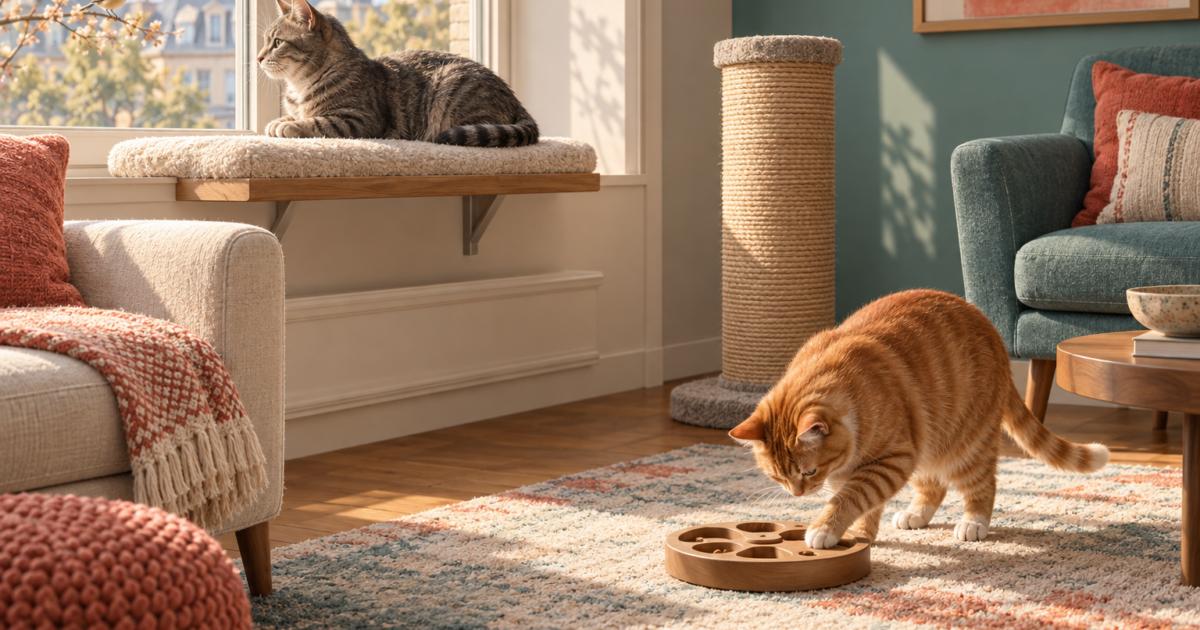
Indoor cat enrichment means offering choices to play, explore, scratch and rest. Start with one manageable change, retain familiar resources and watch how each cat responds. More toys are useful only when the cat can and wants to use them.
On this page
Build the room before adding activities
Check that the cat can reach its food, water, litter and resting places without an obstacle course. Offer suitable perches, hiding and scratching options. In a multi-cat home, spread resources so one cat does not control every route. Cats Protection’s indoor-cat guidance recommends climbing opportunities, interactive toys and separate essential resources for multiple cats.
An example daily plan
Use the sequence below as a starting point, not a required exercise target. Choose activity length and difficulty around the cat’s interest and mobility.
| Moment | Offer | Observe |
|---|---|---|
| Morning | A short interactive game with a familiar toy | Does the cat approach, watch, stalk or choose to leave? |
| A normal meal | An easy puzzle with part of the usual measured food | Can the cat obtain food without repeated failure? |
| Quiet daytime period | Access to a resting spot, hiding place and suitable scratcher | Are these actually reachable and used? |
| Evening | Another brief game using a different movement or toy | Which activity does this cat prefer? |
| Before bed | Remove unsafe or damaged toys and restore the normal room layout | Are essential resources still easy to access? |
Keep play inviting
Cats Protection says very short games can be useful, and recommends rotating toys and inspecting them for wear. Store toys that could entangle a cat or be torn up and swallowed after supervised play. Read the charity’s play guidance.
Offer the toy rather than using your hands as the target. Ohio State’s activity advice warns that using fingers or other body parts as toys can encourage biting and scratching.
Make the first food puzzle easy
Begin with a task where the cat can find the food readily. Count puzzle food within its usual meal plan, and follow veterinary feeding directions where applicable. Keep familiar feeding available while you learn what the cat can manage. Difficulty should not prevent a cat from receiving its food.
For a cat with limited mobility, test an activity at floor level before adding height or reach. The goal is accessible engagement, not making every task harder. Ask your vet about activity adaptations if movement seems painful or behavior changes suddenly.
Try a seven-day observation log
Record one line daily: activity offered, location, response and what to change next. Avoid labeling the cat as lazy after one attempt. Try a different time, easier task or different type of movement, while keeping the rest of the routine recognizable.
- Days 1–2: note what the cat already chooses; make no large room changes.
- Days 3–4: introduce one activity and record its use.
- Days 5–6: adjust one variable, such as toy movement or puzzle difficulty.
- Day 7: keep what worked and put away what did not. Share the familiar routine with a sitter.
Indoor cat enrichment ideas for small apartments
Use the room’s existing routes and resting choices before filling the floor with equipment. Identify a place to watch, a place to hide, a suitable scratching surface and an area for short interactive play. Check that the cat can reach each one without losing access to essential resources.
Begin with a small room map. Mark where the cat already sleeps, scratches and approaches you. Then mark obstacles: a noisy appliance, a narrow route or an area where another cat waits. Improving one awkward access point may be more useful than introducing several unfamiliar objects at once.
A daily enrichment routine for an indoor cat
Attach activities to moments you already remember, such as the morning meal or an evening break. Use the example day earlier in the guide to choose a sequence, then adjust it to your cat’s response. Consistency should make the routine manageable without turning play into a task the cat must complete.
| What happens | One thing to try | What to record |
|---|---|---|
| Cat watches but does not chase | Try a slower movement or a different time. | Whether the cat approaches or remains interested. |
| Puzzle food stays untouched | Make the task easier and keep normal feeding accessible. | Whether food is actually obtained. |
| One cat interrupts another | Offer separate sessions or locations. | Which cat uses each activity comfortably. |
| A new object is ignored | Keep it near a relevant familiar activity without blocking the route. | Whether use changes over several ordinary opportunities. |
DIY cat enrichment without buying more toys
Start with a safe, intact item and a purpose. A plain cardboard box can offer a hiding choice when packaging, staples, tape and loose pieces are removed. Place it where the cat can investigate voluntarily, and remove it if the cat starts chewing off and swallowing pieces. Supervise any unfamiliar setup before deciding whether it can stay out.
Changing how you use an existing suitable toy can also provide variety. Try a different direction of movement or a shorter session in a quieter area. Keep the favorite toy available if the cat consistently chooses it; novelty is an option, not a requirement to remove familiar comforts.
How to introduce a cat food puzzle step by step
- Choose compatible food. Use food appropriate for the puzzle and consistent with the cat’s feeding plan.
- Begin with an easy success. Show where the food is and use the simplest practical setup.
- Watch the result. Interest in the object does not necessarily mean the cat has obtained food.
- Change one thing. Adjust the position or difficulty, rather than changing food, location and equipment simultaneously.
- Clean and reset. Follow the product’s instructions, and include its food in the daily allowance.
Ohio State’s Indoor Pet Initiative advises introducing changes gradually and offering new items as choices rather than abruptly removing familiar ones. Read its guidance on making changes. A puzzle should add a manageable activity, not become an obstacle to eating.
Indoor enrichment for multiple cats
Watch each cat separately. A busy room can look stimulating while one cat quietly avoids it. Offer a way to leave an activity without being cornered, and use separate play opportunities when cats repeatedly interrupt each other. Keep the results in the seven-day log so changes are based on more than the most confident cat’s behavior.
How can I tell whether the activity is useful?
Look for voluntary use, a task the cat can complete and a routine that is practical to repeat. Record changes in normal eating, resting and interaction. Sudden or concerning changes need veterinary attention rather than simply a harder puzzle or longer game.
What should I leave for a cat while I am at work?
Leave familiar resources and only items you have already checked for appropriate independent use. Save entanglement-prone or easily damaged toys for supervised sessions. Plan human interaction around your return; an object cannot replace daily care.
Common enrichment questions
Do I need expensive equipment?
No. Start by improving access to resources and using suitable items you already own. Buy something when it solves a specific gap.
Should I force a hiding cat to play?
No. Leave the cat a choice. Look at noise, visitors, competing cats and changes to the room; seek veterinary advice about a sudden or concerning change.
Can enrichment replace daily human care?
No. Toys and puzzles support a routine; they cannot check health, refresh supplies or handle an emergency during an absence.
Equipment to consider for this routine
Choose by fit and household needs. These are research-based options, not hands-on test winners.
MeowBay may earn a commission from the paid links below, at no extra cost to you. As an Amazon Associate, MeowBay earns from qualifying purchases.

Catit Senses 2.0 Digger
A food puzzle for cats that enjoy retrieving dry food or treats with a paw.
Before you choose: Start with an easy setup and supervise the introduction. Count the food within the normal meal plan; a puzzle should not prevent a cat from getting its food.
Check options on AmazonPaid link · Opens retailer website
Product details checked September 9, 2026. Retailer prices, sellers, availability and delivery terms can change; check the current listing.
Explore the holiday cat care planner
Research-based guidance. Sources checked September 9, 2026. How MeowBay researches its guides.

4 Comments on “Indoor Cat Enrichment: A Simple Daily Activity Plan”