


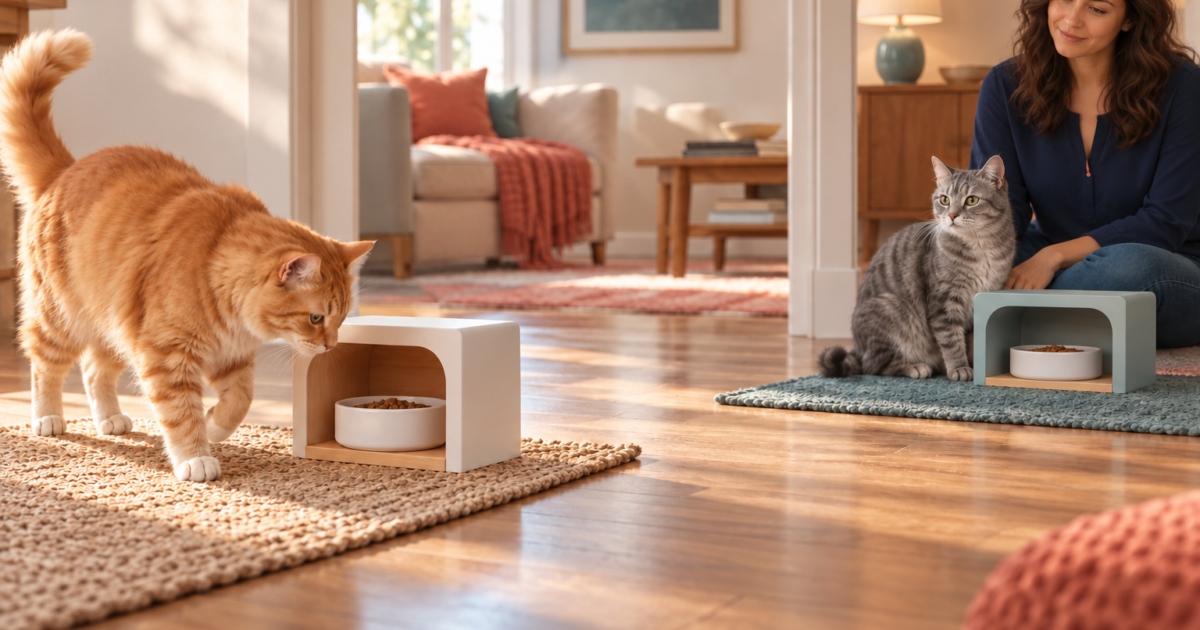
Introduce each cat to its own station separately, keep the device at the least demanding manufacturer-approved training stage, and increase lid movement only when that cat eats comfortably. Do not train both cats at one open feeder and expect them to understand that access will later become exclusive.
There is no useful universal seven-day deadline. A better progression is based on behavior: the cat approaches willingly, eats its normal food comfortably, and returns without repeated coaxing. The faster learner should not set the timetable for the more cautious one.
Prepare the station before introducing the cat
Read the exact model’s training instructions and confirm its supported identifier. Pair the intended cat correctly; label each station so other caregivers do not confuse them. Put the feeder in a stable, accessible location away from the other cat’s meal.
Keep the familiar feeding arrangement available while introducing the new one. Training should not depend on withholding food until the cat gives in. If a cat stops eating or appears unwell, contact your veterinarian promptly rather than continuing a device-training experiment.
Sure Petcare documents a progressive training mode for its Microchip Pet Feeder. Other products can have different controls and stages, so follow the model manual for the actual lid settings. Manufacturer training support.
Use these observation gates, not a fixed calendar
| Gate | What you want to see | If the cat is not ready |
|---|---|---|
| Location acceptance | Willingly approaches the station | Simplify the surroundings and keep the familiar routine |
| Comfortable eating | Eats without repeatedly retreating | Remain at the current approved training stage |
| Movement tolerance | Continues using the bowl with the next stage | Return to the previous supported stage |
| Independent return | Comes back without being carried or pushed | Allow more calm, supervised repetitions |
| Normal operation | Uses the fully configured feeder comfortably | Keep supervision and review setup before progressing |
These gates are MeowBay’s observation framework, not a manufacturer guarantee or a behavioral treatment protocol. They help you decide when to pause rather than press a button on a predetermined day.
Train one cat at a time
Let Cat A practice while Cat B is comfortably elsewhere with appropriate care and access to its own resources. Then repeat with Cat B at its own station. This makes it easier to distinguish fear of the mechanism from pressure caused by the other cat.
Do not move a cat’s head toward the reader or close the device around the cat as a demonstration. The relevant milestone is voluntary use. A cat taking one hurried bite while another waits nearby is not the same as a relaxed meal.
Keep sessions ordinary and predictable. Changing food, bowl location, lid settings, and meal timing simultaneously makes it difficult to tell which change caused a setback. Where practical, change one device-related variable at a time while preserving the established feeding plan.
Reintroduce the shared household carefully
Once each cat uses its own feeder comfortably, observe normal household access with both stations operating. Look for hovering, displacement, or a cat abandoning its meal—not just whether the lids open.
If one cat crowds the other, increase separation or return temporarily to separate-room meals. Do not respond by authorizing both cats on both feeders when separate diets are the reason for the purchase. That would solve a training inconvenience by removing the access restriction you needed.
Make a small progress record
For each cat, record the current manufacturer training stage, whether approach was voluntary, whether the meal was interrupted, and the next planned step. A simple note such as “stayed at current stage; ate comfortably without the other cat present” is more useful than a percentage claiming the cat is trained.
Ask another caregiver to follow the routine before you rely on it when away. They should know how to provide a manual meal, identify the correct food, and contact you if the cat refuses the feeder. Do not make an absence the first real test.
Is a selective feeder the right choice at all?
If your cat never becomes comfortable, the answer is not always a more expensive model. A separate feeding room or supervised routine may be a better fit. Verify return conditions before purchase so you have options if acceptance is poor.
For device selection, compare feeding arrangements for two cats. For a wider layout that keeps food, water, and litter resources usable, see our two-cat household hub.
Research-based introduction guidance. No hands-on training trial or veterinary review is claimed.
Need the starting routine first? Read how to stop one cat eating another cat’s food.
3 Comments on “How to Train Two Cats to Use Microchip Feeders—Without Rushing”