How to Track What Your Cat Eats and Drinks: Smart Tools & Real Limits
Written by Maya BennettCat Product Research Editor at MeowBay··
9 min read ·Content updated:
Research-Based
Disclosure: MeowBay may earn a commission from clearly identified affiliate links, at no extra cost to you. Ordinary source and manufacturer links are not paid, and editorial conclusions remain independent.
Short answer: first decide whether you need to confirm that food was dispensed, estimate how much disappeared, identify which cat approached, or follow drinking patterns. Those are different jobs. No single “smart” device proves every answer.
Match the question to the tool
What you want to know
Most useful tool
Limit to understand
Did the feeder dispense?
Automatic-feeder event log
A dispense event does not prove a cat ate.
How much food disappeared?
Bowl scale or weighed-feeding system
In a shared bowl, it may not identify which cat ate.
Which cat approached?
Camera recognition or collar-tag reader
Recognition and tag use can fail or be inconsistent.
How often did one cat drink?
Individual RFID hydration tracking
The cat must wear the compatible tag; trends are not medical conclusions.
Food tracking: observation is not access control
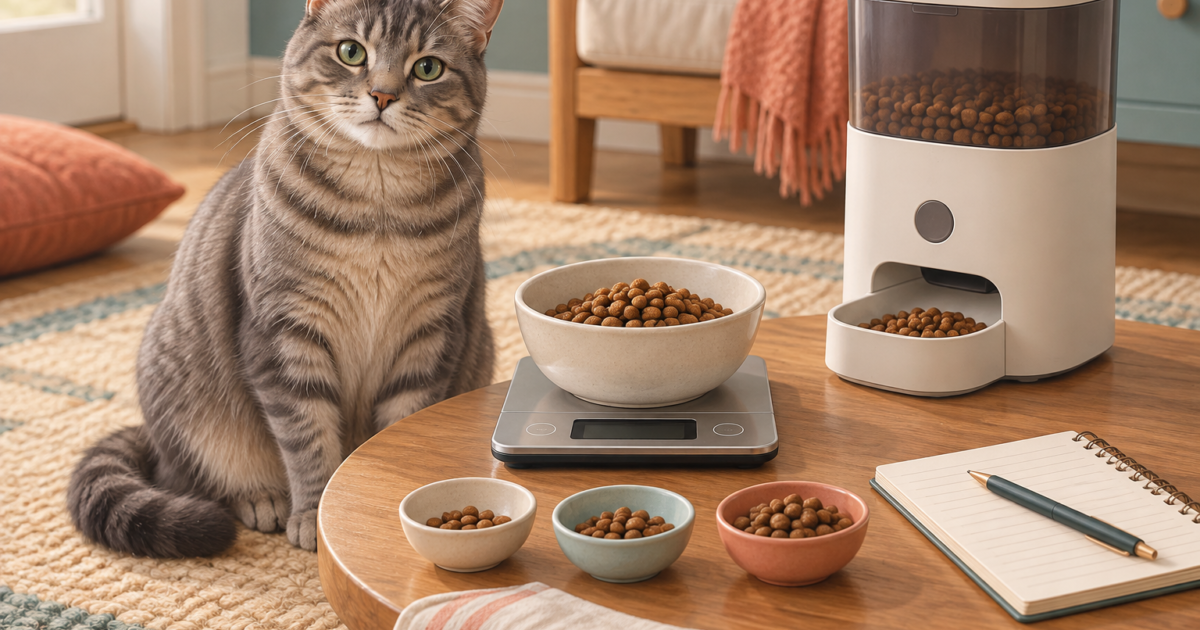
A feeder with a scale can make portion changes visible. A camera can add context. Neither automatically stops another cat from reaching the bowl. For food stealing or different diets, compare a physical access-control feeder rather than relying only on logs or video.
Water tracking: household totals versus individual cats
A connected fountain can report drinking events, trends and maintenance reminders. In a multi-cat home, household-level data may not show which cat drank. An RFID model can separate records by compatible collar tag, but tag tolerance and correct pairing become part of daily ownership.
One cat, routine portion tracking: a bowl scale may be enough.
Two cats sharing an open feeding area: tracking can show activity but may not prevent bowl swapping.
Different diets or food stealing: prioritize selective access and supervised setup.
Hydration concern: use trends as a prompt to observe and contact a veterinarian when behavior changes—not as a diagnosis.
Separate monitoring from access
If the real problem is one cat taking another cat’s food, compare selective-access cat feeders instead of expecting an activity log to control access.
Tracking food does not establish an appropriate calorie target. Start with how much to feed an indoor cat and discuss individual needs with your veterinarian.
Before buying
Write down the exact question the device must answer.
Check whether data is household-level or tied to one cat.
Price subscriptions, filters, tags and replacement parts.
Confirm food type, floor, Wi-Fi and collar requirements.
Choose the simpler device when extra data will not change what you do.
Bottom line
Buy tracking for a decision you will actually make. A useful system answers one clear household question reliably; an expensive dashboard that cannot identify the right cat or prevent the real problem is not a better solution.
A simple 7-day food and water observation log
Record once daily
What to write
Food offered and left
Use the same scoop, scale or container each day; note wet and dry food separately.
Water
Record the amount added and any obvious spill, evaporation or fountain top-up.
Context
Visitors, heat, a new food, medication, feeder errors or competition from another cat.
Behavior
Appetite, thirst, litter use, vomiting, energy and anything clearly different from normal.
The log is an observation tool, not a diagnosis. Contact your veterinarian about sudden, persistent or concerning changes. For equipment decisions, compare the PETLIBRO feeder range, review water fountain tradeoffs, and use the Indoor Cat Living guide to place resources where each cat can use them comfortably.
A food-access log you can copy before buying equipment
For one ordinary meal, separate what you saw from what you inferred. Write “cat not confirmed” when you did not see which cat ate. Keep the existing food amounts and any veterinarian-directed plan unchanged while recording observations.
Example observations — illustrative, not measurements or feeding advice
Time and station
What you actually saw
What remains uncertain
Next household check
Example: morning, kitchen bowl
Cat A finished and approached Cat B’s bowl
How much Cat B ate before leaving
Record each cat’s access separately at the next meal
Example: afternoon, hall station
The app recorded a dispense; the bowl was later empty
Which cat ate, whether food spilled
Check the room and observe the station rather than treating the notification as proof
Your time/station: ____
Cat identified: ____ Observation: ____
Not observed/unknown: ____
Check: ____ Person responsible: ____
A useful handoff says what was offered, what was observed and who should follow up. Avoid entering private access codes or personal contact details into a public shared log.
OPTIONAL MEOWBAY PAID PLANNER
Keep the observations in one place
Our 33-page Multi-Cat Feeding Planner adds a seven-day routine, feeding-location planning and food-access checklists. Includes printable and fillable A4 and US Letter PDFs. It organizes observations; it does not prescribe food amounts or guarantee a behavior change.
Our own paid digital product, sold through Etsy. You can use the free log above without buying anything.
Build a chain of evidence from food offered to food eaten
A useful tracking system follows distinct events instead of collapsing them into “fed.” The scheduled command, physical release, access by the intended cat and consumption each answer a different question. A gap at one step should remain visible even when later steps look reassuring.
Step 1: record what was offered
Name the food, amount, time and location. For a device, record physical output where it matters rather than copying only its setting. Keep wet and dry components separate, and follow the established individual feeding plan.
If the amount is estimated, label it estimated. A notation such as “small scoop” cannot support a precise gram calculation later. Better observation begins with knowing what the input actually represents.
Step 2: identify access
Record which cat was directly seen at the food and whether another animal could reach it. A camera view may show approach while hiding the bowl, and a tag event may show access without proving eating. Keep the type of evidence attached to the event.
If identity is unknown, write unknown. Do not assign the event to the cat whose diet you are monitoring merely because its name appears in the device profile. Confirm what the device’s identification method actually supports.
Step 3: account for what remained
Observe leftovers under a consistent method and note spills, removal by a caregiver or shared access. With perishable food, follow handling instructions and avoid assuming a later changed weight exactly represents the original serving. The record should not encourage unsafe retention of leftovers.
An empty bowl establishes that no food remains in the bowl at that check. It does not, by itself, establish the intended cat’s intake. The missing context can matter more than the apparent precision of a graph.
Use missing, zero and not observed correctly
Entry
Meaning
Measured zero remaining
The bowl was checked and no food remained under the recorded method.
Not observed
The event or quantity was not seen; it is not a zero.
Estimated
A value was inferred or approximated; preserve the basis.
Shared household total
Multiple cats or sources may contribute; individual attribution is unresolved.
A spreadsheet that replaces every blank with zero can create a false story of no drinking or no food. Keep unavailable observations blank or explicitly unknown. This is especially important when exporting an app record for a veterinary discussion.
A worked food record with transparent limits
In an invented example, 30 g is physically supplied to one bowl and 6 g remains at the later check. The simple difference is 24 g. If two cats could reach it or food spilled, 24 g is not a confirmed individual intake.
If only the intended cat was observed during the full relevant period and no other loss was seen, the record provides stronger context, but still keep the method and observation limits. Do not present household tracking as a laboratory intake study.
Translate only what is actually known
Using an imaginary label of 4 kcal/g, 24 g corresponds arithmetically to 96 kcal of that food. The calculation does not repair uncertain identity or loss. A precise calorie result can still rest on an uncertain input.
Give the veterinarian the underlying record rather than only the calculated total. That allows the professional to see whether the question concerns appetite, access, delivery or measurement.
Water needs a separate observation method
Record refills, cleaning, spills and other accessible sources beside fountain or bowl observations. Reservoir loss is not automatically drinking, and a shared fountain does not automatically assign quantities to individual cats. A cat may also obtain water through food and another source.
Do not remove accessible sources to force use of the monitored one. If individual intake is important, ask the veterinarian what method is appropriate and whether a particular device can answer the relevant question.
Keep a refill event distinct from a drinking event
A caregiver adding water changes the reservoir record but is not an event performed by the cat. A cleaning session can discard water. Preserve those times so a chart is not interpreted as a sudden change in thirst.
Use the water-care guide to keep top-ups, fresh refills and component cleaning identifiable. Monitoring should support maintenance rather than replace it.
Choose technology only after naming the unresolved step
If the problem is whether food physically arrives, improve output verification. If the problem is bowl swapping, monitoring alone may not prevent access. If the problem is identifying a visiting cat, check the exact recognition or tag requirements and their limits.
Ask the supplier about the model and current regional feature access, including subscriptions or exports. Keep recurring costs with the function you actually need. A premium dashboard is not useful if it cannot resolve the uncertainty that led you to shop.
Prepare a concise professional handover
Summarize the timeline, food identity, known quantities, observation method, other sources and unknowns. Include changes in appetite, thirst, litter use or behavior without assigning a diagnosis. Seek advice promptly for concerning changes rather than waiting for a perfect dataset.
A clear record can be short. Its value comes from accurate distinctions and visible limits, not the number of graphs or the claim that every missing event has been measured.
A camera-and-feeder example: resolve the right gap
An imaginary household has a scheduled event in feeding history and a camera clip showing a cat near the dispenser. The bowl is outside the frame. That evidence confirms the recorded event and an approach, but not physical output or consumption.
The next useful check is the unresolved step: can an appropriate supported camera position show the bowl during ordinary feeding, or can a caregiver directly observe the release? Buying more cloud history will not necessarily answer a question the camera never sees.
Do not replace uncertainty with a device label
A clip tagged with a cat’s name can be useful context, but verify how the current system identifies animals and what an event means. A successful identification on one clip does not establish that every overlapping visit is correctly assigned.
Keep the existing complete record if seeking support: exact event time, what the physical bowl check showed, camera view and model. That lets the question remain about recording, output or recognition rather than becoming the vague complaint “tracking is wrong.”
If the household’s real concern is food stealing, a better view may document it without preventing it. Use the access-control and feeding-location plan for that separate job. This is why a useful system may combine a simple physical routine with modest technology instead of relying on one expensive all-purpose dashboard.
Maya Bennett is MeowBay’s Cat Product Research Editor and is responsible for this research-led article. She evaluates manufacturer documentation, household fit, cleaning, and product limitations. This article does not replace advice from your veterinarian.
1 Comment on “How to Track What Your Cat Eats and Drinks: Smart Tools & Real Limits”



1 Comment on “How to Track What Your Cat Eats and Drinks: Smart Tools & Real Limits”